





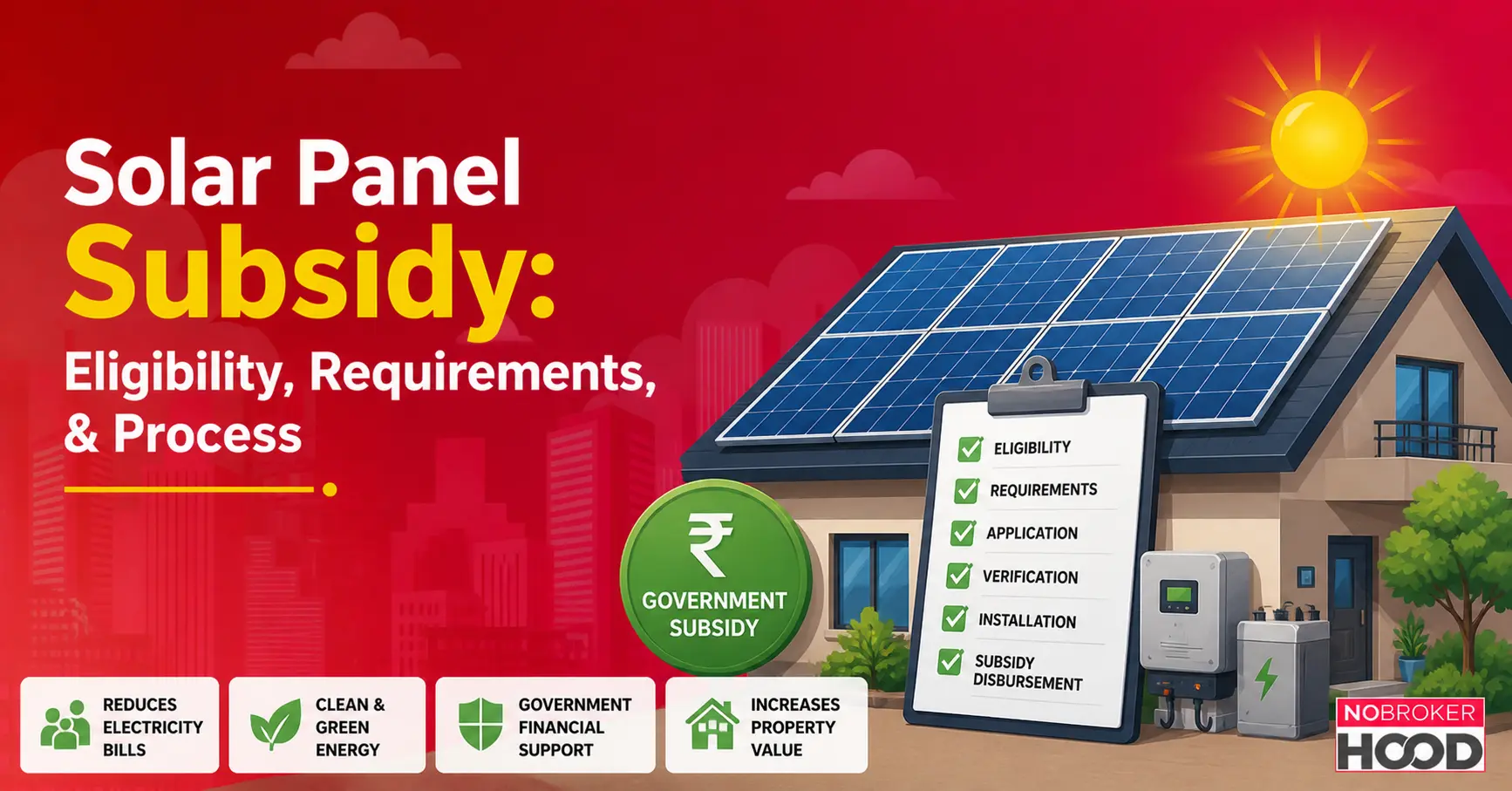


Sun is a powerhouse of energy. Considering its inexhaustible supply and non-polluting nature, solar energy has witnessed a rapid growth in usage. In recent times, an increasing number of consumers are embracing solar power to decrease reliance on the grid and lower monthly electricity costs. To promote and support this adoption of solar energy systems, the Government of India has introduced a solar panel subsidy.

Solar panel subsidies are financial assistance that make this renewable energy accessible to a wide range of beneficiaries, from small households to large-scale cooperative housing complexes. Subsequently, this article walks you through the eligibility criteria, the solar subsidy amount, the application process and more.
Planning to install solar panels on your rooftop? Then avail this opportunity to install Solar Panel for Housing Society With Zero Installation Cost with NoBrokerHood.
What is the Solar Panel Subsidy?
Solar panel subsidy is a financial aid to offset the cost of solar panel installations. This initiative is a part of the PM Surya Ghar Muft Bijli Yojana, also known as the Rooftop Solar Scheme. By introducing this solar panel for home subsidy, the Government aims to equip 10 million homes in India with solar energy or to reach 600 GW of solar energy by 2030.
Both the Central and State Governments are committed to providing these solar panel for home subsidies and making every home a part of this green initiative. The utilisation of this clean energy reduces the dependence on traditional electricity sources.
What is the Solar Panel Subsidy Amount?
The financial support from the solar panel subsidy covers as much as 40% of the installation expenses, which is based on the system's size. Here is a basic overview:
| Capacity of the System | Receivable Subsidy Amount |
| 1- 2kW | ₹30,000 to ₹60,000 |
| 2- 3kW | ₹60,000 to ₹78,000 |
| Above 3kW | Capped at ₹78,000 |
What are the Reasons Behind Offering Solar Panel Subsidies?
The following are some of the reasons for providing solar panel installation subsidies. Take a look:
1. Less Reliance on Fossil Fuel
By providing solar subsidy, the Government aims to reduce dependence on non-renewable energy sources such as coal, oil, and natural gas. Incentivizing solar power not only decreases import dependency but also improves traditional energy security.
2. Energy Affordability and Accessibility
Subsidised solar panels enable consumers to afford solar energy. Thus, they can switch to cleaner energy sources and possibly reduce their electricity expenses. This is advantageous for rural or marginalised communities that may not have access to power grids.
3. Technological Growth
The provision of subsidised solar panels promotes the advancement of solar technologies through research and development. It stimulates innovation and reduces the expenses associated with solar panels and related equipment.
4. Economic Advancement
The growth of the solar industry leads to various employment opportunities in manufacturing, installation, maintenance and research. These opportunities serve as a driving force to facilitate the nation's overall economic growth and providing solar panel subsidy will help in the growth of solar industry.
Top 5 Solar Panel Government Subsidy
| PM Surya Ghar Muft Bijli Yojana |
| Grid Connected Rooftop Solar Programme |
| PM- KUSUM Scheme |
| Production Linked Incentive (PLI) Scheme |
| Delhi Solar Energy Policy 2023 |
Eligibility for Solar Panel Subsidy
To qualify for the subsidy on solar panels, one must meet the following conditions:
- The applicant must be a resident of India and has to belong to a lower-middle-class family.
- The annual income of the applicant must reside within ₹1.5 lakhs.
- Your house must have a suitable roof for an untroubled solar panel installation subsidy. A roof that is less prone to structural damage and has heavy-duty strength is ideal for solar panels.
- Applicants must not have availed any solar subsidy before.
- The solar panels must be domestically manufactured.
- A Government-approved company must carry out the installation process for solar panel installation subsidy.
- Strict compliance with the guidelines of the Ministry of New and Renewable Energy is mandatory for solar panel subsidy.
Please note: The maximum capacity of a solar panel for availing the subsidy on solar panels is 10kW. Certain states, such as Uttar Pradesh, Kerala, Rajasthan, Gujarat etc, may provide additional financial aid.
Documents Required for Solar Subsidy
Here is a list of prerequisites to be eligible for solar panel subsidy:
- Address and identification proof
- PAN card
- Non-encumbrance certificate
- Evidence of income
- Solar rooftop quotation
- Bank statements
- Income tax returns
Complete guide to Solar Power:
How to Apply for Solar Panel Subsidy?
The application process for solar panel subsidy is straightforward. Here is a step-by-step guide:
Step 1
Go to the National Portal for Rooftop Solar, log in using your credentials and, if you are new to this site, register yourself using personal details.
Step 2
Navigate to ‘Apply for Rooftop Solar’ and click on it.
Step 3
Please select your state, district, electric utility company, customer account number, mobile phone number, and email address to fill out the form.
Step 4
Kindly Wait for your utility company to assess the strength of your roof for solar panel installation.
Step 5
If they give the go-ahead, select an accredited firm to carry out the installation of your solar panels.
Step 6
Once the installation is complete, request a net meter. Once everything is in place and inspected, you will receive a certification.
Step 7
Sign in to the website once more and provide your banking details.
And, that is it. The solar panel subsidy amount will be sent to your bank account by the government within 30 days.
What is the Difference between State and Central Solar Panel Subsidy Schemes?
| Aspect | State Scheme | Central (National) Scheme |
| Application process | Customer pays the solar company the amount minus subsidy; company then claims the subsidy from the government | Applicant registers directly through the national portal |
| Involvement | More interactions with local discoms | More consistent, unified platform |
| Payment | Company claims subsidy on your behalf | Applicant pays the full amount upfront |
| Speed | May take longer due to added local coordination | Subsidy transferred within 30 days of commissioning |
| Benefit delivery | Indirect (via company) | Direct to applicant's bank account |
Solar Panel Installation Subsidy
Installing solar panels under the solar panel subsidy scheme can harness several benefits.
1. Reduced Electricity Bills
Solar panel installation is a one-time investment for your property. It is more affordable than thermal power production. With the constant surge of non-renewable electricity prices, powering your home using solar power will not burn a hole in your pocket especially with the solar panel subsidy.
2. Independent Energy Production
By varying the energy sources and encouraging the local production of electricity using solar power, the PM solar scheme helps to achieve greater energy self-sufficiency by providing solar panel subsidy. Additionally, it also decreases consumers' dependence on imported fossil fuels.
3. Tax Benefits
There are multiple state-wise tax benefits plans available for investors of solar installation. Individuals can obtain tax depreciation during the fiscal year in which the installation has taken place. Moreover, this plan also permits the investors to get tax benefits for up to 10 years.
4. Greater Property Value
Another benefit of solar panels is the improvement of property value. Installing solar panels in the property acts as an advantage which will bring greater returns while selling the site. Besides, apart from selling, homeowners can enjoy reduced utility bills for almost 30 years from the month of solar panel installation.
5. Less Environmental Impact
Using more solar energy helps decrease the release of greenhouse gases and air pollution linked to conventional energy sources. Solar panels generate environment-friendly energy without releasing carbon dioxide or other damaging pollutants. It creates a healthier environment and lessens the impacts of climate change.
6. Potential Earnings
Solar panels allow surplus electricity to be sold to the grid to generate additional income. This serves as a potential source to earn. Additionally, the Government of India provides ₹1 for each unit of the total solar power production.
Simplify Solar Panel Subsidy with NoBrokerHood
Applying for a solar panel subsidy is only half the journey for gated communities and apartment complexes, the real challenge is coordinating installation, tracking maintenance, and managing the shared costs and billing that come after. NoBrokerHood's Society Management app helps Management Committees (MCs) and residents smoothly transition to solar power and keep it running efficiently, with zero installation cost options and end-to-end support.
- Zero Installation Cost Solar Solutions - Get rooftop solar installed for your society without upfront capital expenditure, so residents start saving from day one.
- Automated Billing & Accounting - Track solar savings, allocate reduced electricity costs fairly across flats, and generate transparent digital invoices through the Society ERP.
- Vendor & Installation Coordination - Simplify communication with government-approved solar vendors and keep MC members updated on installation timelines and approvals.
- Maintenance Tracking - Log and schedule solar panel upkeep so your society's system keeps performing at full capacity for years.
- Financial Reporting for MCs - Give committee members clear visibility into subsidy utilization, savings, and ongoing solar-related expenses.
All Solutions By NoBrokerHood
