






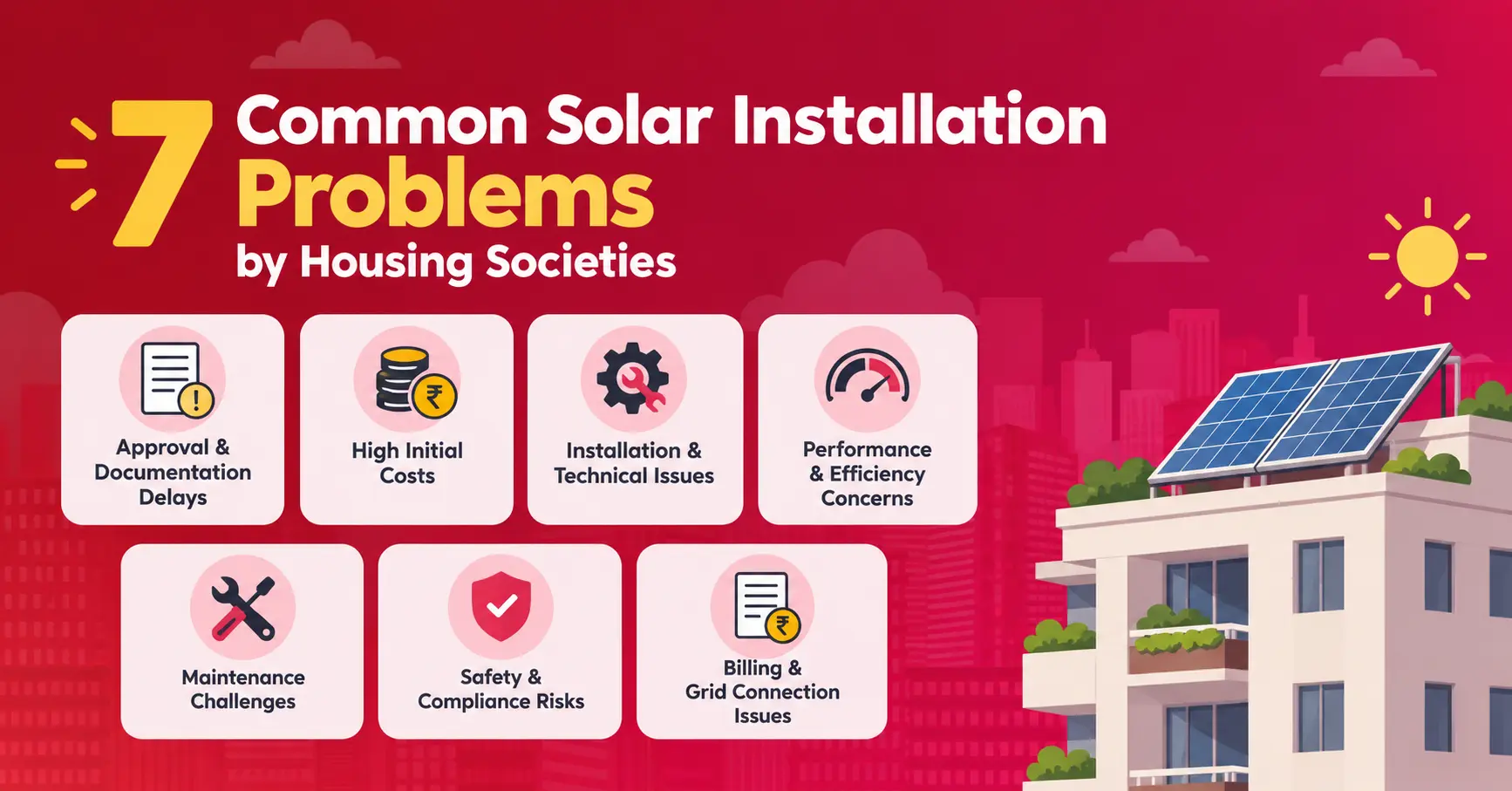


Solar panels provide savings of between ₹150,000 and ₹350,000 to homeowners in their living costs for a 25-year period. However, far too many residential societies have solar installation problems that severely impact these savings. Installing rooftop solar requires rigorous technical diligence, regulatory approvals, and ongoing oversight to deliver anticipated returns.

Solar adoption across Indian apartment complexes has expanded rapidly since 2017 as Resident Welfare Associations (RWAs) seek to offset spiralling common electricity tariffs. However, rushing into procurement without technical feasibility studies creates widespread solar installation problems.
This guide examines the most frequent solar installation problems faced by housing societies, practical troubleshooting strategies, and best practices to safeguard your community's clean energy investment for decades.
7 Common Solar Installation Mistakes Made by Housing Societies
Technical oversights during procurement, design, and mounting can permanently degrade photovoltaic generation and compromise building safety. Below are seven critical solar installation problems that housing societies must prevent during project execution.
1. Improper Sizing of the Solar Power System
Accurate system capacity planning is fundamental to achieving high return on capital and steady operational savings.
Improper sizing of the solar system can be a leading source of solar installation problems. Many societies miscalculate their energy needs, not taking into consideration the seasonal variation or the daily usage pattern.
Installing an oversized solar plant causes surplus energy generation that DISCOM net metering caps or export settlement rules may penalise or reject. Conversely, an undersized plant fails to offset daytime common loads such as lifts, basement ventilation, and water booster pumps, unnecessarily prolonging payback periods.
2. Neglecting Comprehensive Roof Condition Assessments
A rooftop photovoltaic plant represents a 25-year structural load that depends entirely on terrace integrity.
Ignoring roof strength and age before installation causes serious solar installation problems. Solar panels typically last 20 to 25 years, matching the lifespan of high-grade waterproofing systems. Installing panels on aging roofs leads to expensive panel dismounting and reinstalling when civil waterproofing repairs are needed.
Do Solar Panels Cause Roof Leaks?
Standard photovoltaic panels do not leak water themselves; however, improper roof-mounted anchoring is a leading cause of roof leaks from solar panels. If mounting contractors puncture reinforced concrete slabs without industrial chemical anchoring, bitumen waterproofing pads, and raised stub pedestals, monsoon water seeps directly into top-floor apartments. Always mandate elevated GI (galvanised iron) ballasted or grouted stub structures with dual-layer waterproofing re-certification before mounting panels.
3. Attempting Uncertified or DIY Installation Shortcuts
Rooftop solar engineering demands specialised mechanical engineering, high-voltage certification, and strict statutory compliance.
While attempting informal vendor shortcuts or internal society handyman setups may appear to save initial costs, it introduces severe solar installation problems, system failures, and grave safety hazards.
| Risk Category | Technical Explanation & Cause | Society Impact |
| Electrical Shock & Arc Faults | Panels string voltages generate up to 600–1000 Volts DC, creating severe electrocution and arc-flash fire risks during faulty handling. | Resident & Staff Safety |
| Voided Equipment Warranties | Tier-1 solar module and inverter 10–25 year warranties are voided if mounting is not certified by MNRE/DISCOM approved engineers. | Financial Capital Loss |
| Building Code Violations | Unauthorised structures violate local municipal building bylaws and Central Electricity Authority (CEA) safety guidelines. | Statutory Penalties |
| Structural Slab Damage | Incorrect anchor drilling without ballast engineering fractures RCC slabs, causing persistent monsoon water seepage into apartments. | Civil Repair Costs |
4. Ignoring Electrical Safety and Earthing Standards
Rooftop solar arrays operate continuously under fluctuating atmospheric temperatures and severe weather.
A lack of adherence to electrical safety during installation causes many solar installation problems. Proper DC/AC wire sizing, dedicated chemical earthing pits, lightning arresters (LA), DC isolate switches, and overcurrent protection devices (SPDs) are essential to prevent fires, equipment burnout, and unexpected inverter trips.
5. Ignoring Real-Time Monitoring and Generation Tracking
A solar power installation requires continuous operational surveillance to maintain peak yield across all strings.
The lack of regular monitoring allows solar installation problems to go unnoticed until high utility bills reveal irrevocable generation loss. Common problems such as localized bird droppings, dust accumulation, partial tree shading, micro-inverter faults, and loose string terminations degrade power output without triggering an alarm unless an automated cloud IoT gateway is installed.
Why Are My Solar Panels Not Producing Enough Power?
When residential society solar systems produce below rated capacity, the underlying causes usually stem from severe soiling (dust, pollen, bird dropping hotspots), incorrect tilt angle, partial shading from newly erected structures or trees, micro-cracks in cells, or string inverter clipping during peak noon hours. Tracking daily generation through cloud-based analytics enables prompt corrective maintenance.
6. Missing Government Subsidy and Net Metering Timelines
Securing state DISCOM capital subsidies and bidirectional net metering approvals significantly improves project ROI.
Many housing societies lose substantial capital relief simply by delaying government portal registrations. Under schemes like PM Surya Ghar: Muft Bijli Yojana and central rooftop subsidy programs, Group Housing Societies (GHS) and Resident Welfare Associations (RWAs) can secure capital subsidies (up to ₹18,000 per kW for common facilities up to 500 kW capacity, subject to prevailing state DISCOM norms). Missing application deadlines or energisation deadlines adds avoidable financial burdens to the society's capital reserves.
7. Inadequate Preventative Maintenance and Cleaning Plans
Long-term generation relies directly on scheduled physical upkeep and thermal electrical audits.
Omitting regular maintenance causes rapid generation loss and preventable solar installation problems. Societies must establish a fortnightly demineralised water cleaning schedule, bi-annual structure torquing, thermal scanning for hot spots, and inverter earthing checks to protect panel warranties and achieve full 25-year design lifespans.
How to Check If Your Solar Panels Are Working Properly
Management committees and estate managers should implement systematic verification procedures to detect common solar panel defects and generation discrepancies early.
• Inverter Display & Generation Metrics: Verify that the solar inverter's green indicator light is steady during daylight and check whether daily kilowatt-hour (kWh) output aligns with seasonal irradiance estimates (typically 4 to 4.5 units per kWp per sunny day in India).
• Identifying Common Solar Panel Defects: Inspect panels visually for surface micro-cracks, browning ethylene-vinyl acetate (EVA) delamination, snail trails, busbar corrosion, or burned bypass diodes on the rear junction box.
• Verifying Genuine Equipment: To check whether solar panels are genuine or counterfeit, inspect the laminated RFID tag encapsulated inside the glass (mandated by MNRE/BIS), cross-verify the serial number on the manufacturer portal, and request factory flash-test reports with IEC/BIS certifications.
• Bi-Directional Net Meter Verification: Compare the monthly solar generation registered on your inverter log against the export register reading on your DISCOM electricity bill to ensure net-metering energy credits are accurately reconciled.
Housing Society Solar Installation Checklist
| 1. Certified structural stability audit of terrace RCC slab. 2. BIS/ALMM-approved Tier-1 modules with internal RFID tags. 3. Dedicated chemical earthing pits (resistance < 5 Ohms) & lightning arresters. 4. Dual-layer bitumen waterproofing pads beneath all mounting footings. 5. Pre-approved DISCOM feasibility and net-metering synchronization. 6. Scheduled fortnightly cleaning with low-pressure demineralised water. |
How NoBrokerHood Simplifies Housing Society Solar Management
Managing a community rooftop solar project requires financial transparency, vendor accountability, and consensus across hundreds of apartment owners.
The NoBrokerHood society management system streamlines each phase of your society's renewable energy journey through specialised digital workflows:
- Transparent Capex & Opex Accounting: Using the NoBrokerHood society accounting system, management committees can set up dedicated solar capital reserve accounts, track contractor milestone payouts, and automate sinking fund allocations with complete financial audit trails.
- Digital Resolutions and Resident Voting: Achieve mandatory RWA member consensus for solar capital investments through in-app digital voting, survey polls, and real-time notice board broadcasts.
- Verified Vendor and AMC Helpdesk: Log solar maintenance complaints, monitor technician terrace visits via visitor management security, and track service level agreements (SLAs) for quarterly solar cleaning and electrical audits.
- Integrated Green Community Living: Pair your solar generation infrastructure with other green initiatives such as smart EV charging for apartments, creating an energy-efficient, self-sustaining residential society.