






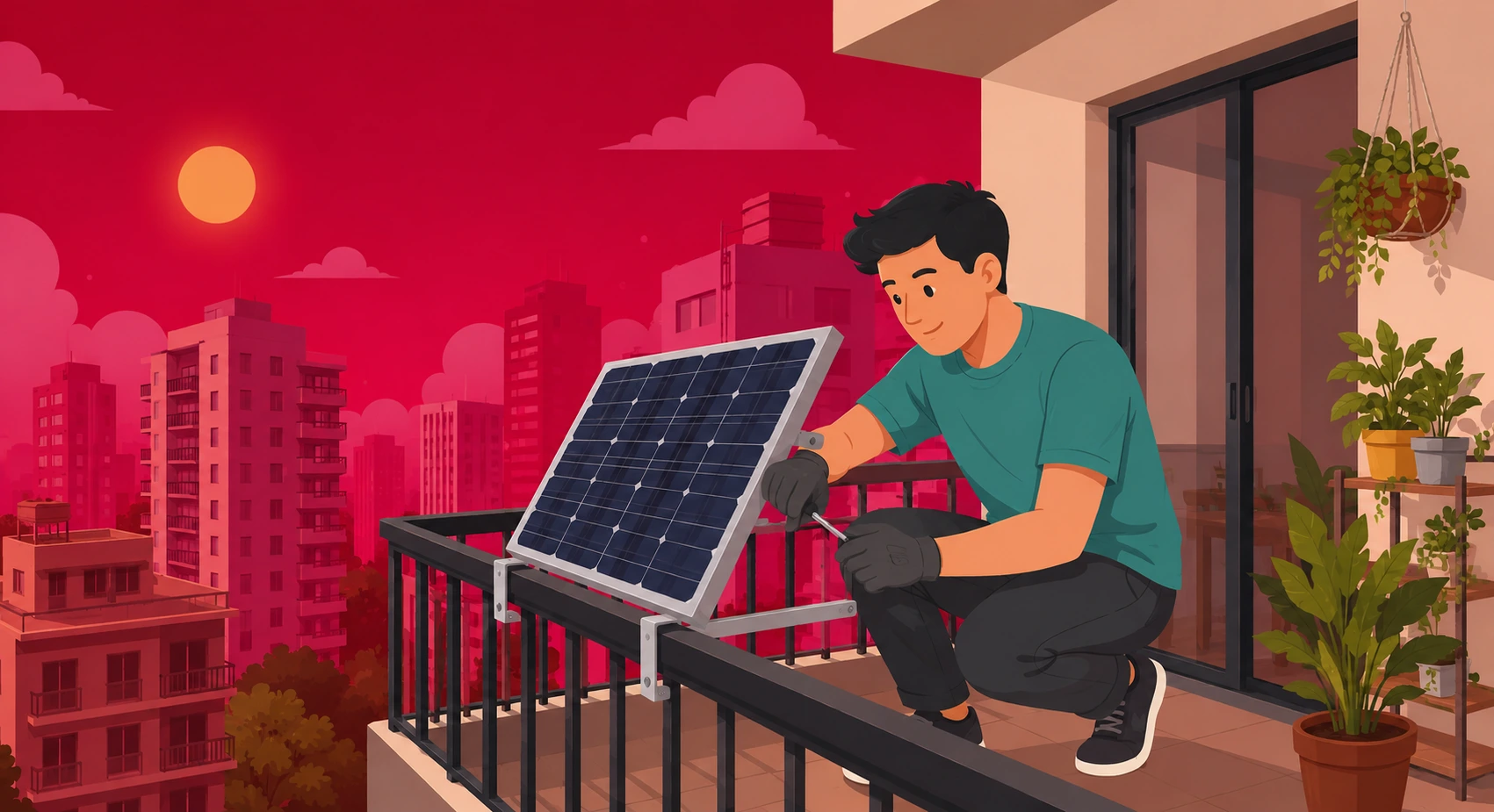


Installing a solar panel for an apartment balcony is an easy way for flat owners and tenants to generate clean electricity without needing rooftop access. These compact, plug-and-play systems can help reduce daytime electricity bills by powering essential appliances while requiring minimal installation. As interest in affordable solar solutions grows across Indian cities, balcony solar panels are becoming a practical option for apartments. This guide explains how they work, their costs, benefits, installation process, and the approvals you may need before getting started.

What Is a Solar Panel for Apartment Balcony Setup?
A solar panel for apartment balcony use is nothing like the large rooftop arrays you see on individual homes. It’s a small, lightweight kit consisting of one to three panels, a small micro-inverter, and a mounting bracket that clips onto your railing or wall.
Instead of being wired into the main power grid in a complicated way, it plugs into a standard socket. It quietly feeds solar power into your home circuit during the day, reducing the electricity your meter would otherwise draw.
For renters, or anyone on a high floor who has zero access to the roof, this is honestly one of the few solar options that make sense. There is no cement work, no rewiring and nothing permanent about it.
Read also: Solar Energy Reduces Electricity Bills
How Does an Apartment Balcony Solar Panel Work?
The concept behind an apartment balcony solar panel isn't that complicated.
- Micro-inverter technology: The panel sends Direct Current to a small inverter, which turns it into the Alternating Current your appliances run on.
- Plug-and-play design: The unit connects to a regular 16A wall socket, so there is no need for an electrician.
- Daytime offsetting: It works alongside your existing power supply, quietly reducing what your refrigerator, router, fans or lights pull from the grid.
- No roof required: Since it mounts on a rail or a wall bracket, even a 12th-floor flat with zero rooftop access can generate its own electricity.
Depending on kit size and how much sun the balcony actually gets, output typically falls somewhere between 300W and 800W.
Read also: How Does Solar Power Work
Why Residents Are Choosing Solar Panel for Flat Balcony Options
Electricity bills across Indian cities haven't exactly been going down, and that's probably the biggest reason interest in solar panel for flat balcony setups keeps growing.
Rooftop solar almost always needs a society-wide decision, sometimes a vote, but balcony units are personal. One household can install one without waiting for the entire building to agree. That independence matters a lot in large complexes where common approvals can take months.
There is also the portability angle. If you are a tenant, you can simply unbolt the kit and carry it to your next home. For owners, it is a low-risk way to test solar before considering a bigger rooftop investment later.
Read also: Best Solar Options for Societies
Cost of a Solar Panel for Apartment Balcony in India
Pricing depends on capacity, brand and panel type, but here is a realistic breakdown for a solar panel for apartment balcony system costs in 2026:
- 500W kit: ₹45,000 to ₹55,000, enough for routers, lights, fans, and part of a fridge's load.
- 1kW setup: ₹90,000 to ₹1,05,000, better suited for households wanting a bigger daytime offset.
- Lightweight flexible panels: Slightly pricier per watt but easier to mount on curved or narrow railings.
Most residents recover this cost in two to seven years depending on local tariffs and sunlight hours. After that, it's more or less free electricity for the rest of the panel's life, and these things often keep working past 18 to 20 years.
One thing people don't always realise is the solar panel subsidy under schemes like PM Surya Ghar is mostly built for larger, grid-connected rooftop systems, not small plug-in balcony kits. So if you're buying one for your flat, budget for the full cost upfront.
Read also: Solar Panel Maintenance
What to Check Before You Install a Solar Panel for Condo Balcony?
Before you commit to a solar panel for condo balcony installation, a few practical checks can save you real trouble later.
- Sunlight direction: South-facing balconies usually get the strongest and most consistent light through the day. East or west still work, just for fewer hours.
- Shading: A neighbouring tower, a water tank, even an overhang can cut your output more significantly. Watch your balcony's sun pattern for a day or two before buying anything.
- Appliance limits: This isn't built to run an AC, geyser, or washing machine. It's a baseline load offset, not a replacement for your regular connection.
- Society or RWA approval: Always check with your Resident Welfare Association or landlord before hanging anything on an exterior wall or railing, even if it is not a permanent fixture.
- Utility and meter rules: A few local grids require a formal agreement or a zero-export meter before you plug a generation device into a household socket. It is worth a quick call to your DISCOM to confirm.
Read also: Common Errors made in Installing Solar Panels by Societies
Steps to Set Up Your Balcony Solar Panel
Getting a solar panel for apartment balcony use up and running usually follows the same broad steps across most Indian cities.
- Assess your balcony's sunlight for at least a couple of days to understand real exposure. Don't just guess.
- Pick the right capacity, typically 500W to 1kW for an average household's daytime needs.
- Get written approval from your RWA or landlord before any exterior mounting begins.
- Mount the bracket on the railing or wall using the manufacturer's fittings, which rarely need drilling into shared structures.
- Connect the micro-inverter to a nearby socket, following the safety instructions that come in the box.
- Watch the output for the first week just to be sure everything's offsetting as expected.
Most kits ship with a simple manual, and most residents manage the entire setup themselves over a weekend without calling anyone.
Read More: How do Solar Panels Work Step by Step
Society Rules and Safety Tips for Solar Panel Condo Balcony Installations
Every housing society runs on its own set of bylaws, and a solar panel condo balcony setup isn't exempt from that. Some associations don't love anything hanging visibly on the outside for how it looks. Others are fine with it as long as you've sent in a written request first.
A few habits matter more than people think. Keep the cabling away from rainwater. Don't overload one socket with other heavy appliances running off it too. Check the mounting bracket every few months, and definitely before monsoon hits, since wind and rain loosen fittings faster on higher floors than most people expect.
If your society hasn't set a policy on balcony solar yet, bringing it up at the next general body meeting is usually the quickest way to get an answer, for you and for anyone else in the building thinking about the same thing.
Simplify Housing Society Solar Installation with NoBrokerHood
A balcony solar panel is a practical starting point for individual households. However, if your society is looking to reduce common area electricity costs, a larger rooftop solar system can offer much greater long-term savings.
NoBrokerHood helps housing societies evaluate and implement solar solutions based on their energy requirements. From understanding electricity consumption to recommending suitable on-grid, off-grid, or hybrid solar systems, the team supports societies through the installation process and ongoing maintenance.
For housing societies, this can mean:
- Guidance in choosing the right solar system based on the society's energy needs
- End-to-end support, from planning and installation to periodic maintenance
- Flexible financing options, including zero installation cost and no-cost EMI for eligible projects
- Lower electricity bills for lifts, pumps, parking lights, clubhouses, and other common areas
For societies planning a long-term investment in clean energy, rooftop solar can be a practical way to reduce operating costs while making better use of available rooftop space.
