





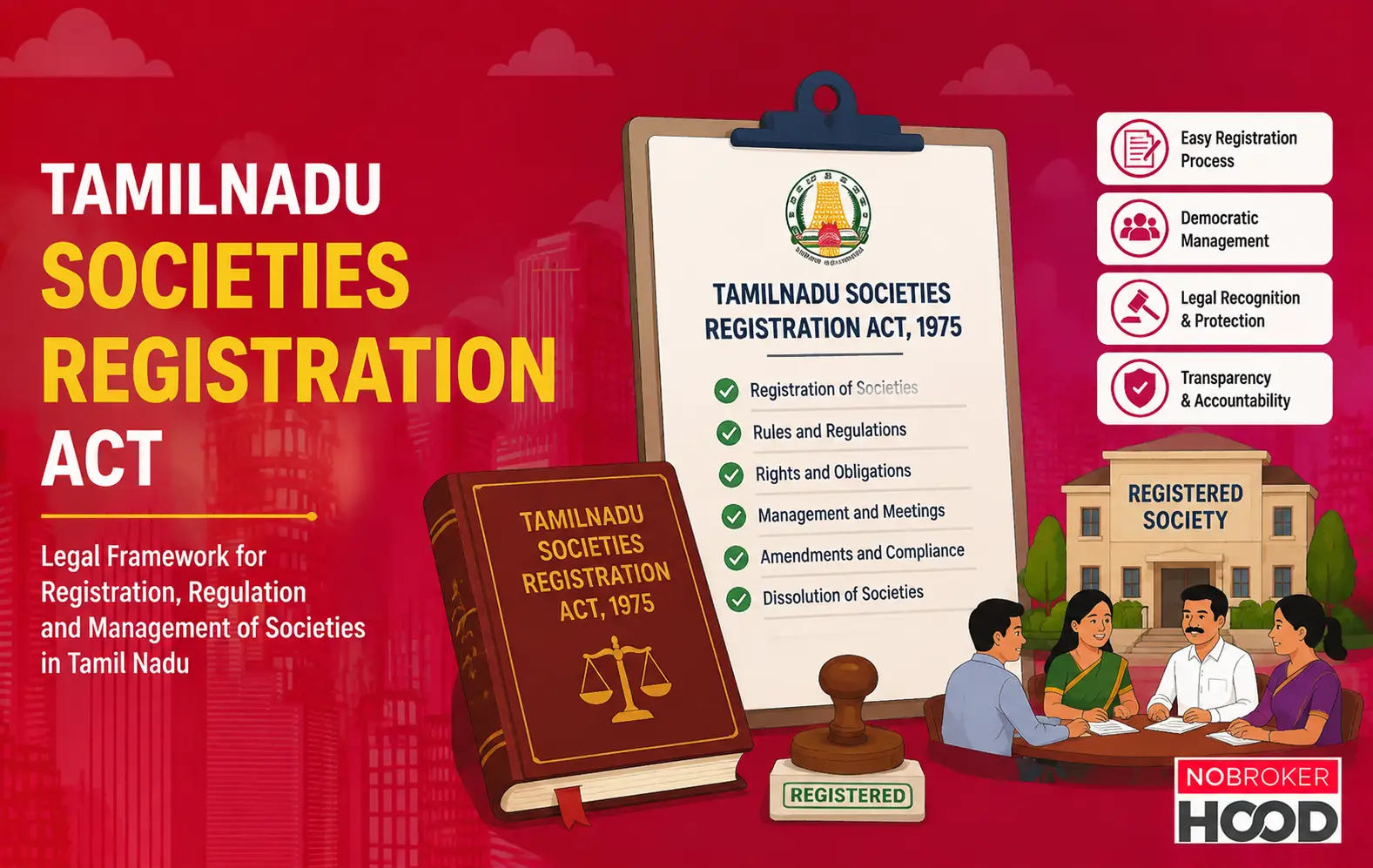


The Tamilnadu Societies Registration Act is a law that tells us how societies in Tamil Nadu should be formed and registered and managed. It sets clear rules for documents, annual filings , members and responsibilities. Residents, RWAs and community groups can use this Act to operate smoothly and stay compliant.

What the Tamilnadu Societies Registration Act Means for Communities
The Tamilnadu Societies Registration Act is an important law that regulates non-profit groups which are working for community welfare, education, cultural development, social service and other public oriented goals.The Tamil Nadu Societies Registration Act makes sure that these groups work in a way and are honest about what they do.
Most residential societies and community organisations follow this Act to manage their affairs responsibly. Residents who understand the Act find it easier to set up committees, maintain records, organise meetings and handle funds clearly and lawfully. This helps communities create trust and avoid conflicts.
Importance of Understanding the TN Societies Registration Act
When a group of residents or members forms a society, they need proper legal backing. The TN Societies Registration Act gives a recognised status to the society and helps them work smoothly with government authorities, banks and service providers.
Here’s why understanding the Act matters:
- It explains how societies must form and register.
- It guides communities on managing funds and member responsibilities.
- It clarifies the roles of committee members and limits their terms.
- It helps avoid penalties and compliance issues.
- It supports societies in resolving internal disputes through proper processes.
Read also: Tamil Nadu Apartment Ownership Act
What Types of Societies Can Register Under This Act?
The Act allows societies to be registered for several useful community-driven purposes. Common categories include:
- Education and literacy development
- Science, research and cultural activities
- Charity and social service
- Social reform and public awareness
- Art, sports and community athletics
- Religious and spiritual activities
- Community welfare initiatives
This wide scope helps many resident groups, volunteer teams, cultural associations, and welfare committees form societies under the Societies Registration Act Tamil Nadu.
Tamil Nadu Societies Registration Act Rules
The Tamil Nadu Societies Registration Act Rules regulates how the societies should be formed and run in the state.
Key Rules Includes:
- Membership: A minimum of seven members is needed to form a society. Some types of societies require at least twenty members to form a society.
- Governing body: At least three members are required for a management committee to run a society. Members are usually servers for three years.
- Eligible objectives: Education, science, literature, charity, social reform, art, sports, and cultural or public welfare activities.
- Excluded groups: Associations aimed at improving worker’s economic conditions and clubs involving games of chance are not eligible.
- Property: Society property vests in the governing committee, which can also sue or be sued on the society's behalf.
- Records: Societies must maintain a member register and pass special resolutions (three-fourths majority) for major changes.
- Government oversight: The state can supersede a mismanaged committee and appoint a special officer to run the society temporarily.
Minimum Requirements to Form a Society in Tamil Nadu
Before applying for registration, a few essential requirements must be met. The Act clearly outlines these:
- A minimum of seven members is needed to form a society.
- Some types of societies require at least twenty members if their registration is compulsory under the Act.
- A governing body or committee of at least three members must be formed to manage the society’s daily affairs.
- Committee members cannot hold office for more than three years per term.
- The members must agree on a clear objective, rules and structure for the society.
These rules help maintain stability and fairness in community operations.
Key Features of the Legal Status Provided by the Act
Once a society is registered under the Tamilnadu Societies Registration Act, it gains a legal identity. This means the society can open bank accounts, acquire property, enter into agreements, sue or be sued and receive grants or donations in its name.
The Act ensures that no part of the society’s funds is shared among members as profit, bonus or dividend. Funds must always be used for the aims mentioned in the society’s Memorandum of Association. The only exception allows support for dependents of a member who has passed away or become disabled.
Step-by-Step Registration Process Under the Act
Registering a society in Tamil Nadu involves submitting the required documents to the District Registrar. Here is a step-by-step guide on how to register your society under the Societies Registration Act:
1. Prepare the Memorandum of Association (MOA)
The Memorandum of Association should include the society’s name, its aims and objectives and the names, addresses and occupations of all governing body members. It must be signed by at least seven members to be valid and complete.
2. Create the Bylaws
The bylaws describe how the society will function daily. They must cover membership criteria, the committee election process, the rights and duties of members, meeting procedures and the rules for managing funds and keeping financial records.
3. Collect KYC Documents
Identity and address proof of all founding members and office bearers must be attached. This ensures transparency and prevents misuse of society formation.
4. Provide Office Address Proof
Clear proof of the registered office location is required. This may include a rental agreement, ownership document or NOC.
5. File the Application with the District Registrar
Once satisfied that all rules are followed, the Registrar issues the certificate of registration. At this point, the society gets legal recognition under the Tamilnadu Societies Registration Act.
Read also: How to Register Your Housing Society in 2025: A Simple Step-by-Step Guide
Ongoing Compliance Responsibilities for Registered Societies
After registration, societies must follow specific compliance rules to operate responsibly. These requirements help maintain accountability and trust within the community.
Compliance duties include:
- Maintaining proper books of account
- Auditing accounts every year through a qualified auditor
- Conducting at least one annual general meeting each financial year
- Filing annual reports and audited statements with the Registrar
- Reporting any changes in the managing committee within the allowed timeframe
Following these rules keeps the society active and prevents penalties or even cancellation of registration.
How the Act Helps Residents Navigate Common Society Challenges
Residents often struggle with unclear roles, fund handling, committee disagreements and irregular meetings. The Societies Registration Act Tamil Nadu offers a structured way to handle these issues. It clearly explains how decision-making should happen, how funds must be used and how committees must rotate.
This helps reduce confusion and brings more transparency. When all members understand the rules, societies function more smoothly and avoid avoidable conflicts.
Stay Compliant with the Societies Registration Act Tamil Nadu, the Easy Way
Meeting the Act's ongoing requirements annual audits, AGM records, fund transparency, and committee filings can get tedious without the right system. NoBrokerHood's society accounting software helps committees stay compliant without the manual paperwork.
- Audit-ready books: Auto-generated ledgers and financial statements make yearly audits faster and error-free.
- AGM management: Schedule meetings, share agendas, and circulate minutes digitally to meet quorum and documentation norms.
- Digital record-keeping: Store MOA, bylaws, resolutions, and Registrar correspondence securely accessible anytime for compliance checks.
- Transparent fund tracking: Every transaction is logged with a timestamp, keeping fund usage aligned with the Act's no-profit-distribution rule.
- Committee changes made simple: Update and share committee member details instantly when reporting changes to the Registrar.
All Solutions by NoBrokerHood:
