





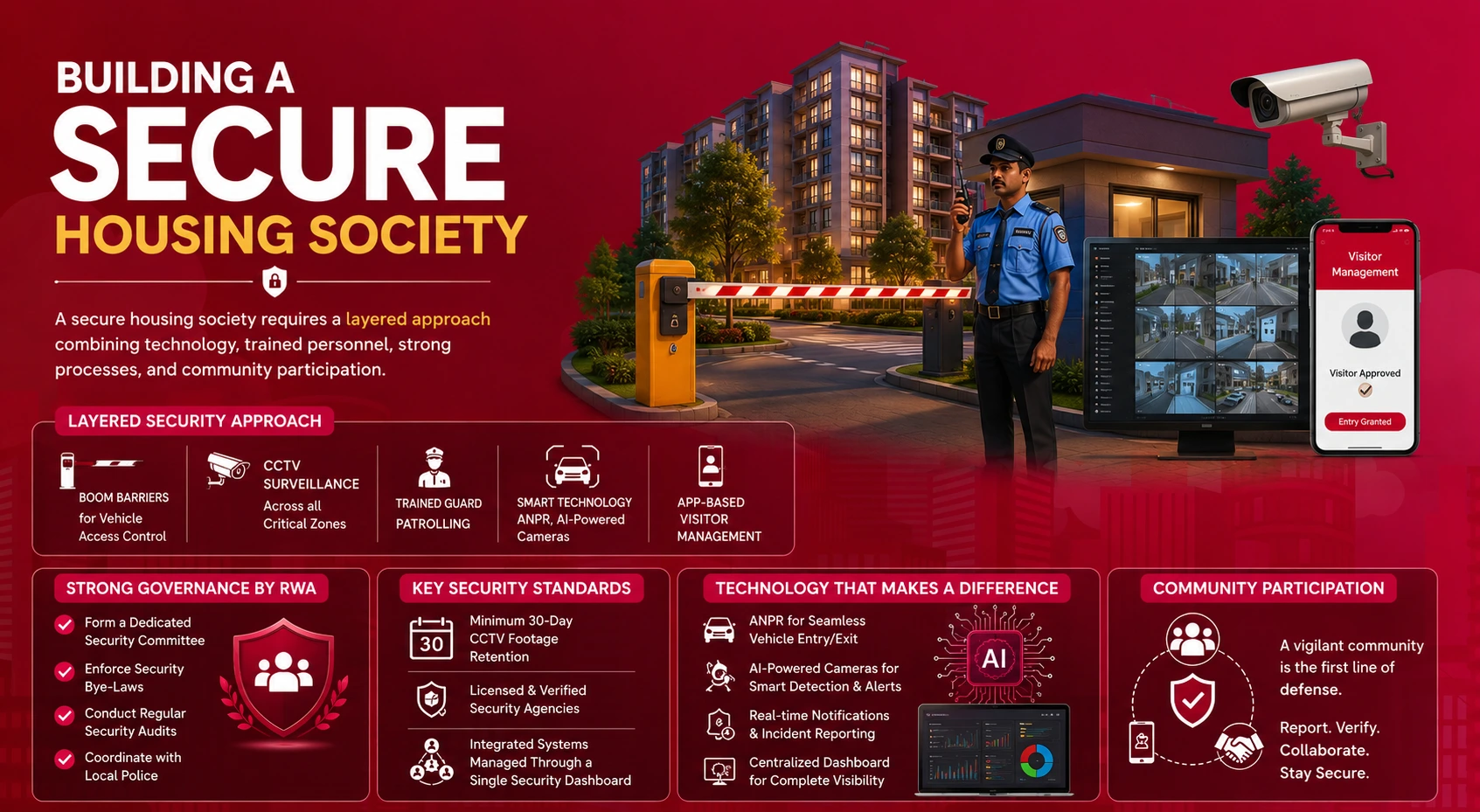


Urban housing societies today face a security challenge that goes well beyond a single guard at the gate. Rising urban crime, increased vehicle density, frequent visitor movement, and the presence of domestic staff and delivery personnel make layered, technology-backed security a non-negotiable requirement.

Why Security Cannot Be an Afterthought:
- Urban crime rates in residential areas have risen steadily across Indian cities
- Shared entry points, parking areas, and common zones create multiple vulnerability points
- A single security lapse can affect hundreds of families simultaneously
- Insurers and property valuers increasingly factor security infrastructure into assessments
The Resident Welfare Association (RWA) is the primary body responsible for planning, funding, implementing, and enforcing security standards. This guide covers every layer : from boom barriers and CCTV to smart technology and emergency protocols.
Boom Barriers & Entry Control
What Are Boom Barriers?
Boom barriers are physical access control systems installed at entry and exit points to regulate vehicle movement. They act as the first line of defence by ensuring only authorised vehicles enter the premises.
Types of Boom Barriers
| Type | How It Works | Best For |
| Manual Boom Barriers | Operated by a guard | Small societies, low traffic |
| Automatic Boom Barriers | Sensor or button triggered | Medium to large societies |
| RFID-Based Boom Barriers | Resident vehicle tag scanned automatically | Large societies, high traffic |
| ANPR-Integrated Boom Barriers | Camera reads number plate, barrier opens | Premium and tech-forward societies |
Key Benefits
- Controls and logs all vehicle entry and exit
- Reduces tailgating and unauthorised access
- Creates a verifiable record of vehicle movement
- Deters opportunistic theft and intrusion
Best Practices
Single Entry/Exit Point Management: Where possible, consolidate vehicle movement through one entry and one exit. Multiple unmonitored gates are the most common security vulnerability in large societies.
Integration with Visitor Management Systems: Boom barriers are most effective when linked to a visitor management app. When a visitor is pre-approved by a resident, the barrier opens automatically : reducing guard workload and human error.
Maintenance and Malfunction Protocols
- Schedule monthly mechanical checks
- Keep a manual override protocol ready for power failures
- Maintain a 24-hour vendor helpline contact
- Log all malfunctions and repair timelines
RWA Considerations
| Factor | What to Evaluate |
| Vendor | Experience, client references, after-sales support |
| Cost | Equipment, installation, AMC (Annual Maintenance Contract) |
| Integration | Compatibility with existing CCTV and VMS |
| Uptime | Guaranteed response time for breakdown |
Real Also: Boom Barrier Installation
CCTV Surveillance
Why 24/7 Video Monitoring Is Essential
CCTV surveillance serves three critical functions : deterrence (visible cameras discourage criminal activity), detection (real-time monitoring catches incidents as they happen), and documentation (recorded footage supports investigations and legal proceedings).
Where to Install Cameras
| Location | Priority | Camera Type Recommended |
| Main entry/exit gate | Critical | PTZ + Night Vision |
| Parking areas | Critical | Bullet + Night Vision |
| Lifts | High | Dome (wide angle) |
| Staircases | High | Dome |
| Perimeter walls | High | Bullet + IR |
| Common areas/corridors | Medium | Dome |
| Gym, clubhouse, pool | Medium | Dome |
| Basement | High | Bullet + Night Vision |
Types of CCTV Cameras
| Camera Type | Best Use |
| Dome Camera | Indoor : lifts, corridors, lobbies |
| Bullet Camera | Outdoor : parking, perimeter, gates |
| PTZ (Pan-Tilt-Zoom) | Wide-area monitoring with remote control |
| Night Vision / IR | Low-light or no-light areas |
| AI-Powered Camera | Motion detection, facial recognition, alerts |
Best Practices
- Minimum 30-day footage retention : essential for delayed complaint filing
- Regular camera health checks : monthly audit of all camera feeds
- Restricted footage access : only RWA chairman, security head, and authorised personnel
- Visible CCTV signage : legally required and acts as a deterrent
- Backup power : cameras must stay operational during power cuts via UPS or battery backup
Legal Compliance
CCTV footage is subject to privacy protections under Indian law. Key points:
- Cameras must not be installed inside individual flats, changing rooms, or washrooms
- Footage must be stored securely and not shared publicly or on social media
- Access logs for footage retrieval must be maintained
- The Personal Data Protection framework (India) treats surveillance footage as personal data : handle accordingly
Guard Patrolling
Role of Security Guards
Security guards are the human layer of your society's security system. Technology can monitor and record : guards can respond, intervene, and prevent in real time. No camera or barrier replaces a trained, alert security professional.
Duties and Responsibilities
| Duty | Details |
| Visitor verification | Check ID, log purpose and flat number, issue visitor pass |
| Entry logging | Manual or app-based record of all entries and exits |
| Vehicle checks | Verify resident stickers/RFID at boom barriers |
| Night patrolling | Scheduled rounds of parking, perimeter, and common areas |
| Emergency response | First responder for fire, medical, or security incidents |
| Domestic staff monitoring | Log entry/exit of maids, drivers, cooks, and delivery staff |
Patrolling Best Practices
- Defined routes and schedules : randomise timing to avoid predictability
- GPS or NFC checkpoints : guards tap NFC tags at fixed points to confirm patrolling completion
- Two-guard system at night : no single guard should patrol alone after midnight
- Communication equipment : all guards must carry walkie-talkies or a society-issued mobile
Guard Verification and Hiring Standards
- Hire only from licensed security agencies registered under the Private Security Agencies (Regulation) Act, 2005
- Verify police clearance certificates for all guards
- Ensure guards have completed basic security training
- Maintain copies of all guard documents with the RWA
RWA Performance Management
| Review Area | Frequency |
| Attendance and punctuality | Weekly |
| Patrolling log review | Weekly |
| Incident report review | Monthly |
| Agency performance review | Quarterly |
| Full security audit | Bi-annually |
Additional Security Measures
A robust society security system goes beyond the three core pillars. These supplementary measures fill critical gaps.
Access Control for Residents
- Intercom and video doorbell systems in every flat : residents verify visitors before granting access
- Biometric or RFID access for residents at main gates and amenity areas (gym, clubhouse)
- Eliminates shared keys or easily duplicated access cards
Perimeter Security
- Boundary wall lighting : motion-activated lights along the full perimeter
- Anti-climb fencing or spikes on top of boundary walls
- Perimeter alarm sensors that trigger on unauthorised entry attempts
Emergency Systems
| System | Purpose |
| Panic buttons | Installed in lifts, parking areas, and guard posts |
| Emergency alarm | Society-wide alert for fire, flood, or security breach |
| Emergency contact directory | All residents, RWA members, local police, fire station |
| Fire extinguishers | On every floor and in all common areas |
| Smoke detectors | In all enclosed common spaces |
| Exit signage | Illuminated, visible on every floor |
Staff and Delivery Verification
- All domestic staff (maids, drivers, cooks) must be police-verified before entry approval
- Delivery personnel must be logged at the gate : no unescorted access to residential floors
- Dedicated delivery drop-off zones near the gate reduce internal movement
- RWA to maintain a staff database with photo ID and contact details
Technology & Smart Security
The Case for Integrated Smart Security
Individual systems : CCTV, boom barriers, guards : work in silos without integration. Smart security connects all these into one unified platform, giving the RWA real-time visibility and control.
Key Smart Security Technologies
| Technology | Function | Benefit |
| Unified Security Dashboard | Central control for all systems | Single view of the entire society |
| AI-Powered CCTV | Motion detection, loitering alerts, anomaly detection | Reduces need for constant manual monitoring |
| ANPR (Automatic Number Plate Recognition) | Auto-identifies registered vehicles at gates | Faster entry, no guard dependency |
| Cloud-Based Storage | Footage stored on secure remote servers | No risk of local DVR tampering or theft |
| Society Security App | Real-time alerts, visitor approvals, incident reporting | Residents stay informed and in control |
| Biometric Access | Fingerprint or face recognition at entry points | Eliminates card/key sharing |
Society Security Apps : What to Look For
- Pre-approve visitors remotely from your phone
- Receive real-time alerts for unrecognised vehicles or after-hours entry
- View CCTV feeds remotely
- One-tap emergency SOS to security desk
- Domestic staff check-in/check-out notifications
Popular platforms used by Indian housing societies: MyGate, NoBrokerHood, Apartment ADDA, and Gatekeeper.
RWA's Role & Responsibilities
The RWA is not just an administrative body : it is the legal and operational backbone of the society's security infrastructure.
Forming a Security Committee
- Constitute a dedicated security sub-committee of 3–5 residents
- Include at least one technically informed member
- Meet monthly to review incidents, vendor performance, and system health
Setting and Enforcing Security Bye-Laws
Key bye-laws every society should have:
- Mandatory visitor logging at all times
- No unauthorised entry of domestic staff without police verification
- CCTV footage access restricted to authorised personnel only
- Penalty for residents who tamper with or bypass security systems
- Mandatory participation in emergency drills
Security Audits
| Audit Type | Frequency | What to Check |
| CCTV health check | Monthly | Camera feeds, storage, blind spots |
| Guard performance review | Monthly | Logs, punctuality, incident handling |
| Boom barrier maintenance | Monthly | Mechanical check, sensor calibration |
| Full security audit | Bi-annually | All systems, vendor contracts, bye-laws |
| Police liaison meeting | Annually | Local crime trends, coordination protocol |
Community Training
- Conduct emergency evacuation drills at least once a year
- Train residents on fire safety protocols
- Share a society emergency contact directory with all residents
- Run awareness sessions on not sharing OTPs or access credentials with delivery personnel
