





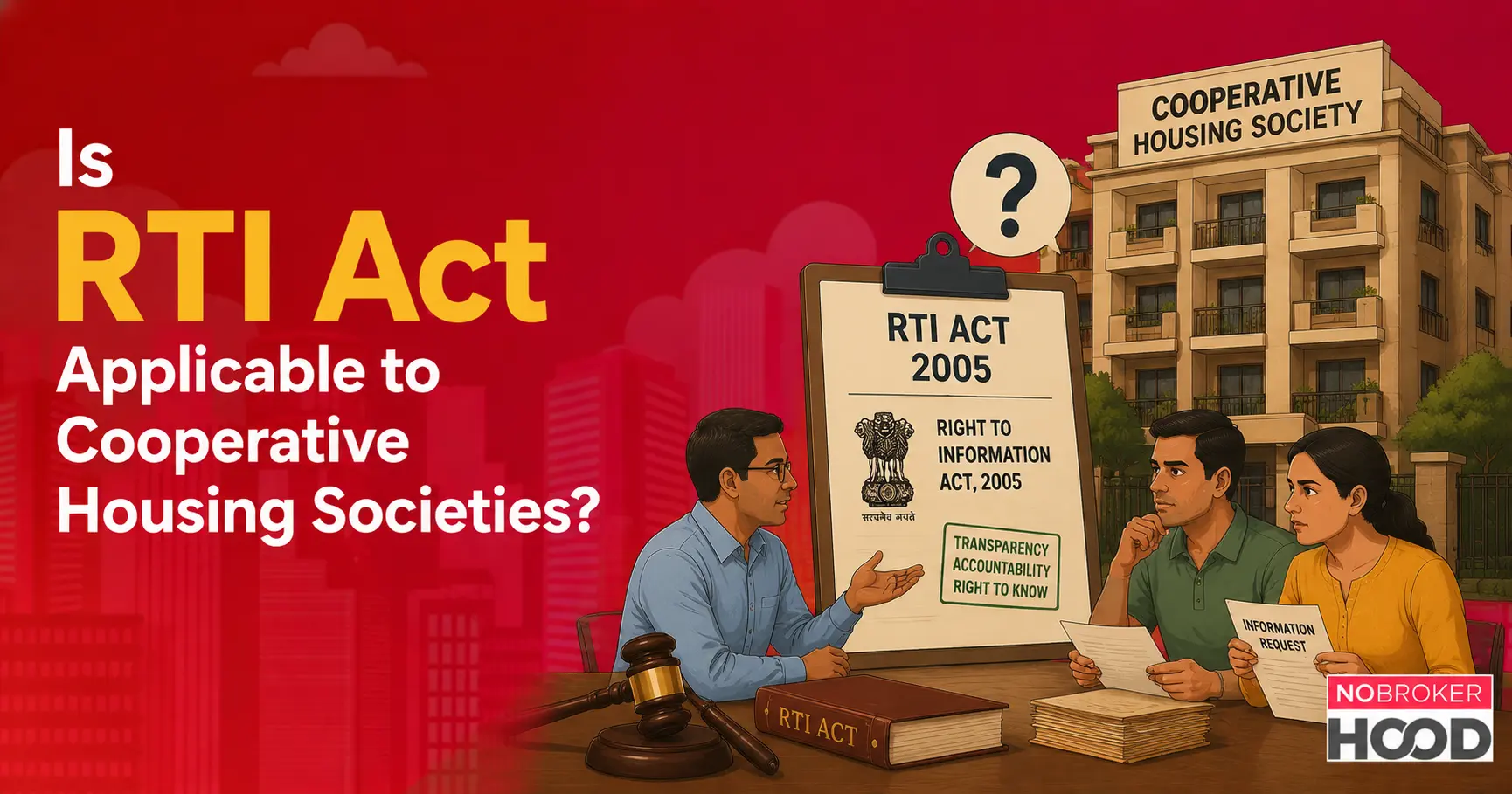


The RTI Act plays a crucial role in bringing transparency to India's cooperative sector, which forms roughly one-sixth of Maharashtra's economy, spanning 6.5 lakh societies and 30 crore members nationwide. For housing society residents, a common question arises: can an RTI be filed against the society? The 97th Constitutional Amendment (2012) strengthened the right to form cooperatives, and courts have held that state-owned, controlled, or substantially funded societies fall under RTI's ambit. The Central Information Commission has further directed that society Presidents and Secretaries be treated as Public Information Officers, extending RTI's reach directly to residents.

Does Co operative Society Come Under RTI Act ?
A cooperative society isn't automatically covered under the RTI Act just because it's registered as a cooperative. It comes under RTI only if the government owns, controls, or substantially funds it.
This also differs by state. Maharashtra courts have generally supported applying RTI to housing societies, while Tamil Nadu's Madras High Court ruled that cooperative societies there are not public authorities under RTI.
Even if your society isn't directly covered, you can still get information by filing an RTI with the Registrar of Cooperative Societies, since the Registrar's office always qualifies as a public authority.
RTI Act for Cooperative Societies: Supreme Court Ruling
The turning point for RTI applicability to cooperative societies came with the 97th Constitutional Amendment of 2012, which recognized the right to form cooperative societies as a fundamental right under Article 19. Building on this, the Supreme Court clarified that a cooperative society falls within the purview of the RTI Act if it is owned, controlled, or substantially financed by the government.
Importantly, the Court held that "substantial funding" does not require the government to hold a majority stake; it can include indirect benefits such as discounted land allotments, subsidies, or grants. This broadened interpretation meant that many cooperative societies which received even partial government support could now be treated as public authorities under Section 2(h) of the RTI Act.
This ruling laid the legal foundation for how RTI applies to cooperative societies, but it also left room for interpretation which is why High Courts across different states have since applied it inconsistently, as seen in the contrasting rulings from Maharashtra and Tamil Nadu.
Can an RTI be filed against a Hosing Society Institution?
The debate around RTI in housing society governance is convoluted and varies across the country. The Aurangabad small bench of the Bombay High Court stated that every co-operative institution, including housing societies, both 75,000 housing societies in Mumbai, to comply with openness circumstances. Yet legal circles continue to debate its universal applicability.
Legal Status Varies by State
- Maharashtra: The Bombay High Court favors applying RTI to housing societies.
- Tamil Nadu: The Madras High Court ruled that cooperative societies under the Tamil Nadu Cooperative Societies Act are not public authorities under Section 2(h) of the RTI Act.
So, while Can RTI be Filed Against Housing Society may have a yes in Maharashtra, it might be a no in Tamil Nadu unless there is substantial government control or funding.
Accessing Information Through the Registrar
If your housing society isn’t directly under RTI, you can still get information via the Registrar of Cooperative Societies, who qualifies as a “public authority” under Section 2(h). What you can do is:
- File a complaint to the District Deputy Registrar
- Wait for a response for 30 days.
- If you are not satisfied, use RTI in the context of housing societies to make an RTI application to the Registrar's office.
The courts have held that no cooperative society can deny the Registrar information, unless it is information exempted under Section 8 of the RTI Act.
RTI Act for Cooperative Societies: Legal Framework
Understanding the RTI Act for Cooperative Societies requires knowing how the term public authority is interpreted:
| Legal Reference | Interpretation |
| Section 2(h) of RTI Act | Definition of a "public authority":• Institutions set up by the Constitution or law• Bodies owned, controlled, or substantially financed by the government• Non-Governmental Organisations that receive substantial government funding |
| Tamil Nadu (Judgment from the Madras HC) | With regard to the RTI Act cooperative societies are independent legal entities and so cannot be deemed a public authority under the RTI Act. |
| Madhya Pradesh (State Information Commissioner) | Awarded society public authority status since it received over ₹50,000 in government funding and fell within the ambit of the RTI Act. |
The Supreme Courts stated that “substantial funding” does not mean amounting to majority funding. Discounts on land or grants can also count as funding.
Even if your society itself does not strictly fall under the RTI, it is still possible to request access to your housing society records or information from the registrar. The Kerala High Court has ruled that registrars must provide all relevant information about housing societies unless there is specific exemption under Section 8.
How to File RTI Against Co operative Society ?
Filing an RTI against a cooperative society is a straightforward process if you follow these steps:
Step 1: Check if the Society Falls Under RTI
Not all cooperative societies are covered. It should be state-owned, state-funded, or registered under a state Cooperative Societies Act.
Step 2: Find the Right Person to Address
Usually, the Society Secretary or President acts as the Public Information Officer (PIO). If you're unsure, send your application to the Registrar of Cooperative Societies instead.
Step 3: Write Your Application
Keep it simple and specific. Ask for exactly what you need — like account statements, meeting minutes, or maintenance fund details. Avoid vague requests.
Step 4: Pay the Fee
A small fee (usually around ₹10) applies. You can pay this via demand draft, postal order, or online, depending on your state's rules.
Step 5: Submit It
You can submit your RTI application:
- In person at the society office
- By registered post
- Online, if your state has an RTI portal
Step 6: Wait for a Reply
The PIO must reply within 30 days. If it's urgent (life or liberty issue), the deadline is just 48 hours.
Step 7: File an Appeal if Needed
No response, or not satisfied with the answer? File a first appeal with the Registrar's office within 30 days.
Step 8. Go to the State Information Commission
If the first appeal doesn't help, you can escalate to the State Information Commission for a final resolution.
How to Request Information from a Housing Society
Even if your housing society is not explicitly covered under RTI, the following methods may give you practical access to the information that you are seeking:
1. Direct Application under the Maharashtra Cooperative Societies Act
Under Section 32 (1) of the Maharashtra Cooperative Societies Act, all members shall have the right to inspect any documents of the society that are required to be maintained under the MCS Act, during office hours; and Section 32 (2) makes it possible to put in a written application to the Chairperson or Secretary. You request should be:
- Polite and non-accusatory.
- Accompanied by a copy to the Deputy Registrar.
- Factual, specific, and within the scope of permitted access.
Fees are usually ₹5 per page, and responses must come within 30 days.
2. Filing RTI Application Through Deputy Registrar
If direct communication fails, here's How to File RTI for Housing Society through the Deputy Registrar:
- Use Annexure A format as per Maharashtra RTI Rules.
- Attach ₹10 court fee or Indian Postal Order.
- Address it to the Public Information Officer at the Deputy Registrar’s office.
- Clearly mention required documents (e.g., audit reports, AGM minutes, registration certificate).
The Deputy Registrar will retrieve the data using Sections 77 and 78 of the MCS Act.
3. Escalation If Information is Denied
If your society or registrar does not respond:
- Lodge Section 146(j) and 147 complaints under the MCS Act.
- Lodge a first appeal under Section 19(1) of the RTI Act.
- Refer to Section 148A of the MCS Act (Contempt of Cooperative Courts) for serious violations.
- You may also file a consumer complaint citing "deficiency in service," backed by prior correspondence.
Reduce RTI (Section 32) Requests in Your Society With NoBrokerHood
A well-run digital record-keeping system can strengthen a committee's position if challenged. Fewer disputes arise in the first place and when they do, response/ compliance is faster and better documented.
Filing an RTI or chasing the Registrar for records shouldn't be the only way residents get visibility into their society's functioning. With NoBrokerHood's Society Accounting Software, Managing Committees can proactively share financial records, AGM minutes, and audit reports with residents, reducing disputes before they escalate into RTI applications or Registrar complaints.
- Digital Record-Keeping: Store audit reports, registration certificates, AGM minutes, and financial statements in one place accessible to residents anytime, without a formal request process.
- Transparent Accounting: Automated maintenance billing, digital invoices, and real-time financial reporting keep every rupee accounted for, addressing the exact concerns that often lead to RTI filings.
- Resident Access Portal: Give members self-service access to relevant society documents, cutting down disputes over "lack of transparency."
- Audit-Ready Reports: Generate compliant financial reports instantly, so your society is always prepared if a Registrar or RTI request comes in.
- Reduced Committee Workload: MC members spend less time responding to individual information requests when records are already digitized and shareable.
All Solutions by NoBrokerHood:
