



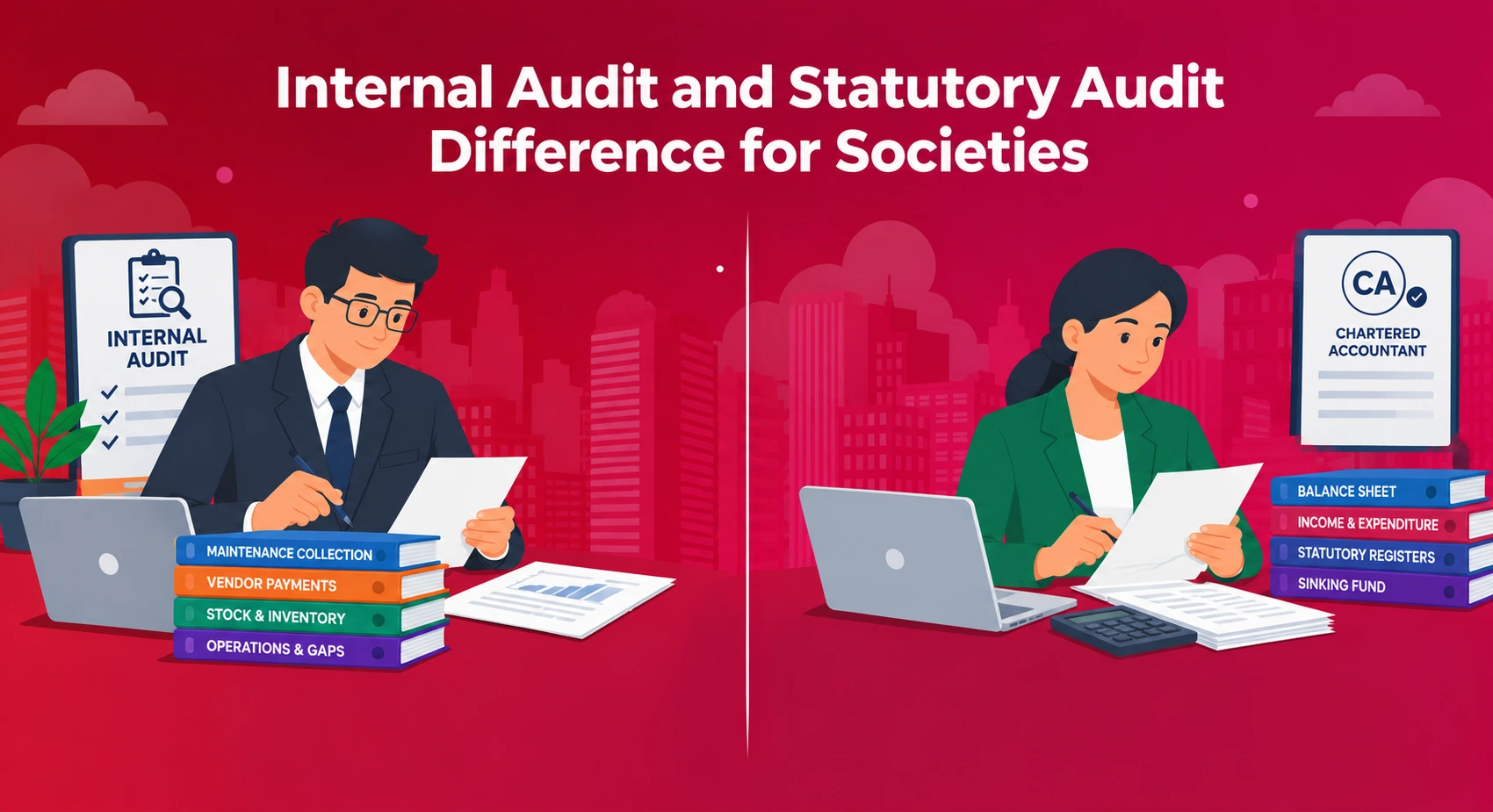


Every housing society collects maintenance charges, pays vendors and manages funds for repairs and future expenses. Regular audits help committees check financial records and identify errors. However, statutory and internal audits serve different purposes. This article explains the internal audit and statutory audit difference, including their objectives, frequency, auditors and reporting process. It also covers which audit a society needs, how both audits work together, and common mistakes committees should avoid when managing finances and audit records.

What Is a Statutory Audit in a Housing Society?
A statutory audit is the yearly check of your society’s books by an independent Chartered Accountant. In most states, the auditor comes from a government-approved panel and is appointed at the general body meeting.
The auditor examines the balance sheet, the income and expenditure account, vouchers, statutory registers, and sinking fund account. Then the auditor expresses an opinion about the truth and fairness of the accounts. Here is what members should know:
- Every registered cooperative housing society must complete it after the financial year ends, usually within a few months.
- The report goes to the general body and the Registrar of Cooperative Societies.
- Auditors usually cannot stay with the same society for more than two to three years in a row.
- Skipping or delaying it can lead to penalties.
Rules and deadlines vary according to each state, so check your state's Act and Bylaws.
What Is An Internal Audit in a Housing Society?
An internal audit is a regular check of daily operations. It looks at maintenance bill collection, vendor payments, stock of maintenance items and gaps in the way work gets done.
This review may be done on a monthly, quarterly, or half-yearly basis. The review may be carried out by a committee member, an internal auditor, or an external consultant, and the report is submitted to the committee or president.
Picture a society where a lift vendor was paid twice for the same repair in one quarter. A statutory audit might catch that next March. A quarterly internal audit catches it in weeks, while the vendor can still return the money.
Internal Audit vs Statutory Audit: Side-by-Side Comparison
Members and the Registrar receive the statutory audit report. The internal audit report usually stays with the committee.
| Point | Internal audit | Statutory audit |
| Purpose | Check daily operations and controls | Verify accounts and legal compliance |
| Mandate | Optional, set by the committee | Compulsory under the state act |
| Done by | Committee member, internal auditor or consultant | Independent external Chartered Accountant |
| Frequency | Monthly, quarterly or half-yearly | Once a year |
| Reports to | Managing committee or president | General body and Registrar |
| Focus | Bill collection, vendor payments, process gaps | Balance sheet, registers, compliance papers |
Statutory Audit vs Internal Audit: Which Is Better?
Neither is better nor worse, because they do different jobs. Your society needs a statutory audit by law, so that decision is already made. The internal audit is the optional one.
It suits larger societies with heavy maintenance dues, big sinking funds or many vendor contracts. A society of 40 flats with two or three vendors may manage with a careful monthly bank reconciliation statement by the treasurer.
If you do add an internal audit, fix the schedule at the first committee meeting of the financial year and put it in the minutes. A date on paper gets followed far more often than a good intention.
How Internal Audit and Statutory Audit Work Together?
The internal audit catches problems during the year. The statutory audit certifies the accounts at the end. When the first is done well, the second runs faster, and the Secretary and Treasurer spend less time answering questions about old entries.
Think of internal audit vs statutory audit as a monthly health check and a yearly medical report. One does not replace the other. Here is a practical routine any committee can follow:
- Compare the bank statement with the cash book once a month.
- Verify all payments made to vendors against approved bills and work orders.
- Check the list of members with pending dues once a month and record follow-up actions.
- Update the statutory register in a timely manner, which includes the share register and the members’ register.
- Discuss internal audit outcomes in the committee’s quarterly meeting and record them in the minutes.
- Hand the statutory auditor a clean set of files soon after the financial year ends on 31 March.
Common Mistakes Societies Make With Audits
Most audit trouble comes from a few repeated habits.
- Assuming the statutory audit covers daily checks: It reviews yearly accounts. A leak in April may stay hidden until the next year’s audit.
- Ignoring the internal audits when planning budgets: Committees sometimes spend nothing on internal checks because “the audit is already paid for.”
- Keeping the same auditor beyond the rotation limit: Check your state rules before the general body votes.
- Accepting cash without proper receipts: Auditors flag missing or unnumbered receipts quickly.
- Delaying the general body presentation: Members have a right to see the audited accounts.
Maintain Audit-Ready Accounts with NoBrokerHood Society Accounting Software
Preparing for a housing society audit involves bringing together payment records, bank statements, expense entries and financial reports. When these records are scattered across spreadsheets and paper files, the treasurer and secretary may spend extra time checking transactions and answering questions from the auditor or committee members.
NoBrokerHood's society accounting software helps committees maintain organised financial records throughout the year. Instead of preparing everything just before the statutory audit, they can keep track of transactions, reconcile bank accounts and generate reports as part of their regular accounting work.
Key features include:
- Bank Reconciliation: Match bank statements with accounting entries to keep financial records updated.
- Financial Reports: Generate reports such as the Trial Balance, Day Book, General Ledger and Balance Sheet.
- Tally ERP Integration: Export accounting data to support bookkeeping and audit preparation.
- Payment Tracking: Maintain records of collections, expenses and outstanding dues for financial review.
Keeping accounts organised throughout the year can make it easier for committees to prepare for statutory audits and review financial activity during internal checks.
