Guide on How to Calculate FSI for Redevelopment of Residential Buildings in India
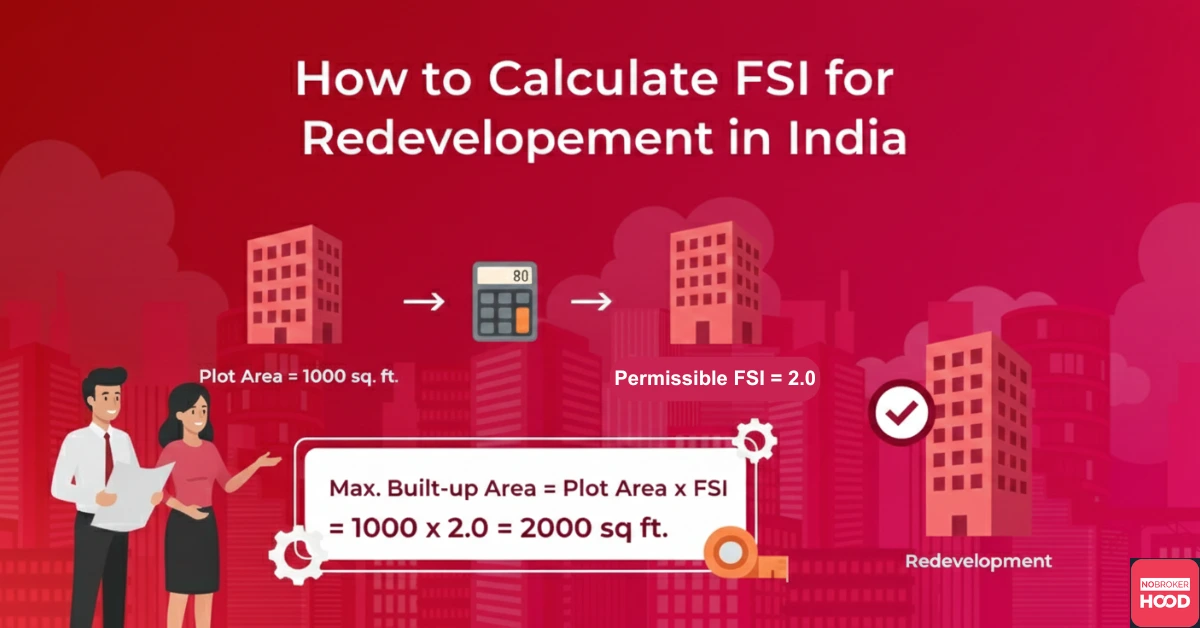
FSI for redevelopment is calculated by dividing the total permissible built-up area of all floors by the plot area. In redevelopment projects, base FSI is added with incentive FSI, fungible FSI, or TDR as per city rules. This total defines how much construction is legally allowed on your residential society plot.
What Is FSI for Residential Building and Why Does It Matter?
FSI for a residential building means Floor Space Index. It tells you how much total construction is legally allowed on a plot of land. It is fixed by the local municipal authority and may vary from city to city. Local municipal bodies set FSI limits based on infrastructure capacity, zoning rules, road width, and location. It is also called FAR or Floor Area Ratio in some cities.
When housing societies plan for redevelopment, FSI is one of the most important financial and planning factors, because it directly determines how much construction can be carried out on the plot. Higher permissible FSI translates into more saleable area for the developer and the possibility of larger or upgraded flats for existing residents, making the project more viable for everyone involved.
Understanding how to calculate FSI for redevelopment helps committee members and resident groups assess whether a developer’s proposal is realistic, clearly understand the additional area being promised, and properly evaluate the overall feasibility of the project. With proper FSI clarity, societies can avoid confusion during negotiations and make informed, fact-based decisions instead of relying only on verbal assurances.
Basic Formula: How to Calculate FSI for Redevelopment
Understanding FSI for residential buildings is the first step before any society redevelopment discussion starts. The core formula stays the same across cities.
FSI = Total Built-up Area of All Floors ÷ Plot Area
Total built up area includes all counted floor areas across every level of the building. Plot area means the full land parcel size.
If your plot is 1,000 sq ft and permitted FSI is 2.0, then you can build 2,000 sq ft in total across all floors. When you study FSI for residential building, you must also check what is included and what is excluded under local building rules. Redevelopment cases add more layers, such as incentives and fungible FSI.
Key Components Used in FSI for Redevelopment
To correctly understand how is FSI calculated for redevelopment, you must look beyond the base number. These are the main components used by planning authorities.
Base FSI
Base FSI is the default FSI allowed on a plot under zoning rules. In many Indian cities, the base FSI ranges from 1.0 to 1.5 for standard residential plots. This is the starting point for any FSI for residential building calculations.
Incentive FSI
In redevelopment projects, governments often allow extra FSI as an incentive. This supports the rebuilding of old or unsafe buildings. Incentive FSI can range from 50 percent to 100 percent or more, depending on the scheme and city rules. This directly affects how to calculate FSI for redevelopment value.
Fungible FSI
Fungible FSI is an additional area that can be purchased by paying a premium fee to the authority. It usually covers areas like balconies and flower beds that were earlier free of FSI count. In many cities, fungible FSI is about 35 percent for residential projects.
TDR in Redevelopment
TDR means Transferable Development Rights. Developers can buy unused development rights from another plot and apply them where rules permit. TDR often plays a role in metro cities and changes how FSI for residential building totals are worked out.
Read also: Redevelopment of Housing Society
Step-by-Step Process on How to Calculate FSI for Redevelopment Projects
If your residential society wants to check redevelopment potential, follow this simple process.
Step 1: Measure Plot Area
Get the exact plot area from land records or approved layout plans.
Step 2: Check Base FSI
Refer to the Development Control Regulations of your city. This gives the base FSI for your zone and road width.
Step 3: Calculate Existing Built-up Area
Add carpet and built-up areas of all current flats and counted common areas.
Step 4: Add Incentive FSI
Apply the redevelopment incentive percentage allowed by the authority.
Step 5: Add Fungible FSI if Allowed
Check if extra purchasable FSI is permitted and financially viable.
Step 6: Include TDR if Applicable
If rules allow, add the TDR area purchased by the developer.
This full method explains how is FSI calculated for redevelopment in real projects.
Read also: Corpus Fund Meaning
Practical Example of FSI for Redevelopment Calculation
Let us take a simple scenario to understand how to calculate FSI for redevelopment.
- Plot size: 1,000 sq m
- Base FSI: 1.33
- Incentive FSI: 50 percent
- Fungible FSI: 35 percent of base built up
Base built-up area
1,000 × 1.33 = 1,330 sq m
Incentive area
1,000 × 0.50 = 500 sq m
Fungible area
1,330 × 0.35 = 465.5 sq m
Total permissible built-up area
1,330 + 500 + 465.5 = 2,295.5 sq m
This total is used to plan flat sizes, rehab area for existing members, and sale area for the developer. This is a working model of FSI for residential building in redevelopment.
City-wise FSI for Residential Building in India
FSI limits are not the same across India. Always verify with your local authority.
Typical ranges:
- Mumbai: Often 2.5 to 5.0, depending on the island city or the suburbs and special regulations
- Chennai: Around 1.25 to 2.0 for many residential plots, higher on major roads
- Bengaluru: About 1.75 to 3.35 based on road width
- Delhi: Roughly 1.2 to 3.5, higher near transit corridors
- Hyderabad: In several zones, there is no strict upper cap, subject to approvals
These values guide early checks of how is FSI calculated for redevelopment feasibility.
Read also: New rules for Redevelopment of Society in Mumbai
What Areas Are Not Counted in FSI for Residential Building?
While calculating FSI for residential building, some spaces are often excluded as per bylaws.
Common exclusions include:
- Open stilt parking in many cities
- Staircases and lift shafts
- Lift machine rooms
- Watchman cabins of limited size
- Certain service ducts
- Parts of balconies in some rules
These exclusions increase usable space without increasing the counted FSI. Always confirm with the latest local code before applying how to calculate FSI for redevelopment numbers.
Practical Residential Society Checks Before Redevelopment
Before moving ahead with a redevelopment project, housing societies should carry out a few essential technical and legal checks to avoid future disputes and miscalculations:
- Verify approved plot area documents from municipal records
- Confirm the latest zoning classification and applicable FSI notifications
- Measure and validate the road width adjoining the plot
- Check eligible FSI exemptions such as stilt parking, staircases, and service areas
- Understand the premium FSI charges payable to authorities
- Review TDR (Transferable Development Rights) loading limits and rules
Simple Tip: Always ask the developer to share the official FSI calculation sheet submitted to the planning authority. Get it reviewed by an independent architect or consultant before approval.
Read also: New Rules for Redevelopment of Cooperative Housing Society
Key Redevelopment KPIs Residents Should Track
Residents should regularly monitor these important redevelopment KPIs:
- Carpet/rehab area allocated per flat
- Total permissible FSI available for the project
- The sale component area allocated to the developer
- Status of statutory approvals and clearances
- Project timeline and milestone completion stages
How Societies Can Plan Redevelopment Better with NoBrokerHood
NoBrokerHood is a residential society and community management platform used by many Indian housing communities for daily operations and governance. It supports committees with document management, resident communication, approvals, and meeting records, which are all important during redevelopment planning.
When societies review FSI for residential building potential and redevelopment proposals, structured data, transparent communication, and recorded resolutions help avoid confusion and disputes. Digital workflows and verified records make coordination smoother for residents and managing committees.
All Solutions by NoBrokerHood:
FAQs
Yes. FSI and FAR both mean the ratio of total built-up area to plot area. Different authorities use different terms, but the calculation method is the same.
Redevelopment adds incentive FSI, fungible FSI, and sometimes TDR. These extra layers are not always present in new standard projects.
Yes. Wider roads often allow higher permissible FSI. Authorities link FSI limits to infrastructure capacity and access width.
A rough estimate is possible using the formula and city FSI tables. Final numbers must be verified by a licensed architect or planner with official records.
In many cities, open stilt parking and some balcony portions are excluded. Rules vary, so local building regulations must be checked.