






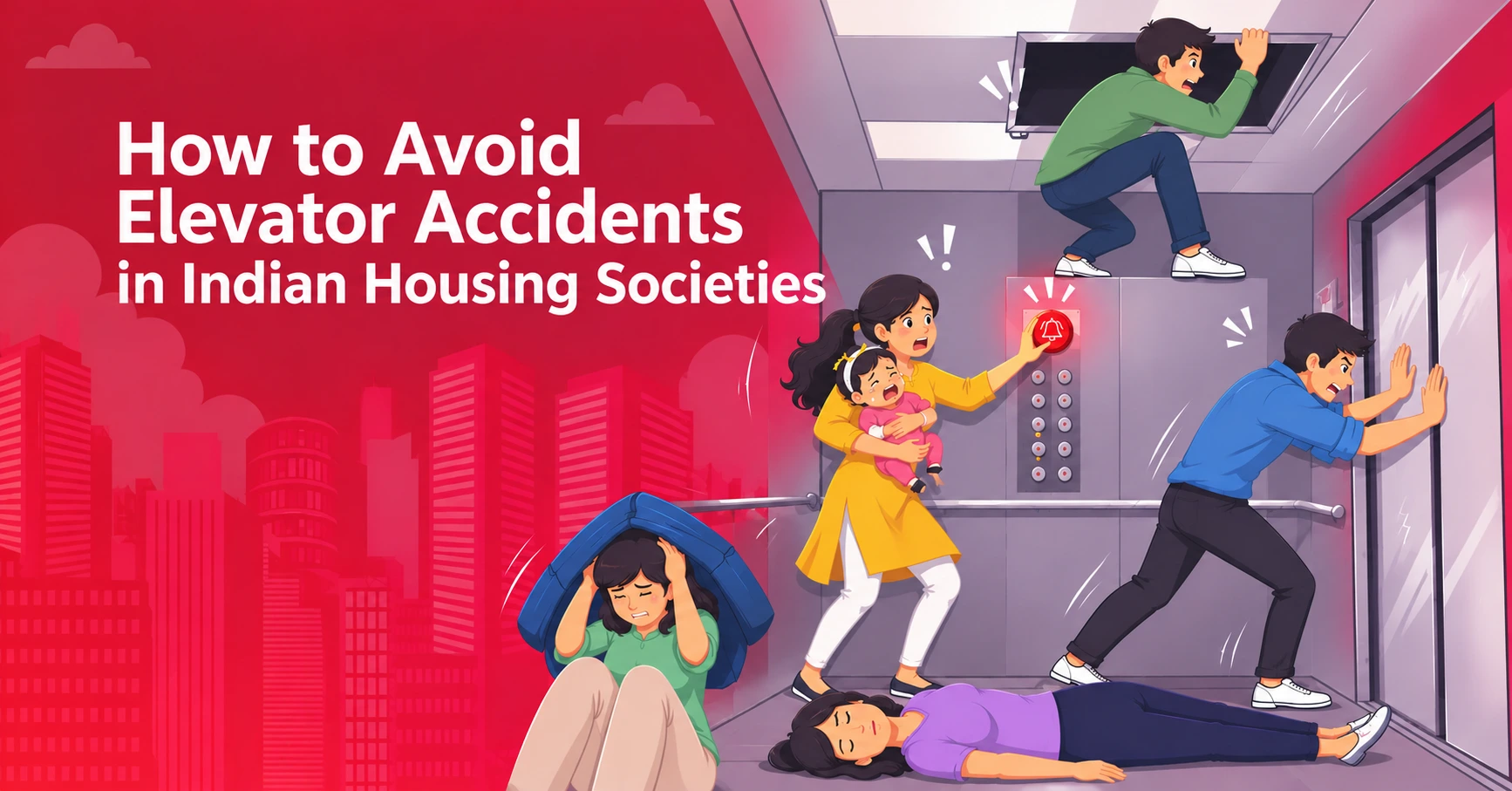


Elevators are part of everyday life in apartment buildings, but a faulty lift can put residents at serious risk. From sudden stops and door malfunctions to maintenance failures, several issues can lead to elevator accidents. Understanding the risks and following basic safety practices can help prevent injuries and emergencies. This guide covers how common elevator accidents are in India, their main causes, safety precautions for residents, what to do if a lift gets stuck or starts falling, and the steps housing society committees should take to keep lifts safe.

How Common Are Elevator Accidents in India?
Serious accidents are rare compared with the number of rides residents take every day. A nationwide survey in July 2026 found that 46% of apartment residents, or someone in their family, had been stuck in their building's lift at least once in the past year. About 15% were stuck six to nine times. One in three said they have no confidence in the lifts in their society.
How Often Do Elevator Accidents Happen in Residential Buildings?
The figure usually quoted is 20 to 30 lift-related deaths a year in India, along with many injuries that never reach the news. India is also ranked second in the world for lift accidents, behind China. Many of the deaths involve maintenance workers rather than residents.
Main Causes of Elevator Accidents in Housing Societies
The causes of elevator accidents in housing societies trace back to a short list of problems. Almost all of them show up as warning signs long before anyone gets hurt.
- Door and gate faults: They cause most of the injuries. A dusty light curtain can fail to see someone in the doorway, a faulty interlock can let the car move with the door open, and an old collapsible gate has enough gap for a child's hand.
- Missed servicing: In a survey, 49% of residential lifts were under an AMC with the manufacturer, 30% with a third-party contractor, and 11% were looked after by society staff. Another 10% got nothing beyond emergency calls.
- Dead ARD batteries: An automatic rescue device brings the lift to the nearest floor during a power cut. With a flat battery, the lift just stops, often in the dark.
- Mis-levelling: A car that stops a few centimetres above or below the floor causes trips and falls, especially for older residents.
- Overloading: It can strain the cables and brakes.
- Locally assembled lifts: In parts of Telangana, an estimated 70% to 80% of lifts are assembled locally with little testing.
A recent case in Gujarat shows where ignored complaints can end. In Narol, Ahmedabad, a 12-year-old boy died after a residential lift suddenly collapsed and trapped his neck. Residents alleged that the lift had been faulty for months and that repeated requests to the builder went unanswered. Police have called in forensic experts and official lift inspectors to examine the failure. Acting on a complaint early is the simplest way to avoid elevator accidents like this one.
How to Avoid Elevator Accidents: Safety Tips for Residents
Small habits prevent most injuries. Share these in your society WhatsApp group or put them on a notice near the lift lobby.
Safety Precautions Before Entering an Elevator
- Look down and check that the car is level with the floor. If there is a gap, wait.
- Let people step out before you step in.
- Press the Door Open button instead of putting a hand, bag or foot in a closing door.
- Hold a small child's hand or carry them.
- Stay out of a lift that shakes, makes strange noises or stops unevenly, and tell the committee or manager right away.
- Take the stairs during a fire or an earthquake. Smoke or a power loss can trap you.
Safety Rules to Follow Inside an Elevator
Keep these simple apartment elevator safety rules in mind.
- Stand near the wall and hold the handrail.
- Keep scarves, dupattas and bag straps clear of the doors.
- If the overload alarm sounds, step out and take the next ride.
- Press buttons gently with a finger. No jumping, running or bouncing.
- Never let young children play in the lift or ride alone.
What to Do If an Elevator Starts Falling or Gets Stuck Between Floors?
A lift getting stuck between floors is more common than a sudden fall. Knowing how to respond can help you stay safe until help arrives. Modern elevators have safety mechanisms such as steel cables, speed governors and emergency brakes to prevent free falls. Housing societies should also have an emergency response team comprising trained security guards and maintenance staff to coordinate assistance and contact authorised lift technicians during emergencies.
What to Do If an Elevator Stops Between Floors?
- Stay inside. The car is a safe enclosure.
- Press the alarm button or use the intercom, and tell security where you are.
- Do not pry the doors open or climb out through the ceiling hatch. People have fallen down shafts or been crushed doing this.
- Stay calm and wait for the technician.
What to Do If an Elevator Starts Falling?
- Lie flat on your back in the middle of the floor so the impact spreads across your body.
- Cover your head and neck with your arms, a bag or a jacket.
- Do not jump just before impact. You cannot time it, and you may hit the ceiling.
- Do not stand stiff or squat. Stiff legs pass the shock up your spine, and squatting strains the knees.
How Housing Society Committees Can Prevent Elevator Accidents?
Preventing elevator accidents is not just the responsibility of residents or lift operators. Housing society committees must ensure that lifts are properly maintained, safety equipment works as expected, and complaints are addressed without delay. Regular inspections, planned upgrades and trained staff can reduce the risk of breakdowns and serious accidents. Here are the key steps committees should follow:
- Maintain an elevator maintenance checklist, sign a comprehensive AMC with a certified lift company, and ensure monthly and annual service visits are properly logged.
- Confirm that every lift has an overload sensor with an alarm, an ARD with a healthy battery, infrared light curtains, emergency lighting, an intercom and a working alarm bell.
- Replace old collapsible gates.
- Budget for overhauls and safety upgrades at the AGM instead of waiting for a breakdown.
- Teach apartment security guards and staff the protocol for a trapped resident: calm the person, call the technician, and never let untrained volunteers force the doors.
- Answer every lift complaint quickly and write down what was done.
- Follow your state Lift Act and BIS codes such as IS 14665. Enforcement differs by state. Maharashtra, for example, now requires regular inspections and third-party audits. Under cooperative housing laws, committees can also be held personally liable for negligence.
Who Is Liable for Elevator Accidents in Housing Societies: Builder, RWA or AMC Agency?
In a landmark ruling (M/s Otis Elevator Co. (India) Ltd. v. Rashmi Handa & Ors., 2026), the Supreme Court of India held that elevators are "common carriers", like public transport. The lift manufacturer, the maintenance agency (AMC) and the building owner or management (such as the RWA or housing society) are jointly and severally liable for a lift accident.
Injured passengers or their families do not have to work out which party caused the failure before claiming compensation. All responsible entities can be held jointly accountable.
Housing society or RWA (building management)
- Responsible for daily upkeep, prompt approval of repair and modernisation recommendations, maintaining AMC logs and keeping operating conditions safe.
- If the RWA ignored reported faults, delayed repairs to save costs or failed to enforce safety checks, it shares direct civil liability and potentially criminal liability under the Bharatiya Nyaya Sanhita, 2023.
AMC agency (maintenance contractor)
- Responsible for routine servicing, timely inspections, responding to complaints within the contractual window and keeping the AMC service register updated.
- Negligent maintenance, a delayed response or failure to flag a critical mechanical defect makes the agency a co-accused in liability claims.
Builder or manufacturer (OEM)
- Responsible for original equipment defects, faulty design, improper installation or substandard hardware.
- If an accident stems from a manufacturing or installation flaw, the manufacturer or builder shares the joint burden of compensation.
Manage Daily Operations with NoBrokerHood Society Management System
Managing a housing society involves coordinating maintenance work, addressing resident complaints, monitoring staff and keeping important records updated. A society management platform can help committees handle these responsibilities without depending entirely on manual registers and scattered communication. NoBrokerHood brings several everyday management activities together through its platform. Some useful features include:
- Complaint Management: Residents can report lift breakdowns, unusual noises or other maintenance issues. Committees can track complaints and follow up on their resolution.
- Staff Management: Maintain staff details and attendance records to coordinate security and maintenance personnel.
- Vendor Management: Keep vendor information and service records organised for easier coordination with lift maintenance agencies.
- Digital Notices: Share lift maintenance schedules, service interruptions and safety instructions with residents.
- Document Management: Store AMC agreements, inspection reports, service records and important society documents digitally.
- Accounting Management: Track maintenance collections, repair expenses and payments made to service providers.
These features help committees organise routine operations, maintain records and keep residents informed about important society activities.
