





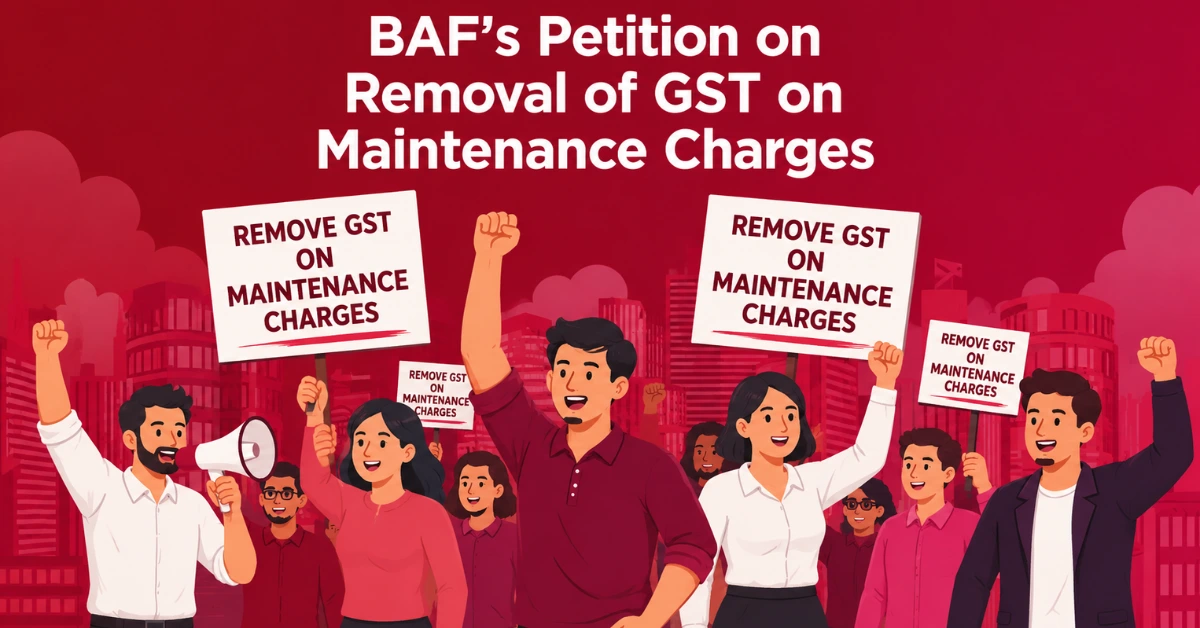


The Bangalore Apartments’ Federation (BAF), representing thousands of residents across the city, has initiated a petition calling for the removal of Goods and Services Tax (GST) on apartment maintenance charges. Apartment owners face a financial burden after the application of 18% gst on maintenance charges bangalore to monthly maintenance bills exceeding ₹7,500. Many residents believe that GST on apartments in bangalore unfairly affects middle-class families already struggling with increasing utility expenses.

Why are the Residents Opposing GST on Maintenance Charges Bangalore?
Under current GST rules, any flat where monthly maintenance charges cross ₹7,500 is subject to 18% GST. On paper, this may appear to be a modest rate, but for families in larger residential complexes, the impact is substantial. Costs for essentials like security staff, lifts, water supply, housekeeping, and regular upkeep already push charges beyond the threshold, and the added tax only inflates monthly expenses.
Residents emphasise that maintenance is a basic requirement, not a luxury. Housing societies operate on a non-profit model, with funds collected solely to maintain standard facilities. However, GST for apartment in bangalore treat these associations similar to commercial entities, which many believe to be unfair.
Key Points from the Petition to Remove GST on Apartments in Bangalore
The BAF petition highlights three primary reasons for scrapping GST on apartments in Bangalore:
Lower Monthly Costs for Households
With rising utility bills, higher cost of living, and inflation, households are already stretched. Removing GST on maintenance charges bangalore would ease monthly expenses for thousands of households.
Non-Profit Nature of Associations
Resident Welfare Associations (RWAs) and Apartment Owners’ Associations are not profit-making bodies. Their role is limited to managing shared spaces and ensuring the comfort of residents. Treating them like commercial entities for taxation purposes is unjust.
Maintenance Is a Necessity
Maintenance encompasses vital services such as water supply, sewage management, security, elevator maintenance, firefighting systems, and cleanliness. These are necessities of community living and should not be categorised as luxury spending. This is one of the central concerns driving opposition to gst on maintenance charges bangalore apartment owners face today.
Read also: Everything You Need to Know About GST on Maintenance Charges
National Attention on Bangalore Apartments Federation GST Demand
Though the initiative began in Bengaluru, the concern extends far beyond the city. With rapid urban growth, millions of Indians now reside in high-rise communities overseen by resident associations. Cities like Mumbai, Delhi-NCR, Chennai, Hyderabad, and Pune report the same strain on households. BAF maintains that scrapping GST on maintenance charges bangalore would provide meaningful relief to middle-class families nationwide, making it a national issue rather than a city-specific demand.
Rules for GST on Apartments in Bangalore
A similar provision existed under Service Tax (with a ₹5,000 threshold), which was carried forward into GST. In its present form, the rule requires flat owners contributing more than ₹7,500 per month toward maintenance charges to pay 18% GST.
Experts and resident bodies highlight several concerns:
- The ₹7,500 limit no longer matches the rising cost of basic services in housing societies.
- Unlike club memberships or spa fees, apartment maintenance is tied to safety and daily living.
- Just as education and healthcare are exempt from GST for being necessities, housing maintenance should also be treated the same way.
Read also: 18% GST on Apartment Maintenance Above ₹7,500
Impact of GST for Apartment in Bangalore on Monthly Expenses
For many families, the GST on apartments upkeep translates into thousands of extra rupees each year, adding to already steep household expenses.
- A resident of Whitefield, Bengaluru, said, “We already pay for power, water, and property tax. On top of that, paying GST on maintenance charges bangalore feels like double taxation.”
- Another resident from Electronic City said, “Our society has 800 flats. Security and infrastructure costs are high. Monthly maintenance crosses ₹8,000, and GST adds an extra ₹1,400 per flat. It is a huge burden.”
Such voices explain why the petition has quickly gathered broad support.
How Bangalore Apartments Federation GST Petition Started?
The Bangalore Apartments Federation GST has taken a leading role in raising this issue. The federation points out that:
- Apartment residents are being unfairly burdened with GST.
- The central government needs to step in and revise the current rules.
- Removing GST will ease the financial load on millions of households and give RWAs the fair recognition they deserve.
To push the demand further, BAF has also launched a nationwide petition, calling on residents across India to lend their support.
Bangalore Apartments Federation GST Petition Campaign
A petition link has been widely circulated on social media and among residents’ WhatsApp groups. There is also a QR code provided for easy access. The campaign highlights that “Your Signature = Your Voice Heard”, emphasising the power of collective action in driving policy change.
Possible Changes to GST on Apartments in Bangalore After the Petition
If the petition gains wide support, the GST Council may be compelled to revisit the current rule. Some possible measures under consideration could be:
- Full Exemption: Scrapping GST entirely on apartment maintenance, regardless of the monthly amount.
- Revised Threshold: Raising the ₹7,500 cap to ₹15,000 or higher, in line with present-day urban expenses.
- Selective Taxation: Keeping GST only for non-essential facilities such as gyms, clubhouses, or swimming pools, while exempting basic services.
Make GST Compliance Easier with NoBrokerHood
Managing maintenance collections and GST records manually can become difficult for large apartment communities, especially when monthly charges cross the taxable threshold. Errors in billing, missing records, or unclear calculations often create confusion among residents and managing committees.
NoBrokerHood understands the challenges faced by housing societies and supports the ongoing petition, as adding GST on apartments in Bangalore only increases the burden on residents. While the demand for the removal of GST continues, NoBrokerHood is committed to helping RWAs manage the compliance process more smoothly through its digital tools.
How NoBrokerHood supports GST compliance for RWAs:
- Automated GST Billing: Maintenance bills are auto-generated with GST wherever it applies, reducing the scope for mistakes.
- Digital Record-Keeping: All payments and expenses are tracked online, making it easier for RWAs to prepare GST returns.
- Transparent Accounts: Residents get complete clarity on how much of their maintenance fees go towards GST and other expenses.
- Simplified Compliance: RWAs can quickly generate financial reports for GST filing, saving both time and effort.
By using NoBrokerHood, societies can cut down the hassle of compliance and focus on community living, while the larger fight for GST relief continues.
All Solutions by NoBrokerHood:
