







GST on apartment maintenance charges directly impacts residents and housing societies. If your monthly maintenance exceeds ₹7,500 and the society’s annual turnover crosses ₹20 lakh, GST may apply. Understanding the 18% GST rate, exemptions, inclusions, and compliance rules is essential for smooth apartment management. This guide explains everything apartment owners and societies need to know.

Applicability of GST on Apartment Maintenance Charges
As per the provisions of the GST Act, a co-operative housing society should be considered as a ‘person’. The applicability of this tax law does not depend on whether the society is making a profit or loss. All types of housing societies engaged in business activities are liable to pay GST. However, GST on apartment is not applicable if the annual turnover from business activities is less than Rs. 20 lakhs.
The business activities of a cooperative housing society include:
- Receipts from investments
- Income from renting of common areas
- Share transfer fee from society members
- Income from mobile towers on the premises
- Receipts from the advertisement board
- Society maintenance charges from its members
Is GST Applicable on Apartment Maintenance Charges?
If your apartment’s monthly maintenance charges go beyond ₹7,500 or the society collects more than ₹20 lakh a year, then there’s an 18% GST on Apartment Maintenance charges.
This rule could affect over 50 lakh residents in Bengaluru alone, and nearly 40 lakh people living in other cities across Karnataka.
There’s a common misconception that GST for Apartment Maintenance is just 5%, but the actual rate is 18%.
Once a housing society registers for GST, it must file two returns every month and one annually.
To find out whether GST on Apartment Maintenance applies to your society, the association can visit the Commercial Tax Office and get it checked by paying a fee of ₹500.
Registration of Housing Societies under the GST Act
A co-operative housing society is liable to register under the GST Act once its annual turnover exceeds Rs. 20 lakhs. This requirement is stated under the provisions of Section 22. However, special category states have a limit of Rs. 10 lakhs before they are eligible to register. These states include Mizoram, Tripura, Assam, Uttarakhand, Himachal Pradesh, Nagaland, Manipur, Arunachal Pradesh, Sikkim, Meghalaya, Telangana, Jammu and Kashmir.
The new regime of GST on apartments in cooperative housing societies requires a society to register even if it has not crossed the annual turnover threshold. However, they do not need to register if they cross the limit, and each member needs to make a monthly maintenance contribution of less than Rs. 7500.
GST on Apartment Registration and New Flats
GST on new flats depends on the type of property. Affordable housing is taxed at 1%, while non-affordable housing attracts 5% GST.
GST for apartment registration applies when registering an under-construction apartment with the housing society. This tax is separate from regular maintenance charges and is generally payable before the property is handed over.
Ensuring the proper GST invoicing for housing society and the exact GST amount with the society provides clarity and avoids complications. Being aware of both GST on new flats and GST for apartment registration helps to plan the expenses efficiently.
GST on Apartment Maintenance Charges Rules and Regulations
Housing societies are responsible for collecting GST on apartment maintenance charges from residents. However, GST can be levied only after verifying specific eligibility criteria defined under GST laws.
As per the GST on Apartment Maintenance Charges Rules and Regulations, GST is applicable only when both conditions are met: the housing society’s annual turnover exceeds ₹20 lakh, and the monthly maintenance charge per apartment is more than ₹7,500. If either of these conditions is not satisfied, the maintenance charges remain exempt from GST.
GST Applicability Criteria for Apartment Maintenance Charges
While the housing society is responsible for collecting the GST on apartment maintenance charges in apartments from the respective owners, before levying the GST, the following criteria must be considered:
| Annual Turnover Limit | Monthly Maintenance Payment | Applicability of GST |
| Rs. 20 Lakh or less | More than Rs. 7500 | Exempt |
| Rs. 20 Lakh or less | Less than or equal to Rs. 7500 | Exempt |
| More than Rs. 20 Lakh | More than Rs. 7500 | Applicable |
| More than Rs. 20 Lakh | Less than or equal to Rs. 7500 | Exempt |
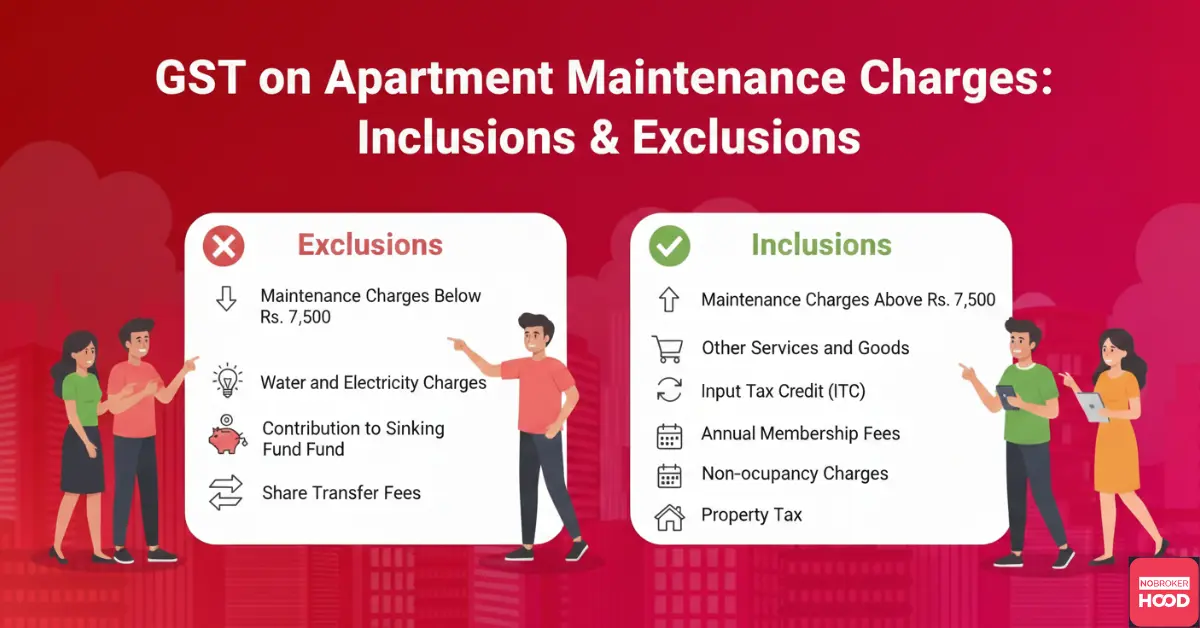
GST on Apartment Maintenance Charges: Inclusions and Exclusions
The GST law imposes specific rules for co-operative housing societies. It states what is included and excluded from its applicability. Therefore, it is important to analyse the taxation of common services supplied to society members and perform an accurate GST calculation for apartments.
Here are the inclusions and exclusions of expenses for co-operative housing societies under the GST Act:
Inclusions
1. Maintenance Charges above Rs. 7500
GST on Maintenance Charges in apartments is imposed on services like cleaning, security, maintenance, and other community amenities. When the monthly maintenance charge exceeds ₹7,500, the society becomes liable to pay 18% GST for Apartment Maintenance above ₹7,500.
2. Other Services and Goods
All other incomes derived by the housing society from services or goods are liable to GST on apartments. These services include renting common spaces and advertisement spaces, and exclude maintenance services. Furthermore, the supply of services to a person and leasing the premises for mobile towers are also subject to GST.
3. Input Tax Credit (ITC)
Cooperative housing societies are eligible to claim Input Tax Credit on goods and services. For instance, the society can include repairs, constructions, or purchases on the list for ITC services. These services are defined under the taxable income of the society.
4. Annual Membership Fees
If societies charge annual membership renewal fees and the total annual turnover crosses the amount of Rs. 20 Lakhs, then GST is attracted.
5. Property Tax
The payment of property tax attracts GST on apartments. The government does not consider a property tax payment as subject to GST.
6. Non-occupancy Charges
This charge is not considered to be a part of the property tax for common areas in housing societies. So, it is considered under GST on apartments of housing societies.
Exclusions
1. Maintenance Charges Below Rs. 7,500
If the monthly maintenance charges recovered from members are less than Rs. 7,500, then these charges are not liable under GST for apartment maintenance. Smaller societies with lower expenses can use this provision to reduce their tax burdens.
2. Water and Electricity Charges
GST excludes collection made for the provision of necessities such as water, electricity, and property taxes. Furthermore, utility providers and local authorities exempt these services.
3. Contribution to Sinking Fund
The contributions which members pay towards the sinking fund are outside GST. The society makes payments for future repairs or replacement of its property. These services are not considered taxable under GST provisions and are therefore excluded.
4. Share Transfer Fees
The sale of property in a cooperative housing society is not considered a taxable service. Hence, it is not charged under the GST on apartments.
Also Check: Supreme Court Judgement on Apartment Maintenance Charges
Statutory Compliance of Co-operative Housing Society Under GST
Co-operative housing societies need to follow certain statutory compliance under the GST scheme. Here are some of the compliance regulations of GST on housing societies:
1. Returns
A society needs to file GST returns monthly using forms GSTR-1, GSTR-2, and GSTR-3. These returns include details of sales and taxes paid on outward and inward supplies. If you fail to file returns on time, fines and penalties may be imposed.
2. Applicability of Maintenance Charges
The monthly maintenance charges should exceed Rs. 7500 for the applicability of GST on the housing society. However, if it is below this limit, then the society is exempt. Hence, it becomes mandatory to continuously monitor the collections of maintenance charges in a society.
3. Invoices
Collecting GST for apartment maintenance requires the housing society to change the invoice format of bills payable. The GSTIN number, amount of tax counted, and other details need to be mentioned in the invoice. Otherwise, it will be termed as non-compliance with GST provisions and attract fines and penalties.
4. Books of Accounts
The housing society should prepare and maintain proper books of accounts. It is mandatory for compliance with GST laws and tax audits. Once the threshold limit is exceeded, the housing society’s books of accounts will be audited.
Also Check: FAQ on GST on Housing Society
Is GST Applicable on Maintenance Charges Collected by Builders?
Yes, GST is applicable on maintenance charges collected by builders. Since builders act as service providers, especially when the RWA hasn't been formed yet, they are liable to charge 18% GST on the maintenance amount collected. Unlike Resident Welfare Associations (RWAs), builders don't automatically get the benefit of the ₹7,500-per-month exemption. Builders can also claim Input Tax Credit (ITC) on GST paid for maintenance-related expenses during the possession phase, whereas RWAs cannot claim ITC. If the builder hands over maintenance responsibilities to the RWA within 2 years, the GST collected is refunded. Residents should always check that the builder holds a valid GST registration and that the invoice clearly breaks down the maintenance amount and GST component. Once the RWA takes over, different rules apply; GST is charged only if monthly charges exceed ₹7,500 per flat and annual collections cross ₹20 lakh.
Simplify GST on Apartment Maintenance with NoBrokerHood
Calculating GST accurately, tracking the ₹7,500 threshold across residents, and generating compliant invoices every month can be a genuine headache for MC members especially when charges vary between units or exemptions apply selectively. NoBrokerHood's Society Accounting Software takes this burden off committees by automating the entire process, so residents get accurate bills and societies stay audit-ready.
- Auto-applies GST rules - automatically calculates 18% GST only when a member's maintenance crosses ₹7,500, avoiding manual errors
- GST-compliant invoicing - generates invoices with proper CGST/SGST breakup for every resident, ready for scrutiny
- Turnover tracking - helps MC members monitor the society's annual collections against the ₹20 lakh threshold
- ITC tracking support - keeps records of GST paid on vendor services (repairs, security, housekeeping) for Input Tax Credit claims
- Digital record-keeping - securely stores all GST invoices and financial reports in one place, simplifying audits and GSTR filings
- Online payment collection - residents pay maintenance digitally with GST reflected transparently on every bill
All Solutions by NoBrokerHood:
