





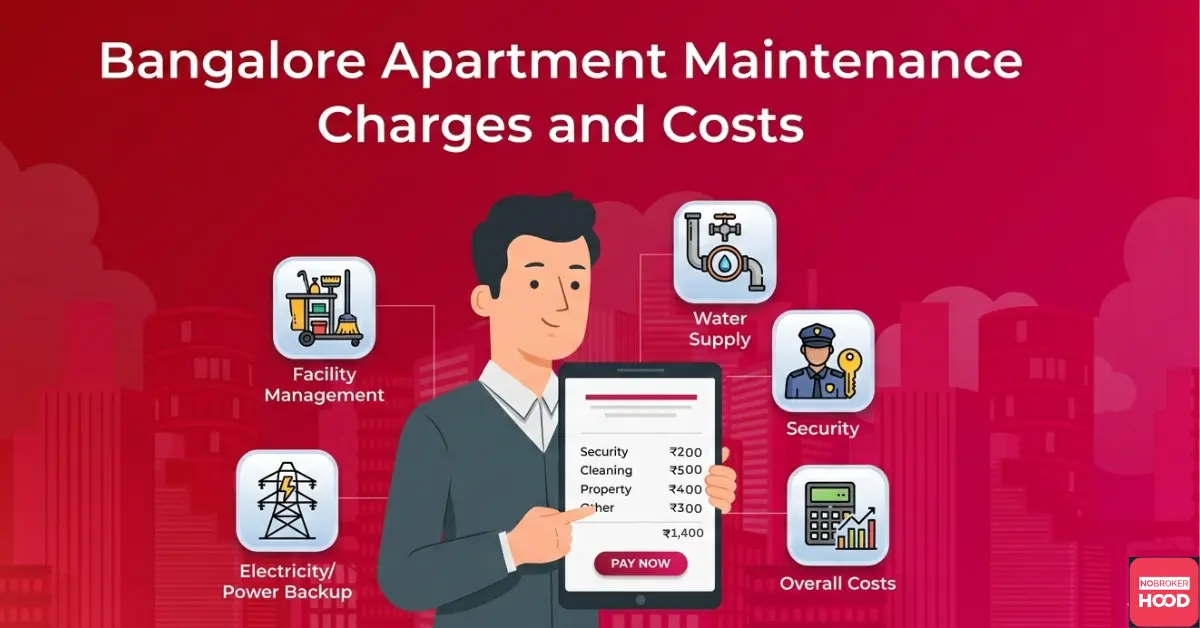


When purchasing an apartment in Bangalore, homebuyers would be interested in the purchase price, loan eligibility, and the builder’s reputation. Although these are important aspects, one thing is indispensable and is usually neglected is Bangalore apartment maintenance charges. These costs are a fee paid monthly, and they are very viable in ascertaining the real cost of living in a residential society. When most residents move in, they discover that maintenance fees are a significant cost to their monthly payments. This paper will describe apartment maintenance fees, their computation, inclusions, determinants of their increase, and general lessons to both homeowners and tenants in Bangalore.

What Are Apartment Maintenance Charges in Bangalore?
The Apartment maintenance charges are mandatory payments, whereby the builders, the property managers, or the Resident Welfare Association of an apartment complex impose such payments on the residents to maintain the common services and facilities.
These fees are imposed even when a unit remains vacant, because shared infrastructure still requires upkeep. Understanding maintenance charges for apartments in Bangalore helps buyers plan their long-term housing budget more accurately.
Key Aspects of Apartment Maintenance Charges in Bangalore:
- Maintenance charges can be gathered on a monthly, quarterly, or annual basis.
- Relevant to all residents and landlords, including those with empty flats.
- These charges are legally backed by the Karnataka Apartment Ownership Act, 1972,
- Prices are different based on the project size, facilities, developer’s reputation, and ownership year.
How Builders-Led Maintenance Works
The first years are normally the maintenance period of the Builder until they form the RWA.
- Components: The Builders -led maintenance covers components that the developer maintains.
- Shared space maintenance: cleaning of corridors, lobby, and parking spaces.
- Security and housekeeping: Uniforms, salaries, and welfare contributions to employees.
- Power reserve and water: Generators, sewer pumps, and sewage treatment.
- Facility management: Gym, clubhouse, pool, and landscaped areas.
- Minor repairs: Consumables such as lights, plumbing, and fixtures.
Advance Maintenance Charges Collected by Builders
Advance maintenance charges collected by builders are upfront payments taken at the time of possession to cover the initial cost of maintaining common areas and shared facilities. Homebuyers in Bangalore should clearly understand what these charges include and how they are used.
Key points to know:
- Collected at possession: Builders usually collect advance maintenance for 1 to 3 years when handing over the apartment.
- Purpose of the advance: The amount is used to manage day-to-day expenses such as security, housekeeping, electricity for common areas, and basic repairs.
- Not a lifetime fee: Advance maintenance is only for the initial years. Once the advance period ends, monthly maintenance is usually revised based on actual expenses.
- May not reflect real costs: Builders sometimes quote lower initial charges. After the RWA takes over, residents may see a 15–25% increase in maintenance fees.
- Breakup should be provided: Buyers should always request a detailed cost breakup to understand what services are covered.
- Separate from corpus fund: Advance maintenance is different from the corpus or sinking fund collected at possession.
- Refund policy varies: Any unused advance amount (if applicable) should be transferred to the RWA, but policies differ by project.
Read Also: How to Form Residents Welfare Association
What Do Apartment Maintenance Charges in Bangalore Cover?
Apartment maintenance charges in Bangalore are primarily driven by workforce and utilities.
| Component | % of Total Cost | What It Covers |
| Staffing (security, cleaning) | 35% – 50% | Salaries, PF, uniforms, multiple shifts |
| Utilities (EB/water/DG) | 20% – 30% | Generators, lighting, pump sets, sewage systems |
| AMC & technical maintenance | 10% – 15% | Lifts, CCTV, RO plants, STP systems |
| Waste management | 5% – 10% | Garbage collection, composting units |
| Facility management fee | 5% – 10% | Agency or administration charges |
| Repairs & consumables | 5% – 8% | Plumbing, lighting, and cleaning materials |
Workforce costs and electricity are the largest expenditure categories, often affected by inflation and rising urban demands.
How Are Apartment Maintenance Charges in Bangalore Calculated?
| Calculation Method | Description | When Used / Notes |
| Per Square Foot Basis | Charges based on the size of the flat (e.g., ₹3 per sq ft). | Used when flat sizes vary significantly |
| Equal Fee | Same fixed amount for all flats, regardless of size. | Suitable for societies with uniform flat sizes |
| Hybrid Model | Combination of equal fee and per sq ft methods; fixed costs shared equally, variable by size | Balances fairness and simplicity for mixed-size flats |
Most maintenance charges in Bangalore apartments follow the per-square-foot model, as it is considered more equitable for varying unit sizes.
Also Check: Apartment Maintenance Charges Calculation
Apartment Maintenance Charges Rules and Regulations in Bangalore
Understanding the apartment maintenance charges rules and regulations is important for every homeowner.
- Apartment maintenance charges in Bangalore are governed mainly by the Karnataka Apartment Ownership Act 1972 (KAOA) and the Societies Registration Act.
- Maintenance fees must be approved by the Apartment Owners’ Association or RWA through a General Body Meeting.
- Charges are usually calculated on a per square foot, equal share, or hybrid basis.
- The builder typically collects maintenance before handover, after which the RWA takes control.
- Associations must maintain transparent accounts and audited financial records
- Late payment penalties may apply, but essential services to a flat cannot be disconnected without due process.
- Contributions to the corpus fund or sinking fund must be separately approved and properly utilised.
- Apartment owners have the right to review accounts, question increases, and participate in decisions.
Understanding Maintenance, Corpus, and Sinking Fund
Residents often confuse monthly maintenance with other funds. Here’s the difference:
| Fund Type | When Collected | Usage | Management |
| Maintenance | Monthly/Quarterly | Day-to-day cleaning, security, utilities, and minor repairs | Builder initially, later RWA |
| Corpus Fund | One-time at possession | Interest used for operations, principal for emergencies or major repairs | Collected by the builder |
| Sinking Fund | Periodically | Large expenses like painting, waterproofing, and structural repairs | Managed by RWA |
Always check whether corpus and sinking fund contributions are included in your total charges before possession.
Read More on: What is Sinking Fund in a Society
Factors that Influence Maintenance Charges in Bangalore Apartments
Our analysis of over 30 residential projects in Bangalore highlights two key factors: possession year and developer grade.
1. Possession Year
The newer projects are prone to charge more because of better amenities, inflation, and infrastructure.
| Possession Year Range | Avg. Maintenance (₹/sqft) | Monthly Charge (2000 sq. ft. Apartment) |
| 2023–2025 | ₹4.31 | ₹8,620 |
| 2026–2027 | ₹4.50 | ₹9,000 |
| 2028–2032 | ₹5.88 | ₹11,760 |
This reflects a 36% increase over a few years. For a 2000 sq. ft. apartment, that’s nearly ₹37,700 more per year if possession is in 2028 instead of 2023.
2. Developer Grade
Grade A developers usually charge higher fees but provide better planning and continuity.
Grade Avg. Maintenance (₹/sqft)
A ₹5.72
B ₹4.23
C ₹4.08
Comparison in Percentage Increase:
- C → B: 3.68%
- B → A: 35.23%
- C → A: 40.20%
While Grade A charges are higher, they are often more predictable than Grade B or C projects, where inefficiencies later drive costs upward.
Also Check: GST on Apartment Maintenance Charges
What Happens After the Advance Period Ends?
After the first 1–3 years of advance maintenance:
- Costs typically rise by 15–25%.
- RWAs or third-party facility agencies take over management.
- Hidden expenses such as AMC renewals, increased utility bills, and staff replacements emerge.
This is when residents often realise the gap between initial advertised costs and the real long-term expenses of community living.
Formation of RWA in Bangalore
A Resident Welfare Association (RWA) is usually formed once 50% or more units are occupied.
Legal Framework
- Governed by the RERA Act and the Karnataka Apartment Ownership Act (KAOA).
- The developer must initiate RWA within three months of handing over 50% units.
- Residents then register an association using the Societies Registration Act or KAOA.
After it is established, the RWA balances budgets, negotiates with suppliers, and monitors equitable use of resources.
Key Takeaways for Bangalore Homebuyers and Tenants
Before finalising an apartment in Bangalore, consider these points:
- Request disaggregated maintenance charges.
- Don’t assume charges will remain constant after possession.
- Compare fees with similar projects nearby.
- Expect a 15–25% rise within a few years.
- Attend association meetings to understand how funds are allocated.
- Keep records of payments for accountability.
Challenges in Managing Apartment Maintenance Charges in Bangalore
Despite such an organisation, residents usually struggle to take care of community maintenance.
Common Issues Faced
- Delayed payments: Non-payment or delayed payment by a few residents impacts overall budgeting.
- Rising utility costs: Fluctuating electricity and water rates directly influence apartment maintenance charges in Bangalore, increasing monthly living expenses.
- Vendor inefficiency: The cost is increased with poor quality of outsourced housekeeping, security, or AMC vendors.
- Disputes within RWA: Differences in budgeting and fund allocation create conflicts.
These problems can be minimized with the help of transparent communication, timely audits, and digital payment systems.
How to Reduce Bangalore Apartment Maintenance Charges
Residents can proactively lower Bangalore apartment maintenance charges without compromising service quality.
Effective Strategies
- Energy-efficient systems: Install LED lights and solar panels to lower electricity costs.
- Water conservation: Use rainwater harvesting and efficient STPs to reduce water expenses.
- Smart vendor management: Negotiate long-term contracts with reputed facility agencies.
- Resident participation: Involve the community in audits and decision-making.
Small sustainable initiatives can reduce long-term costs while improving the quality of community living.
How NoBrokerHood Simplifies Apartment Maintenance Charges
Managing apartment maintenance charges manually often leads to calculation errors, delayed collections, and poor transparency. With advanced society management software, apartment communities can automate billing, track payments, and manage accounts efficiently. NoBrokerHood helps streamline the entire process for RWAs and residents.
| Feature | How It Works | Benefit for Society |
| Automated Maintenance Billing | Monthly invoices are generated automatically based on set formulas | Eliminates manual errors and saves time |
| Online Payment Collection | Residents can pay through UPI, cards, or net banking | Faster collections and improved cash flow |
| Real-Time Due Tracking | Dashboard shows paid and pending dues instantly | Better financial visibility |
| Auto Payment Reminders | System sends alerts for upcoming or overdue payments | Increases on-time payments |
| Expense & Vendor Management | Records utility bills, vendor payments, and service costs | Complete transparency in spending |
| Digital Accounting Reports | Generates income, expense, and audit-ready reports | Simplifies co operative society accounting |
| Integrated Visitor & Security Records | Syncs billing with entry logs and approvals | Improves operational coordination |
| Secure Cloud Storage | Stores financial data safely in one platform | Easy access and reduced paperwork |
All Solutions by NoBrokerHood:
Conclusion
Bangalore apartment maintenance charges are not just monthly fees; they ensure safety, functionality, and smooth community living. Costs vary based on the builder, property age, and amenities. By understanding the apartment maintenance charges rules and regulations, homeowners and tenants can plan their finances more confidently and avoid unexpected increases.
