EV Charging Housing Society Rules
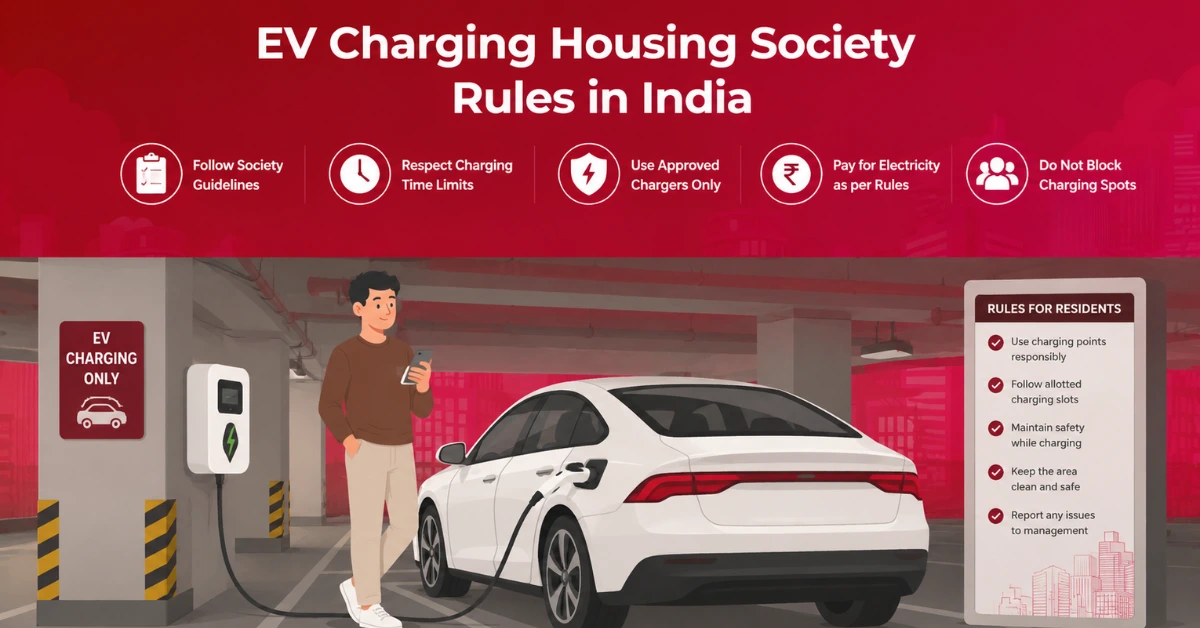
Most of the residents in India are clueless about installing EV chargers in their parking slots. Some housing societies delay approvals, while others deny permission on grounds of safety concerns, electricity load issues or lack of clear policies. The government guidance and court observations are increasingly supportive of residents wanting to install EV chargers responsibly. This guide specifies the EV charging housing society rules, approvals, safety standards, legal rights, cost responsibilities, etc. and actionable steps that residents and RWAs can take to avoid conflicts and build EV-ready communities.
Why EV Charging Rules Matter in Housing Societies?
Electric vehicle ownership is increasing, particularly in Indian metro cities where apartment living is normal. But many housing societies lack clear policies, even though residents want the convenience of charging their vehicles at home. This is where EV charging housing society rules come to the fore.
Without proper guidelines, societies may face:
- Disputes over electricity costs
- Transformer overload concerns
- Fire safety risks
- Improper wiring in parking areas
- Confusion about permissions and approvals
Some government departments, including the Ministry of Housing & Urban Affairs and the Ministry of Power have advised residential communities to be EV-ready. Several state EV policies also support charging infrastructure in apartment buildings. Most rules follow one simple principle: societies should allow EV charging if installations are safe, compliant, and financially managed by the EV owner.
Read also: EV Charging Regulations for Housing Societies in India
Can Housing Societies Legally Stop Residents from Installing EV Chargers?
In most cases, housing societies cannot impose blanket bans on EV chargers. Under evolving EV charging housing society rules, RWAs and apartment associations are expected to facilitate safe installations instead of rejecting requests without valid technical reasons.
A society can still review applications for:
- Electrical safety
- Load capacity
- Cable routing
- Fire protection
- Common area impact
However, denying permission simply because “there is no EV policy” may not hold legal strength anymore.
The Ministry of Housing & Urban Affairs has advised that new residential projects should make at least 20% of parking spaces EV-ready. Existing buildings are also encouraged to develop structured EV charging policies.
Residents usually have the right to:
- Install a charger in their designated parking space
- Use their domestic electricity meter for charging
- Request a separate sub-meter
- Receive fair approval consideration from the RWA
At the same time, residents must also follow all safety and compliance requirements. EV charging housing society rules are designed to balance individual convenience with community safety.
EV Infrastructure in Apartments: Who Pays and Who Approves?
One of the biggest concerns in apartments is cost responsibility. In most cases, the resident installing the charger bears all related expenses.
This usually includes:
- Charger purchase cost
- Wiring and cabling
- Sub-meter installation
- Electric panel upgrades
- Maintenance costs
- Monthly electricity usage
The society may only contribute financially if it is building common EV charging infrastructure for all residents.
Approval Process in Most Housing Societies
Residents generally need to submit:
- Charger specifications
- BIS certification details
- Parking location details
- Wiring route diagram
- Power load requirement
- Electrician or vendor information
The RWA or managing committee may review whether the building transformer can handle additional load. If the sanctioned electrical load requires upgrading, the expense is usually shared among EV users or borne by the requesting resident. Under EV charging housing society rules, societies are expected to process requests reasonably and not delay approvals unnecessarily.
Read also: EV Charging Business Opportunity for Housing Societies
EV Charger Installation in Basements: Rules and Risks Explained
Basement parking is common in Indian apartments, which makes basement EV charging an important topic. Safety becomes critical because enclosed parking areas can create higher fire risks if installations are poorly managed.
Important Safety Rules
- Chargers should be installed by licensed electricians only
- Proper earthing and MCB protection are necessary
- Cables should not cross walking or driving paths
- Charging points should remain away from combustible materials
- Outdoor installations should have suitable IP-rated protection
- Equipment must be child-safe and weather-protected
Several fire departments and DISCOMs also recommend maintaining safe distances from transformers and hazardous electrical installations.
Common Basement Risks
Poorly planned charging setups can lead to:
- Cable overheating
- Water exposure
- Tripping hazards
- Overloaded circuits
- Fire spread risks
This is why EV charging housing society rules often require technical inspection before approval.
Residents should avoid temporary extensions or loose cabling. A professionally installed charging setup protects both the EV owner and the entire community.
Read also: EV Charging Station Problems in Housing Societies
What Are Your Rights If a Society Refuses EV Charging Permission?
Residents often feel helpless when their EV charging request is rejected. But apartment owners do have certain protections under current policy directions and evolving legal interpretations.
If your society rejects permission without proper technical reasoning, you can:
- Ask for written clarification
- Request a formal committee review
- Share applicable government EV guidelines
- Seek support from the local DISCOM
- Escalate through cooperative housing authorities if required
Many state EV policies encourage RWAs to issue approvals within a reasonable timeframe after receiving complete documentation. Under EV charging housing society rules, societies are expected to focus on safety compliance instead of arbitrary restrictions.
Residents should also maintain cooperative communication. In many cases, disagreements happen because societies lack technical understanding or fear future liability. A transparent proposal with safety documents often helps resolve concerns faster.
Legal Solutions When Your Society Rejects EV Charging Requests
If discussions with the society fail, residents can consider formal legal or administrative remedies.
Practical Solutions Residents Can Explore
1. Submit a Detailed Written Application
Always keep written records of your requests, technical drawings, and safety certifications.
2. Refer to Government Guidelines
Mention the Ministry of Power and state EV policy recommendations supporting residential charging infrastructure.
3. Request a Technical Inspection
Independent electrical inspections can help address safety concerns objectively.
4. Approach Cooperative Authorities
In cooperative housing disputes, registrar offices or housing authorities may help mediate.
5. Seek Legal Advice if Needed
If a society imposes arbitrary bans despite compliance, residents may seek legal remedies through consumer or cooperative forums.
The goal should always be a practical resolution rather than conflict. Most societies become cooperative once technical and financial responsibilities are clearly defined.
Bombay High Court on EV Charging Rights in Housing Societies
Recent legal discussions and court observations in India have increasingly supported the idea that residents should not face unreasonable barriers when installing EV chargers.
The general legal direction has been clear:
- Sustainable transport should be encouraged
- Housing societies should create practical EV policies
- Safety concerns should be managed through compliance, not bans
- Residents cannot be denied permission arbitrarily
While each dispute is on its own facts, these developments are defining the application of EV charging housing society rules across India. This transition is also forcing many RWAs to develop EV charging infrastructure proactively rather than on a case-by-case basis.
Steps Residents Should Take Before Installing a Charger
Following a structured process reduces delays and avoids conflict with the housing society.
Step 1: Identify Your Charging Requirement
Choose a charger suitable for your vehicle and daily usage. Slow chargers are often sufficient for overnight apartment charging.
Step 2: Check Parking Ownership or Allocation
Most societies permit charging only in designated or legally allotted parking spaces.
Step 3: Consult a Licensed Electrician
The electrician should evaluate:
- Existing electrical load
- Cable routing
- Safety protection
- Earthing requirements
Step 4: Submit a Formal Request to the Society
Include:
- Charger model details
- Electrical load requirement
- Installation layout
- Vendor details
- Safety certifications
Step 5: Decide the Billing Method
Residents can usually choose between:
- Existing apartment electricity meter
- Dedicated EV sub-meter
Sub-metering is often preferred because it creates transparent billing records.
Step 6: Sign an NOC or MoU
Many societies require a formal agreement confirming that the resident will handle:
- Installation expenses
- Maintenance
- Electricity bills
- Future repairs
Following these steps helps both residents and RWAs comply with EV charging housing society rules smoothly.
How NoBrokerHood Supports EV-Ready Housing Societies?
In many apartment communities, EV charging discussions become difficult because approvals, resident requests, and committee communication are handled informally. This often leads to delays, confusion, and misunderstandings around safety requirements or installation timelines.
NoBrokerHood is a society management app that helps to simplify this through its community communication and request management system. Residents can submit installation-related requests digitally, while managing committees can share EV charging guidelines, approval requirements, and safety instructions with all residents in a more organised manner.
How this improves EV charging coordination in societies:
- Residents can raise documented installation requests
- Committees can share clear EV charging policies and updates
- Communication around approvals becomes more transparent and traceable
- Societies can reduce confusion around safety compliance and timelines
This structured communication process helps apartment communities manage EV adoption more smoothly while reducing unnecessary conflicts between residents and RWAs.
All Solutions by NoBrokerHood:
FAQs
Most housing societies do ask for NOC or written approval before installing. Society checks for safety, wiring, load capacity, parking allocation and gives permission.
If a resident is following safety and compliance requirements, apartment associations usually can’t impose arbitrary blanket bans. But they can regulate installation standards and electrical safety practices.
Societies may charge reasonable costs of administration or infrastructure, according to society rules. The EV owner pays the electricity consumption and installation costs separately.
RWAs can regulate how chargers are installed and used, but are expected to allow compliant charging setups. Limitations should be limited to safety, load management and protection of common areas.
Yes, many DISCOMs have permitted residents to use their existing domestic electricity connection for EV charging. Other residents choose separate submeters for easier billing and tracking.
Yes, generally charging in the basement is permitted if proper safety standards are followed. Where necessary, the installations should have fire protection, proper cable routing, earthing and weather-resistant equipment.