





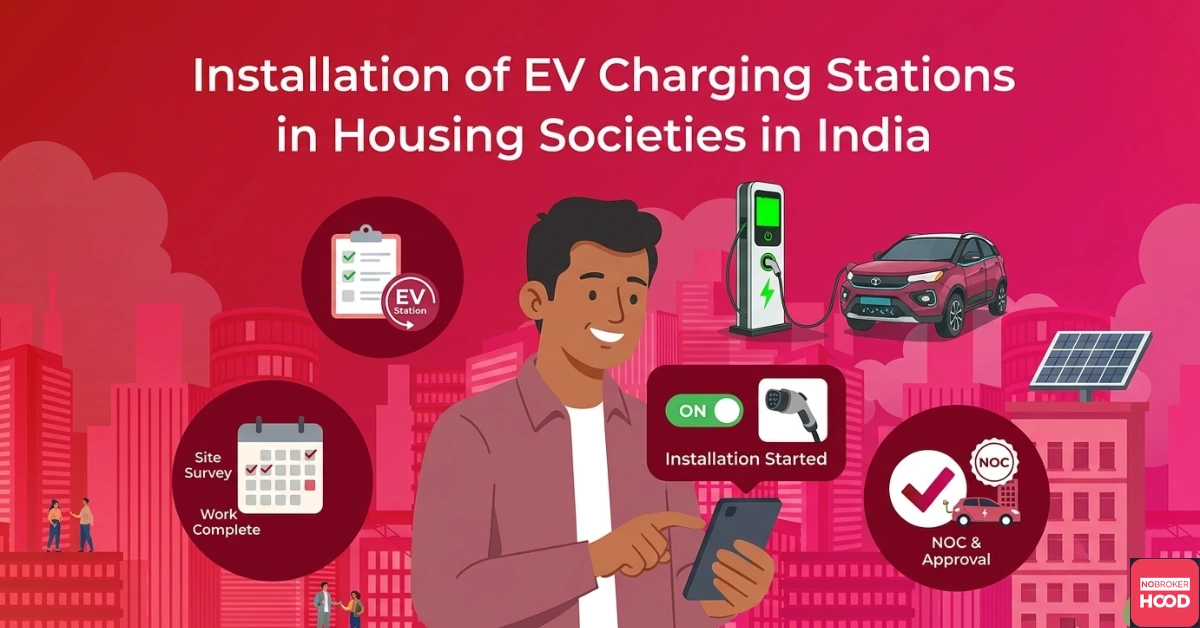


Maharashtra’s new EV Charging Regulation requires housing societies to provide EV charging provisions at the time of issuing occupancy certificates, supporting India’s electric mobility mission. With electric vehicles in India expected to reach around 2 million by 2026, understanding EV Charging Station Guidelines is becoming essential for residents and society managers. Currently, only 3.2% of housing societies have EV charging, though nearly 24% plan installations soon. Since about 80% of EV owners prefer home charging, the Ministry of Housing and Urban Affairs recommends allocating 20% of parking spaces for EV charging. Staying updated will help societies prepare for future infrastructure needs effectively.

EV Charging Station Requirements in India: A Primer
Understanding the EV Charging Station Requirements in India is essential for housing societies planning compliant installations. The following table summarizes key regulatory developments, government roles, and legal clarity shaping EV charging in residential complexes.
| Aspect | Details |
| Regulatory Changes | EV Charging Regulations have changed significantly in recent years across India. |
| Government Role | Central and state governments are actively introducing new EV Charging Station Guidelines to ensure safety and promote EV adoption. |
| Key Legal Case | Bombay High Court ruling directed the Maharashtra government to establish clear EV Charging Regulations for housing societies. |
| Case Background | A resident from Malabar Hill was denied permission by his society to install an EV charger in his private garage. |
| Legal Outcome | The court emphasized the need for unambiguous EV Charging Station Requirements in cooperative housing societies. |
| Impact of Ruling | The decision reinforced residents’ rights to install EV chargers and pushed for regulatory clarity in residential society governance. |
Ministry of Power EV Charging Guidelines and Maharashtra EV Policy Highlights
India’s EV ecosystem is being strengthened through clear national building regulations and state-level policies. These guidelines focus on safe installation, infrastructure readiness, and making EV charging more accessible in residential and public spaces.
Highlights from Maharashtra’s EV Policy
- New housing projects must include EV Charging Station Requirements in their blueprints to obtain occupancy certificates.
- Funding support is available from MP/MLA funds for retrofitting existing societies with EV charging equipment.
- Chargers will be placed at 25 kilometres along primary highway corridors.
National-Level Standards Include: The Ministry of Housing and Urban Affairs has produced a revised Model Building Bye-Laws (MBBL) 2016, which places requirements on EV Charger Installation Regulations in residential buildings.
- Each building is required to have a minimum of 20% of parking allocated to EV chargers
- Must demonstrate an adequate load with a safety factor of 1.25% factor.
- At a minimum, there must be one slow charger provided for every three EVs in a residential complex.
Ministry of Power Guidelines
- Allow residents to establish private EV charger services within their existing parking spaces.
- Permits allow only electricity flow through the existing meter which may or may not allow the Infrastructure load through a similar dedicated sub-meter.
- All states have been requested to advise/notify appropriate RWAs about the updated EV Charging Regulations.
The Central Electricity Authority requests that all installations conform to the guidelines for EV charging stations to minimise electrical hazards. In addition, the GST on EVs and chargers has steadily declined to 5%, with an improvement to affordability.
Rules for EV Charging Stations in Housing Societies and Key Requirements
Housing societies must meet specific EV Charging Station Requirements to create safe, scalable, and regulation-compliant infrastructure. Managers and RWAs must understand these rules for EV charging stations in housing society and adhere to the technical standards they define.
EV Charging Station Requirements for Infrastructure
Thinking of launching EV charging in your society? These are the EV Charging Station Guidelines you need to follow:
- 20% of parking slots must be set aside for EV charging, a non-negotiable under modern EV charging housing society rules.
- Electrical infrastructure must support:
- Peak loads of simultaneous charging (with a 1.25x safety factor).
- Overcurrent protection and Residual Current Devices (RCDs).
- Final sub-circuits that are adequately insulated.
Safety Requirements Under EV Charging Station Guidelines
- The charging points must be installed at 800mm above the flood level.
- Child-proofed designs, positioned away from play areas.
- Protection from water ingress and foreign objects.
- Within 5 meters of designated parking spaces.
Charging Station Requirements for Fire and Spatial Safety
- Charging points must be 10 meters from combustible items
- 15 meters from high-risk zones (transformers, fuel stores).
Smart placement tips:
- Close to existing power sources to cut installation costs
- In areas available to residents and visitors
- With enough space for vehicles to move safely
DC fast chargers, which operate on direct current, must be installed away from standard AC chargers due to higher fire and electrical risks, per EV charging housing society rules.
Also Check: EV Charging Station in Apartment
Electric Charging Points in Residential Buildings
Electric charging points in residential buildings are becoming essential as more residents adopt electric vehicles. Properly planned charging infrastructure ensures safe, convenient, and scalable EV charging within housing societies and apartment complexes. Residential developers and RWAs are increasingly integrating EV-ready provisions to comply with evolving regulations and meet future mobility needs. Installing well-designed charging points not only supports sustainability goals but also enhances the long-term value of the property.
Electric Vehicle Charging Points Building Regulations
Electric vehicle charging points building regulations ensure that EV chargers in residential buildings meet required electrical and safety standards. Housing societies must follow these rules to minimise risks and maintain compliance.
Key regulatory focus areas:
- Proper load assessment before installation
- Certified charging equipment
- Safe mounting height above flood level
- Protection from water and dust
- Adequate distance from high-risk zones
Benefits of Installing Electric Charging Points
Implementing electric charging points in residential buildings offers multiple advantages for both residents and society management.
Key benefits:
- Greater convenience for EV owners
- Increased property value
- Reduced reliance on public chargers
- Support for sustainability goals
- Future-ready infrastructure
Best Practices for Electric Charging Point Installation
Societies should follow best practices to ensure safe and efficient operation.
Recommended practices:
- Conduct an electrical load study
- Allocate EV-ready parking
- Install proper earthing and RCD protection
- Use BIS-certified chargers
- Plan for future expansion
Read also: EV Charging Business Opportunity for Housing Society
EV Charger Installation in Society: Step-by-Step Process
To adhere to EV Charger Installation Regulations for safety, regulation compliance and regulation cooperation, which improves the chances that the project goes off without a hitch to make it as easy as possible for everyone! Societies thinking about the installation of utility charging infrastructure should undertake a process as follows.
First, let’s look at the correct way to install an EV Charging Dock as per the new EV Charging Station Guidelines.
Communicate with your Residents
- Identify current and future owners of EVs.
- Assess interest in slow versus fast charging.
- Collect preferences that affect charger type and volume.
Assess the Electrical Infrastructure
- Calculate new load requirements based on EV Charging Station Requirements.
- Check if the spare load suffices or a new connection is needed.
- Evaluate cable length, connection points, and upgrade needs.
Society NOC for EV charging Installation
- If all safety requirements have been approved by the Chief Electrical Inspector, the Maharashtra societies must provide a NOC within 7 days.
- The Indian courts have continuously reiterated that these approvals must be expedited as part of a broader suite of EV Charging Regulations.
Select Charging Equipment
- Level 1 (₹4,000–₹40,000)
- Level 2 (₹40,000–₹1,50,000)
- DC fast chargers (₹2,50,000–₹15,00,000)
EV Charging Installation Regulations: Execution
- Obtain quotes from licensed, state-approved electrical contractors.
- Conduct a full load analysis.
- Install wiring and breakers, and install conduit according to code.
- Install the charging equipment and test it.
The total installation costs vary between ₹67,420 and ₹1,68,677 depending on the distance of wiring, method of installation, and distance from the existing power circuit on the main panel. The estimates above conform to the current EV Charging Station Requirements.
Also Check: EV Charging Station Problems in Housing Societies
EV Charging Station in a Housing Society
Setting up an EV charging station in a housing society has become a practical necessity rather than a luxury. Since most EV owners prefer overnight home charging, residential complexes play a crucial role in the overall charging ecosystem.
Housing societies usually install AC chargers in designated parking areas after a proper electrical and safety assessment. A well-planned installation ensures convenience for residents while maintaining compliance with applicable regulations.
Typical Installation Considerations
| Factor | What Societies Should Check |
| Electrical Load | Whether existing capacity supports EV charging |
| Parking Allocation | Dedicated EV-ready parking bays |
| Safety Compliance | RCD protection, proper earthing |
| Approvals | NOC and DISCOM requirements |
| Future Scalability | Provision for additional chargers |
Simplify EV Charging Station in Housing Societies with NoBrokerHood
Keeping up with EV charging stations in housing societies from parking allocation and load checks to NOC approvals and billing can get overwhelming for MC members, while residents often struggle to track the status of their charger requests. NoBrokerHood's society management app removes this friction by digitizing the entire process, so societies stay compliant and residents get faster approvals.
- Raise & track requests online - Residents can submit EV charger installation requests digitally instead of chasing the MC office.
- Faster NOC approvals - Automated workflows help committees process approvals within regulatory timelines (like Maharashtra's 7-day mandate).
- Verified vendor network - Connect with trusted, BIS-compliant electrical contractors for safe installation.
- Transparent billing - Sub-metered usage tracking ensures fair, dispute-free cost allocation among EV owners.
- Compliance made easy - Stay aligned with evolving EV charging station in housing societies without manual tracking.
- Built for scale - Plan and manage additional charging points as EV adoption in your society grows.
All Solutions by NoBrokerHood:
