Best Homeowners Association Management Software for Indian Housing Societies
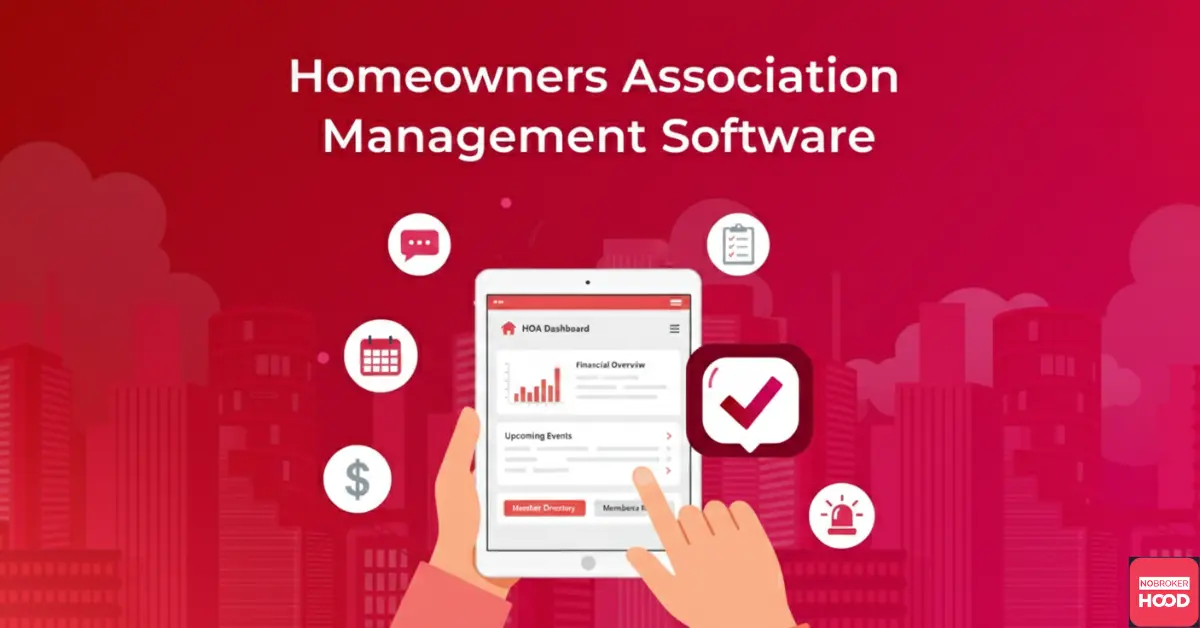
Homeowners association management software is a digital platform that helps housing societies manage billing, maintenance, communication, complaints, and compliance in one place. It replaces manual registers and spreadsheets with transparent, trackable workflows. For Indian RWAs and apartment associations, it brings structure and accountability to daily operations.
What is Homeowners Association Management Software?
Homeowners association management software is a digital system used by RWAs and apartment associations to run daily society operations. It centralises billing, accounting, complaint tracking, asset records, and resident communication.
Instead of handling everything through paper files and chat groups, committees use home owners association management software to keep records organised and visible to the right members.
In Indian apartment complexes and gated communities, this software usually handles:
- Maintenance billing and receipts
- Resident database and flat records
- Complaint and tracking
- Visitor and gate entry logs
- Meeting notices and voting
- Facility booking
- Document storage for bylaws and audits
Good homeowners association management software helps committees work in a structured and transparent way, even when volunteers change.
Why Indian Housing Societies Need HOA Management Software Today?
Many Indian societies still depend on manual registers and spreadsheets. This often leads to delayed collections, missing records, and confusion during audits. As communities grow larger, manual systems stop working well.
HOA management software helps solve common society problems:
- Missed or delayed maintenance payments
- No clear complaint tracking
- Vendor payments without an approval trail
- AGM notices not reaching all members
- Audit data scattered across files
- Difficulty tracking defaulters
- Lack of transparency in fund usage
When data is logged inside hoa software, every action leaves a digital record. Committee members can see what is pending and what is completed, so they can answer resident questions with proof, not guesswork. Residents also feel more confident when processes are visible. This is especially useful in Indian metro cities where large apartment complexes may have hundreds of flats.
Read also: What Repairs Are HOA Responsible For?
Core Features to Expect in HOA Software
Not all hoa software tools are equal. Some focus only on accounting, while others cover full community operations. A complete system should support governance, finance, and resident engagement.
Key functional areas:
- Billing and collections
- Accounting and audit reports
- Complaint and helpdesk module
- Facility and amenity booking
- Communication tools
- Compliance document storage
Feature checklist table
| Feature Area | What It Should Do | Why It Matters |
| Billing engine | Auto-generate maintenance invoices | Reduces manual errors |
| Payment tracking | Show paid and pending dues | Improves collection rate |
| Helpdesk | Ticket-based complaint system | Ensures closure tracking |
| Communication | Notices, alerts, circulars | Keeps residents informed |
| Vendor module | Work orders and approvals | Controls expenses |
| Document vault | Store bylaws, audit, AGM minutes | Supports compliance |
The best HOA management software usually combines finance, communication, and compliance tools instead of offering only one module.
How HOA Billing Software Simplifies Collections?
Maintenance collection is one of the biggest pain points for any association. HOA billing software automates this process and reduces follow-up effort.
With Hoa Billing Software, committees can:
- Create flat-wise maintenance bills
- Add sinking fund and corpus charges
- Apply late fees automatically
- Send digital invoices to residents
- Collect online payments
- Track part payments and arrears
- Auto update ledgers
- Generate a receipt instantly
When billing is automated through homeowners association management software, payment data directly connects with accounting reports. This helps during audits and budget planning. It also creates fairness. Every resident is billed using the same formula and timeline.
Read also: HOA Reserve Fund Accounting Guide for Indian Societies
How Committees and Residents Use the Software Daily?
Home owners association management software is not only for the managing committee. Residents also use it for daily needs.
Residents typically use it to:
- Pay society maintenance charges
- Raise complaints
- Book amenities
- View notices
- Download receipts
Committee members use it to:
- Approve expenses
- Reply to complaints
- Review financial reports
- Send announcements
- Track rule violations
Practical tip: Start with the billing and complaint modules first. Once residents are comfortable, enable voting and document sections.
How to Choose the Best HOA Management Software
Choosing the best HOA management software should be based on the housing society’s needs, not just price.
Evaluation checklist for Indian societies:
- Does it support Indian billing formats and charges?
- Can it handle apartment-wise maintenance logic?
- Does it include hoa billing software features?
- Are audit and financial reports easy to export?
- Does it provide onboarding support?
- Is complaint tracking structured?
- Does it support mobile access for residents?
- Does it offer role-based access for committee members?
- Is resident data kept securely?
- Does it support document and bylaw storage?
Also, check how easy it is for elderly residents to use. Good home owners association management software should be simple, not confusing. The best HOA management software is one that residents actually use regularly, not one that only stores data.
Common Mistakes Societies Make Without Using HOA Software
Societies that avoid HOA software often face repeated operational issues.
Common mistakes include:
- Using multiple spreadsheets for accounts
- No ticket system for complaints
- Verbal vendor approvals
- No central resident database
- AGM and audit documents are scattered
- Manual receipt writing
- No KPI tracking
Without the HOA management software, new committee members struggle to understand past records. Digital continuity matters for long-term governance.
Read also: Housing Society AGM Meeting Rules
How NoBrokerHood Supports Homeowners Association Management
For Indian RWAs and apartment associations looking for practical homeowners association management software, NoBrokerHood offers modules that directly address day-to-day operational gaps, especially billing, compliance, communication, and security-linked records. Below is a focused view of HOA-relevant problems and how the platform helps simplify them.
| Society Problem | How NoBrokerHood Simplifies It |
| Manual maintenance, billing and errors | Automated flat-wise billing with recurring invoices and auto dues calculation |
| Poor maintenance, collection, and tracking | Live dashboards for paid, pending, and overdue amounts |
| No proper complaint system | Ticket-based complaint tracking with status and closure records |
| Notices are not reaching all residents | Centralised in-app notices and announcements |
| Audit and bylaw documents are scattered | Secure document vault for AGM, audit, and compliance files |
| No vendor approval trail | Work order and vendor approval workflow with expense tracking |
| No central resident and flat database | Structured resident directory with flat records, contact details, and occupancy status |
| Poor transparency in fund usage | Financial reports and account summaries are accessible to authorised committee members |
All Solutions by NoBrokerHood:
FAQs
Yes. Even small societies benefit from structured billing, complaint tracking, and document storage. It reduces dependency on one committee member and keeps records consistent year after year.
HOA software covers full society operations. HOA billing software focuses mainly on invoicing, dues tracking, and receipts. Many modern platforms include billing as one module inside a larger system.
Yes. Indian RWAs handle audits, AGMs, and maintenance collections. Digital systems help meet compliance timelines and keep financial records organised for verification.
Most platforms provide resident login access. Residents can pay dues, raise complaints, book facilities, and download notices without visiting the association office.
Key indicators include collection rate, complaint closure time, audit completion, AGM timelines, and vendor approval tracking. These show whether governance is active and compliant.