Illegal Parking in Apartment Complex: Laws, Rules & Fixes
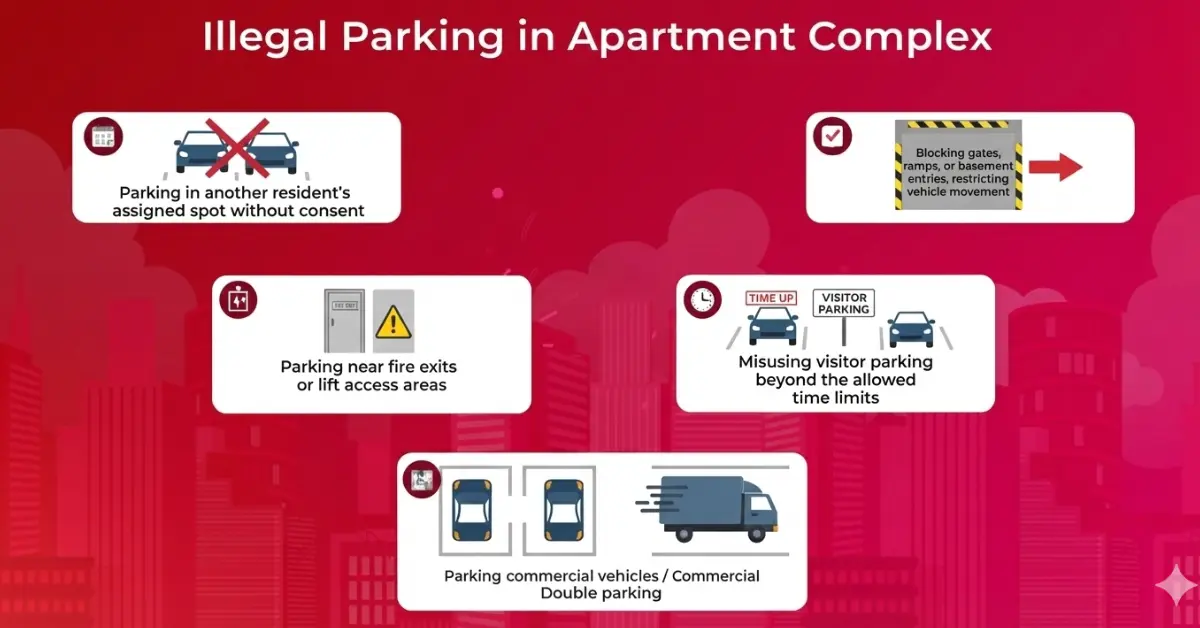
Parking a vehicle in another resident’s allotted space, blocking entry or exit points, or misusing common areas violates society’s bylaws or Indian laws. All such practices come under illegal parking in an apartment complex and call for immediate attention. In India, such issues are mainly handled by the Resident Welfare Association, and in serious cases, by the police under IPC Sections 339 or 290. Clear rules, proper documentation, and calm escalation usually resolve most cases.
What Is Illegal Parking in an Apartment Complex?
Illegal parking in an apartment complex refers to any parking activity that violates society bylaws, approved building plans, or Indian laws. This includes parking in someone else’s allotted slot, blocking entry or exit points, or misusing common areas meant for movement and safety.
In India, parking inside residential societies is not just a convenience issue. It affects emergency access, daily mobility, and peaceful coexistence among residents. That is why RWAs and managing committees are legally empowered to regulate parking within their premises.
Common Illegal Parking Scenarios in Indian Apartments
The following situations are the most reported forms of illegal parking in apartment complex environments:
- Parking in another resident’s assigned spot without consent
- Blocking gates, ramps, or basement entries, restricting vehicle movement
- Parking near fire exits or lift access areas creates safety risks
- Misusing visitor parking beyond the allowed time limits
- Parking commercial vehicles where society rules prohibit them
- Double parking or parking outside marked lines, causing congestion
These issues often arise due to a lack of clarity, weak enforcement, or limited parking space, but that does not make them acceptable.
Why Is Illegal Parking Is a Serious Issue?
Illegal parking in apartment complex areas goes beyond inconvenience. It can delay ambulances, block fire tenders, and create daily friction among neighbours. Over time, repeated violations can reduce trust within the apartment complex and lower the overall living experience.
From a legal standpoint, blocking access or causing obstruction can attract penalties under Indian law. That is why most housing societies treat parking discipline as a shared responsibility, not just an individual choice.
Laws Governing Illegal Parking in Apartment Complexes
India does not have one single parking law for housing societies. Instead, multiple legal frameworks work together to regulate illegal parking in apartment complex spaces.
Society Bylaws and RWA Powers
RWA (Resident Welfare Associations) are authorised to frame parking rules under their registered bylaws. These car parking rules in apartment usually cover:
- Allotted parking spaces
- Visitor parking limits
- Penalties such as fines or towing
- Sticker or access-based parking systems
RWAs can impose fines, issue notices, or arrange towing if rules are consistently violated, as long as due process is followed.
Applicable IPC Sections to Parking Issues
Certain parking violations fall under the Indian Penal Code when they affect public movement or safety:
- IPC Section 339 (Wrongful Restraint): Applied when a vehicle blocks another resident’s exit or entry.
- IPC Section 290 (Public Nuisance): Used when parking creates repeated inconvenience or obstruction.
Police intervention is generally reserved for serious or repeated violations, particularly when internal resolution has failed.
Supreme Court and RERA Guidelines
Supreme Court judgement on car parking in flats has clarified these key principles:
- Open and stilt parking are common areas, as held by the Supreme Court in landmark judgments
- Builders cannot sell open parking spaces separately unless clearly defined and approved
- Under RERA, residents can file complaints if promised parking provisions are violated
Parking is considered a shared facility unless explicitly allotted through approved plans.
Read also: RERA Rules for Parking Allotment
How Residents Can Resolve Illegal Parking Issues
Handling illegal parking in apartment complex settings works best when approached step by step:
- Communicate calmly: Many issues arise from misunderstanding. A polite conversation often solves the problem.
- Document the violation: Take photos or videos with date and time for records.
- Inform the RWA or property manager: Submit a written complaint so it is officially recorded.
- Allow society action: The committee may issue warnings, fines, or arrange towing as per the bylaws.
- Contact the police if access is blocked: For severe obstruction, police can take action under IPC Sections 339 or 290.
- Legal action as a last option: Residents may approach civil courts if the issue persists.
What To Do If the Builder Is at Fault?
Sometimes illegal parking problems originate from the developer rather than residents.
If a builder has sold common parking areas or failed to provide promised parking:
- Check approved building plans and sale agreements
- Raise the issue with the managing committee
- File a complaint with RERA for violations
- Refer to Supreme Court rulings on common areas
Parking allotment rules for builder under RERA provide a structured platform for addressing parking-related grievances against developers.
Key Takeaways for Apartment Residents
- Illegal parking in apartment complex areas is both a civic and legal issue
- RWAs have the authority to regulate and penalise violations
- Serious obstruction can involve police action
- Builders cannot misuse or sell common parking areas
- Clear rules and calm escalation prevent most disputes
How NoBrokerHood Supports Parking Discipline in Societies
NoBrokerHood helps societies organise and automate parking operations for residents and guests. The system allows visitor parking management with temporary permits and pre-booking of slots through the mobile app, making guest arrivals smoother. A centralised control dashboard helps the RWA or admin monitor parking flow and make decisions easily.
CCTV and vehicle identification tech enhance security and entry/exit tracking for all vehicles. Real-time alerts notify management about unusual activity or overstays. Overall, the system reduces conflicts, supports fair use of spaces, and makes parking operations more efficient for apartment communities.
All Solutions by NoBrokerHood:
FAQs
Usually no. Most cases are handled by the RWA. Police get involved only when access is blocked or the nuisance is severe under IPC Sections 339 or 290.
Yes. RWAs can arrange towing if society bylaws allow it and residents are informed in advance.
Yes. As per Supreme Court rulings, open and stilt parking are common areas and cannot be sold separately.
Blocking access may fall under IPC Section 339 for wrongful restraint, allowing police intervention.
Yes. Residents can approach RERA if builders violate approved parking plans or sell common parking illegally.
Yes. Direct and calm communication often resolves parking issues without formal action.