





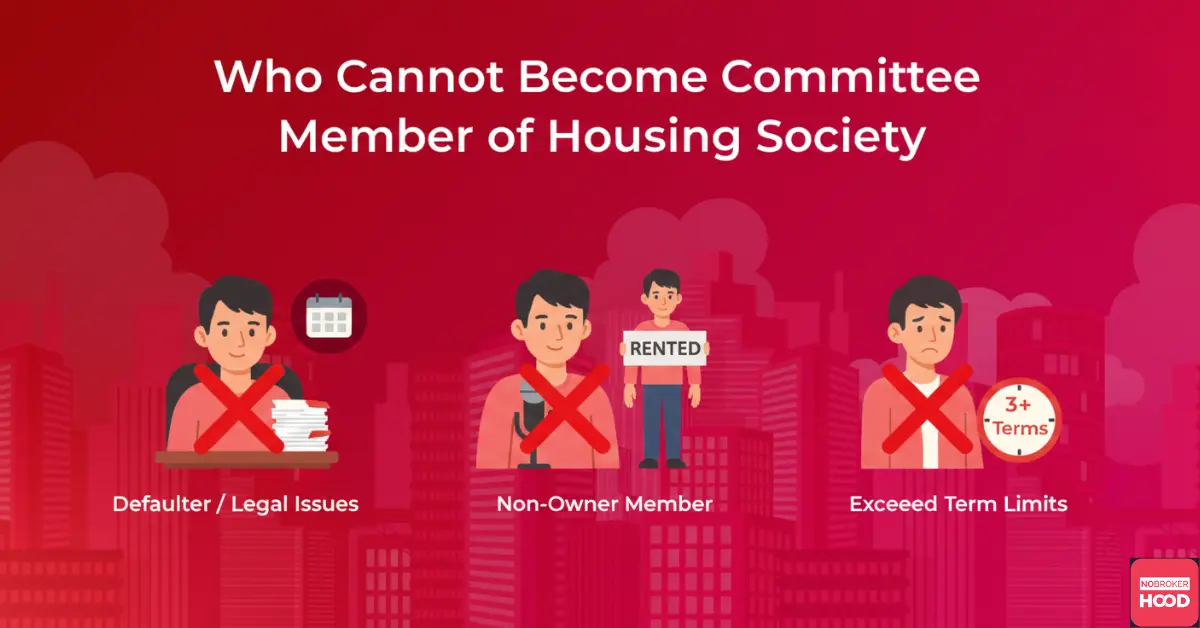


Housing society committees play a vital role in managing and governing residential complexes. However, not everyone can become a committee member. Clear rules and eligibility criteria exist to ensure responsible and trustworthy management. Here is a detailed guide on who cannot become committee members of housing society in India.

Committee Member Meaning in Housing Society
In a housing society, a committee member is an elected person in charge of overseeing daily operations and making decisions. Members of the committee manage maintenance, finances, and compliance in addition to representing the interests of the residents. They guarantee adherence to social norms and bylaws. Their work fosters community welfare, openness, and efficient operations.
Housing Society Committee Members List
Standard housing society committee positions with key roles for effective management.
- Chairman: Leads meetings, resolves disputes, represents society externally, and oversees operations
- Secretary: Manages admin tasks, records minutes, handles correspondence, coordinates with authorities
- Treasurer: Controls finances, prepares budgets, maintains accounts, and ensures audit compliance
- Committee Members (5-15 members): Assist office bearers, handle specific portfolios (maintenance, security, events)
Read Also: Housing Society Secretary Responsibilities
Eligibility Criteria to Become a Committee Member of Housing Society
Before understanding the restrictions on becoming a committee member, it’s important to know the eligibility of Committee Member. Here’s a concise overview:
Basic Eligibility of Committee Member
- Must be a registered member of the housing society (usually a property owner).
- Must have cleared all outstanding maintenance charges and dues.
- Must be at least 18 or 21 years of age (varies by society).
- Should reside within the society’s premises or have close ties to it.
- Must not have any ongoing legal disputes with society.
Society Committee Members’ Rules
- Minimum Age: Usually, candidates must be at least 18 or 21 years old to stand for election.
- Good Track Record: A dependable history in community matters builds trust among society members.
- Proper Understanding of Responsibilities: Candidates should clearly understand the duties and goals of the position before contesting.
- Leadership Potential: Active participation in society affairs, even without an official role, indicates leadership.
- Effective Communication Skills: The ability to convey ideas clearly helps in gaining trust and effectively addressing residents’ concerns.
- Social and Environmental Commitment: Dedication to improving living conditions and the society’s environment reflects commitment to the community.
Why These Eligibility Criteria Matter?
- They ensure that only capable and responsible individuals represent the society.
- Help foster trust and cooperation among members.
- Lead to better decision-making and community welfare.
Summary Table: Eligibility of Committee Member
| Eligibility Factor | Description |
|---|---|
| Minimum Age | 18 or 21 years (depending on society rules) |
| Community Track Record | Proven involvement and reliability in society matters |
| Understanding of Responsibilities | Clear knowledge of committee duties and objectives |
| Leadership Potential | Active participation without official designation |
| Communication Skills | Ability to clearly express ideas and hear residents’ concerns |
| Social & Environmental Commitment | Dedication towards maintenance and community well-being |
With these eligibility requirements in place, potential candidates can prepare themselves for effective service in housing society committees. Next, one should understand the restrictions or disqualifying factors to ensure smooth functioning and fair governance.
Read also: Housing Society Election India
Who Cannot Become Committee Member of Housing Society?
Housing society committees usually consist of positions such as President (Chairman), Vice President, Treasurer, Secretary, etc. These members are elected democratically to ensure responsible leadership. However, certain limitations exist to maintain fairness and effective management.
Disqualification of Housing Society Committee Members
- Unstable Financial Standing: Members with financial instability may struggle to pay pending dues, affecting their eligibility. Reliable financial standing is essential for committee roles.
- Conflict of Interest: Members must be objective. Any personal, business, or familial conflicts affecting impartial decision-making disqualify a candidate.
- Inability to Maintain Fairness: Committee members must be impartial. Partiality or favouritism in any form leads to disqualification.
- Non-Membership in the Society: Typically, only residents or property owners within the society can become committee members. Non-residents are generally excluded.
- Legal Limitations: Individuals involved in past or ongoing legal disputes with society are ineligible to preserve harmony.
- Ownership Requirement: Only property owners can contest society elections. Tenants or non-owners are barred from protecting the interests of those invested in the property.
- Personal Connections with Vendors: Members with close relations to vendors risk bias, so they are restricted to prevent favoritism in contracts.
- Limits on Consecutive Terms: Some societies restrict members from serving consecutive terms to encourage fresh representation and fairness.
- Unstable Mental Health: Those declared mentally unsound are disqualified to ensure capability in managing responsibilities.
- Basic Eligibility Criteria: Candidates must meet age, membership, residency, and ownership criteria to qualify for election.
Also Check: How to Fill Vacancy in Housing Society
Summary Table: Disqualification of Managing Committee Member
| Limitation | Explanation |
|---|---|
| Unstable Financial Standing | Inability to pay dues disqualifies candidates |
| Conflict of Interest | Personal/business conflicts prevent objective decision-making |
| Partiality or Bias | Lack of fairness leads to ineligibility |
| Non-Membership | Non-residents or non-owners cannot contest |
| Legal Issues | Ongoing or past legal disputes disqualify |
| Property Ownership | Non-property owners cannot become committee members |
| Vendor Relations | Personal ties may cause bias, hence disqualification |
| Consecutive Term Limits | Prevents repeated terms to maintain fairness |
| Mental Health | Mental incapacity bars candidacy |
| Basic Criteria | Age, residency, and membership requirements must be met |
Also Check: Best Practices for Apartment Society Management Committees
Why Are These Restrictions Necessary?
- To ensure the society’s funds and affairs are managed by responsible, trustworthy individuals.
- To promote transparency and fairness in society management.
- To avoid conflicts and legal complications within society.
- To ensure committee members are committed and can actively participate in decision-making and maintenance.
Can Associate Member Become Committee Member of a Housing Society?
Yes, an associate member can become a committee member of a housing society, but only under specific conditions laid down by law and the society's bye-laws.
An associate member is someone whose name appears in the society's records but not first on the share certificate, typically a spouse, parent, sibling, child, or other close relative of the primary (original) member. Because their name is recorded in the society's register, they hold recognised membership status, even though they don't have primary ownership rights.
Also Check: Sub-Committee Roles and Responsibilities
New Rules for Associate Members in Housing Society
- Check the society’s bylaws and government acts relevant to cooperative housing societies (such as the Maharashtra Cooperative Societies Act).
- Confirm all maintenance dues are paid, and no legal notices or disputes exist.
- Verify age, residence, and membership documentation before nomination.
- Obtain the necessary No Objection Certificates if an associate member intends to apply
Also Check: New Rules for Associate Members in the Housing Society
How to Fill Vacancy in Managing Committee of Housing Society?
A committee seat can become vacant if a member resigns, moves away, or becomes disqualified. When that happens, society needs to fill the spot so work doesn’t get stuck. The usual process is simple:
- Record the vacancy and Invite nominations: The committee can call a meeting, invite nominations, and conduct voting.
- Co-opt a member: If elections can’t be held immediately, the committee can temporarily add (co-opt) an eligible member until the next election.
- Update records: After the replacement is finalised, the society updates its records and informs the Registrar if needed.
Some bylaws allow co-opting a temporary member until the next election, ensuring society operations like maintenance approvals, banking, and documentation continue smoothly.
Read also : How to Fill Vacancy in Managing Committee of Housing Society
How to Dissolve a Housing Society Managing Committee?
If the committee is involved in mismanagement, corruption, or is not functioning as per society bylaws, members can call a Special General Body Meeting (SGBM). With a majority vote, the committee can be dissolved. After dissolution, the Registrar of Cooperative Societies may appoint an administrator until fresh elections are held.
Also Check: How to Dissolve a Housing Society Managing Committee
How NoBrokerHood Simplifies Committee Member Eligibility & Elections
Verifying who can (and cannot) become a committee member is often the trickiest part of a housing society election, checking dues, ownership records, associate member consents, and past disqualifications manually can drag on for weeks and invite disputes. NoBrokerHood's ERP for Co operative Society removes this guesswork by digitising the entire eligibility and election process, so committees can focus on choosing the right leaders instead of chasing paperwork.
- Digital Member & Ownership Records: Instantly verify whether a candidate is a registered owner, associate member, or tenant no more digging through physical share certificates.
- Automated Dues Tracking: Flags members with pending maintenance dues beyond 3 months, so ineligible candidates are filtered out before nominations even open.
- NOC & Consent Management: Associate members can upload No Objection Certificates digitally, keeping consent records transparent and audit-ready.
- Election Dashboards: Manage nominations, candidate lists, and voting digitally reducing scope for disputes over eligibility or fairness.
- Audit-Ready Compliance: All committee-related records (dues, ownership, disqualifications) are stored centrally, ready to produce if the Registrar or a member raises a challenge.
- Time Savings for MC Members: Cuts election administration workload significantly, letting office bearers focus on society governance rather than manual verification.
All Solutions by NoBrokerHood:
