





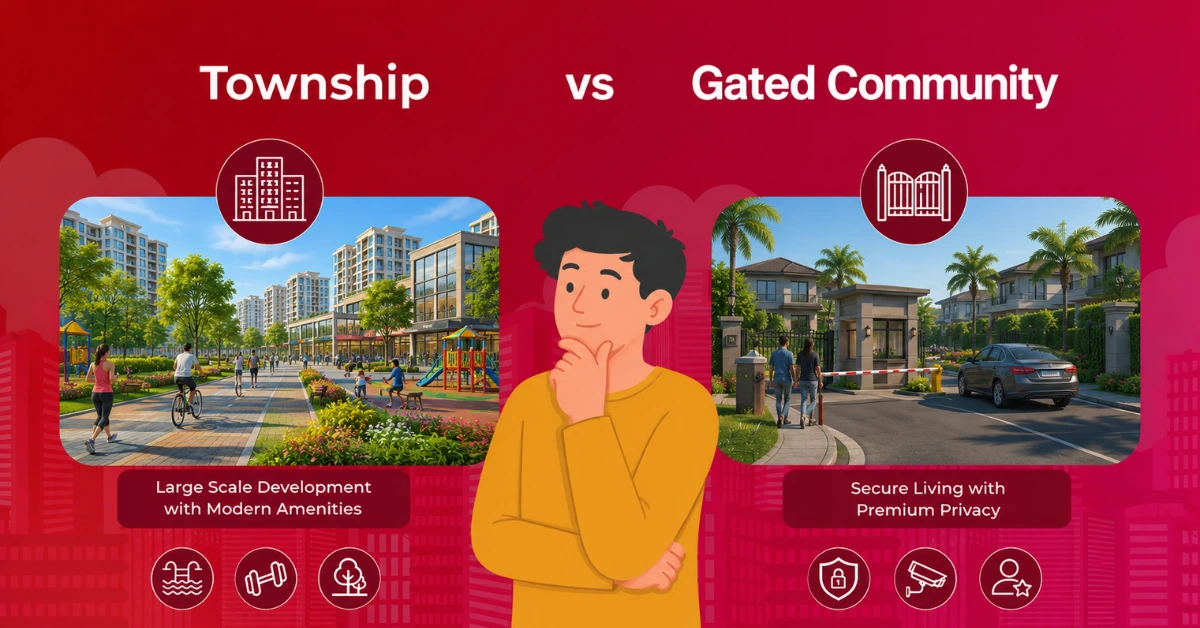


Over the years, metro cities have witnessed a real estate boom. The expansion of the IT sector has helped attract more investment to the housing markets in major cities. At present, the housing market offers various options, including row houses, independent villas, townships, and gated communities.

Due to the convenience of security, luxury, and infrastructure, townships and gated communities have gained a more popular following. In this article, we will explore the key differences between a township vs gated community, compare their advantages and disadvantages, and their investment potential.
What Is a Township?
A township is planned as an integrated urban space where residents can live, work, shop, study, and access essential services within the same development. It is like a mini-urban system with access to all the essential services needed for comfortable cityside living.
Townships are usually spread across a large land area and often include multiple residential projects, such as apartments, villas, row houses, or plotted developments, within a single master plan, along with social and civic infrastructure that supports everyday living.
Key Characteristics of a Township
- Large land area with integrated planning
- Multiple residential projects or clusters
- Schools and educational institutions
- Hospitals, clinics, or healthcare facilities
- Shopping centres, supermarkets, and retail outlets
- Office spaces in some mixed-use developments
- Parks, landscaped open spaces, and recreational zones
- Internal roads, utilities, and community infrastructure
Common Facilities Found in Townships
Townships include social and civic infrastructure because they are designed to minimise residents’ dependence on external infrastructure. These typically include:
- Schools
- Clinics
- Supermarkets
- Clubhouses
- Sports complexes
- Community centers
Read also: Integrated Township
What is Mean by Gated Community?
A gated community is a residential development with controlled access, security systems, and shared amenities exclusively for residents. These communities are designed around residential living, usually consisting of apartment complexes, villas, or a mix of both, within a secured boundary.
Key Characteristics of a Gated Community
- Restricted entry and exit points for controlled access
- Security personnel, CCTV surveillance, and monitored gates
- Shared recreational and lifestyle facilities
- Apartment-based or villa-based housing options
- Strong emphasis on community living and resident interaction
Common Amenities in Gated Communities
- Swimming pools
- Fully equipped gyms
- Children’s play areas
- Clubhouses
- Landscaped gardens and walking tracks
Read also: What is a Gated Community?
Township vs Gated Community: Key Differences
When comparing townships vs gated communities, both offer a secure living environment but differ in scale, facilities, infrastructure, and more. Below is a comparison of township vs gated community:
Key Differences Between Township and Gated Community
| Factor | Township | Gated Community |
| Size | Large-scale, expansive developments | Relatively smaller residential projects |
| Planning | Master-planned, multi-use ecosystem | Primarily residential planning |
| Facilities | Schools, hospitals, retail, and offices | Limited to lifestyle amenities |
| Lifestyle | Self-sufficient urban living | Community-based residential living |
| Dependence | Low external dependence | High external dependence |
| Housing Types | Apartments, villas, plots, mixed-use | Mostly apartments and villas |
| Infrastructure | Internal roads, utilities, services | Basic internal infrastructure |
| Commercial Spaces | Often included within development | Usually not included |
| Convenience | High due to in-house facilities | Moderate, depends on the nearby area |
| Ideal For | Long-term integrated living | Secure, comfortable housing focus |
| Population | Higher | Moderate |
| Maintenance Structure | Multiple layers of management | Single society management |
| Investment Potential | Long-term growth driven by infrastructure | Depends on location and demand |
| Cost of Entry | Generally higher | Wider range of budgets |
Lifestyle Differences Between a Township and a Gated Community
In the township vs gated community comparison, lifestyle expectations often play a major role in the buying decision.
Township Lifestyle
A township offers a more self-contained, convenience-driven lifestyle, with many daily needs available within the same development. Residents often benefit from:
- Walk-to-work possibilities in mixed-use townships
- Access to daily essentials like schools, shops, and clinics nearby
- Larger open spaces, parks, and landscaped zones
- Integrated community experience with multiple residential clusters
- Reduced need to travel outside for basic services
Gated Community Lifestyle
A gated community focuses more on comfortable, secure, and community-oriented residential living. Residents typically enjoy:
- Close-knit neighborhood environment
- Easier interaction among residents
- Short internal travel within the complex
- Simpler residential setup with fewer external facilities
- Strong emphasis on safety and maintenance
How Lifestyle Needs Differ by Buyer Type
- Families: Townships are ideal for school access and long-term convenience, while gated communities suit families seeking safety and simpler living.
- Working professionals: Townships may offer better access to offices and shorter commutes; gated communities are preferred for quiet living after work.
- Retirees: Gated communities are often more manageable and peaceful, while townships offer better healthcare and access to services.
- Investors: Townships may provide stronger long-term appreciation potential, while gated communities often offer stable rental demand in prime locations.
Security Comparison: Township vs Gated Community
When it comes to security, the township vs gated community debate becomes an important factor.
Security in Townships
Townships usually have a larger area, so security is designed across multiple layers. Common features include:
- Multiple entry and exit checkpoints
- CCTV surveillance across key areas
- Dedicated security teams for different zones
- Visitor management systems at entrances
Security in Gated Communities
Gated communities are smaller and more compact, so security is usually simpler and more centralised. Common features include:
- Controlled access gates
- Security guards at entry and exit points
- CCTV monitoring in common areas
- Resident verification systems for visitors
Security in both townships and gated communities depends heavily on:
- Developer quality
- Maintenance and management standards
- Use of modern security technology
Amenities and Infrastructure Comparison
Amenities are among the important factors buyers consider when buying their dream new homes. It also plays a major role in shaping property value, convenience, and overall resident satisfaction when comparing the township vs gated community. Below is a table to understand the differences better:
Amenities Comparison Table
| Category | Township | Gated Community |
| Schools | Often available within development | Not available inside |
| Hospitals | Clinics or hospitals included | Not included |
| Retail outlets | Supermarkets, malls, shops | Usually not included |
| Sports facilities | Large sports complexes | Basic gym and courts |
| Business centers | May include office spaces | Not included |
| Community parks | Large landscaped parks | Small gardens and open spaces |
| Clubhouse | Multiple or large clubhouses | Single clubhouse |
| Swimming pool | Often multiple pools | One common pool |
| Children’s play area | Larger, multiple zones | One dedicated play area |
| Walking tracks | Extensive internal networks | Limited internal tracks |
Which Offers Better Convenience?
When comparing convenience, townships offer greater access to social infrastructure and essential services without external support. Whereas a gated community focuses more on recreational and lifestyle amenities, creating a comfortable living environment. The comparison shows that townships provide a broader, all-in-one convenience, while gated communities offer focused residential comfort with basic lifestyle amenities.
Maintenance and Community Management
In the township vs gated community comparison, maintenance and management play a key role in how smoothly daily life functions.
Township Management Structure
Townships usually have a more complex, layered management system due to their large size and multiple components.
- Multiple residential associations for different phases or clusters
- Central township administration to manage overall operations
- Shared infrastructure management for roads, utilities, and services
- Coordination between residential, commercial, and public spaces
Gated Community Management Structure
Gated communities usually have a simpler and more direct management system.
- Managed by a Resident Welfare Association (RWA) or housing society
- Direct involvement of residents in decisions
- Faster and simpler decision-making process
- Focus mainly on residential maintenance and common amenities
Maintenance Responsibilities and Challenges
- Townships: Maintenance is more complex due to larger infrastructure, multiple services, and coordination between different zones. Operational challenges can include delays in decision-making and higher management complexity.
- Gated Communities: Maintenance is simpler but depends heavily on active resident participation. Challenges may include limited funds or disagreements among residents.
Cost and Affordability Comparison
When it comes to the township vs gated community discussion, cost is not just about the initial purchase price but also about the maintenance charges, utility expenses, and long-term ownership costs.
Initial Purchase Cost
The price of a property in both townships and gated communities depends on several common factors:
- Location of the project
- Reputation of the developer
- Range of amenities offered
- Type of property (apartment, villa, etc.)
Townships may have a wider price range, as they offer multiple residential options, while gated communities are usually more focused and have a more compact pricing structure.
Maintenance Charges
- In townships, maintenance costs are often higher because they include large infrastructure, such as roads, landscaping, utilities, and shared facilities across multiple zones.
- In gated communities, maintenance may be comparatively lower, depending on the size of the project and the number of amenities provided.
Long-Term Ownership Costs
- Utility expenses (water, electricity, waste management)
- Monthly or annual community charges
- Infrastructure upkeep and repairs
In townships, these costs can be higher but are often balanced by the availability of in-house services. In gated communities, costs may be lower, but residents often rely more on external services, which can lead to indirect expenses.
Investment Potential of Townships and Gated Communities
Investment potential becomes a key factor for many buyers when it comes to the township vs gated community debate. Both models can offer good returns, but the investment appreciation may differ.
Why Investors Choose Townships
- Planned infrastructure growth within the project
- Higher long-term development potential
- Mixed-use ecosystem with residential, commercial, and social spaces
- Value appreciation as the township becomes fully developed over time
Why Investors Choose Gated Communities
- Strong rental demand, especially in urban locations
- Wider buyer and tenant pool due to simpler housing format
- Located in established or well-connected city areas
- Faster occupancy and quicker income generation potential
Key Factors Influencing Appreciation in Township and Gated Communities
- Location and connectivity
- Developer reputation and project quality
- Infrastructure development in the surrounding areas
- Demand from end-users and tenants
- Overall economic and real estate market trends
Who Should Choose a Township?
When comparing all the infrastructure, amenities, scale, and investment potential, it all boils down to one question: what should one choose? In this township vs gated community discussion, a township is best suited for buyers who want a more complete, self-sustaining living environment.
A township may be suitable for:
- Families seeking a self-sufficient environment
- Buyers looking for extensive amenities and infrastructure
- Residents preferring integrated living with everything nearby
- Long-term homeowners planning to stay for many years
When Township Living Provides Greater Value
Township living offers greater value for residents who want most of their daily needs within easy reach. For example, families with school-going children benefit from having educational institutions inside or near the development. Similarly, working professionals may appreciate reduced travel time if office spaces or commercial hubs are part of the township. A township works best for those who value complete lifestyle integration, long-term comfort, and self-contained living.
Who Should Choose a Gated Community?
A gated community is often the preferred choice for buyers who want a simpler, more secure, and more affordable residential setup without the complexity of a large-scale township.
A gated community may be suitable for:
- First-time homebuyers
- Urban professionals working in nearby job hubs
- Smaller families looking for manageable living spaces
- Buyers seeking affordability and basic convenience
When a Gated Community Is the Better Choice?
A gated community is a better option when the priority is practical and easy living in an established area. First-time buyers often prefer gated communities because they are more affordable and easier to maintain compared to townships. A gated community works best for those who want secure, comfortable, and convenient living without the scale and complexity of a township in the township vs gated community decision.
Read also: 7 Reasons Why Living in a Gated Community is Better
How NoBrokerHood Helps Manage Townships and Gated Communities
In a township or gated community, you would need to ensure security, smooth operations, resident satisfaction, and transparent communication. This is where NoBrokerHood steps in. It is a society management system that helps housing communities to streamline these processes through a single digital platform.
For Township Management
In townships, where multiple residential clusters and facilities exist, management becomes more complex. NoBrokerHood helps simplify it by:
- Visitor and Gate Management: Managing multiple entry and exit points efficiently across different zones
- Community Communication: Sharing announcements across various residential clusters instantly
- Facility Management: Tracking and managing shared amenities and infrastructure usage
- Complaint Management: Digitally recording, tracking, and resolving resident issues
- Accounting and Billing: Simplifying maintenance, collection, and financial record-keeping
For Gated Communities
In gated communities, the focus is on smooth day-to-day operations and resident convenience. NoBrokerHood supports this through:
- Visitor Management: Digital verification of visitors and service staff
- Helpdesk System: Tracking complaints and service requests efficiently
- Notice Board: Sharing society updates and important announcements
- Resident Directory: Improving communication among residents
- Digital Payments: Enabling easy maintenance and community fee payments
Benefits for Residents from both the Gated Community and the Township
- Greater transparency in society's operations
- Improved security through digital monitoring
- Faster resolution of complaints and issues
- Better communication between residents and management
- Convenient access to all community services in one place
All Solutions by NoBrokerHood:
