






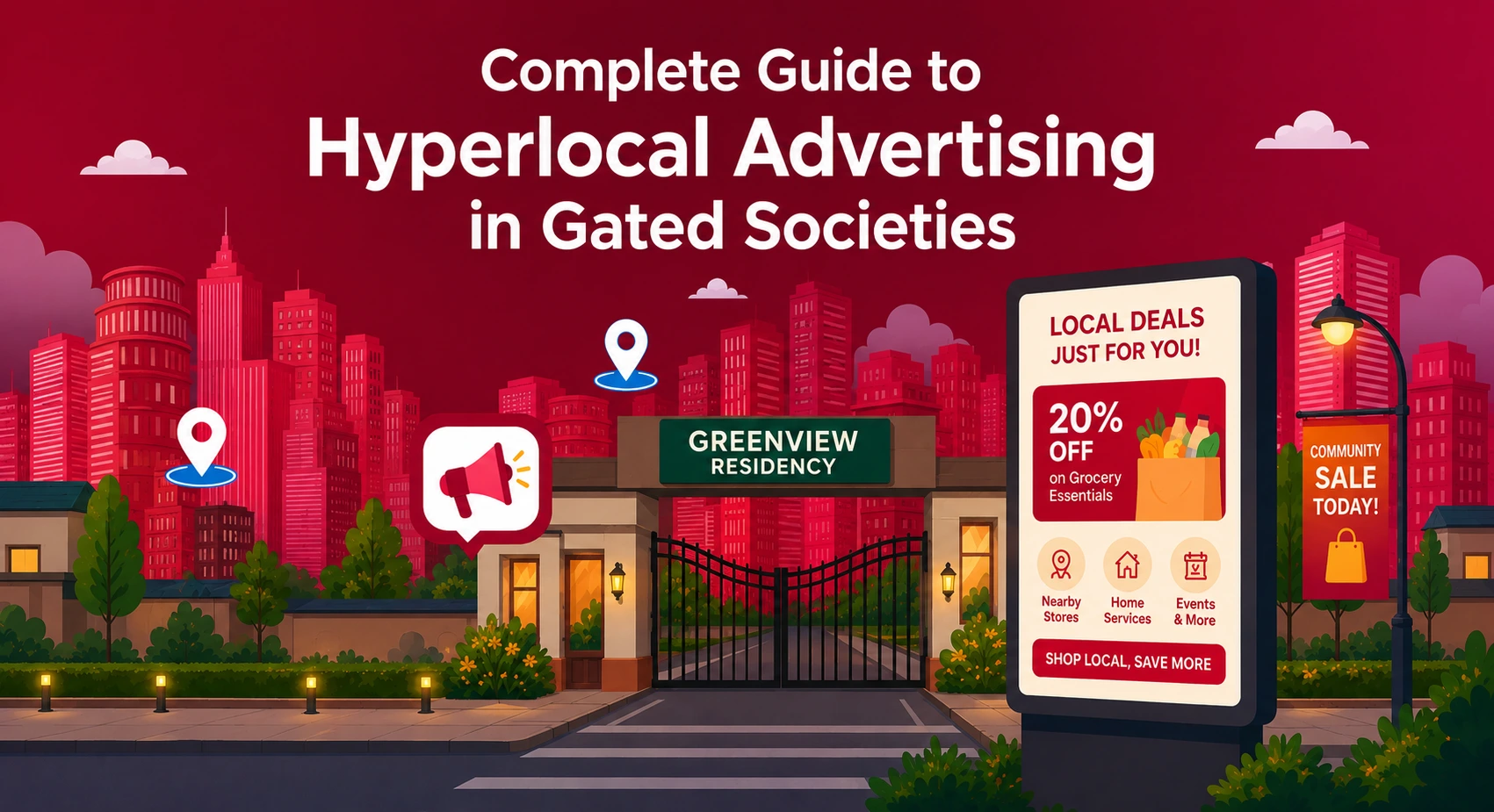


Hyperlocal advertising in gated societies is changing how brands connect with urban households by focusing on highly targeted communities instead of broad audiences. This guide explores what hyperlocal advertising is, why it has become so effective in Indian gated communities, the different advertising formats brands use, its benefits for residents and RWAs, best practices for running campaigns, and the market trends, engagement, and ROI that are making this one of India's fastest-growing local advertising channels.
What Is Hyperlocal Advertising?
Hyperlocal advertising is a way of promoting a brand within a very small, defined geography, sometimes a single pin code, sometimes a single housing complex. Instead of casting a wide net across a city, brands focus on the exact streets and buildings where their target customer lives.
In a gated society, this could mean a banner at the main gate, a poster inside the lift, or a push notification on the community app when a resident logs in to pay maintenance. The idea is simple: show the right message to the right household, in a space they already trust.
For India's urban housing market, this approach has grown from a side experiment into a serious advertising category, and residents are noticing it more each month.
Why Do Brands Use Hyperlocal Advertising in Gated Communities?
Housing societies are not just buildings. They are small, self-contained economies with predictable spending patterns and a captive audience that passes through the same gates, lifts, and lobbies every single day.
Industry estimates suggest gated communities in India could account for close to 32 million households by FY2031, nearly half of all homes across the top 50 cities, with per capita incomes running several times the national average. That combination of scale and spending power is exactly why hyperlocal advertising has found such a natural home here.
A few reasons this audience is so valuable:
- Concentrated, affluent households: FMCG, real estate, BFSI, and home services brands get direct access to families with genuine purchasing power.
- Trust built through offline presence: A brand seen physically inside a known, secure space earns more attention than the same ad seen online.
- Zero spillover: Campaigns can be pinned to one exact community, so budgets are not wasted on people outside the target zone.
This is also why hyperlocal advertising India is increasingly discussed as a distinct advertising category, separate from broader outdoor or digital media.
[Get Started with Hyperlocal Advertising]
Hyperlocal Advertising Examples in Indian Housing Societies
If you live in a housing society, you have probably already seen a few hyperlocal advertising examples without labelling them as such. Here is what these campaigns usually look like on the ground.
On-Ground and Physical Formats
- Gate and pillar branding: Static banners or standees at the main entrance, seen by every resident entering or leaving.
- Lift and lobby posters: Small A3 or A4 frames inside elevators, viewed repeatedly during short daily rides.
- Weekend kiosks: Sampling booths or demo stalls set up in the clubhouse or garden area, common for food, wellness, and quick commerce brands.
Digital and App-Based Formats
- In-app banners: Ads shown on the housing society app during moments residents are already paying attention, such as visitor approvals or bill payments.
- Push notifications: Locality-specific alerts sent only to residents within a chosen society or pin code.
- Digital notice boards: LED screens in common areas displaying rotating brand messages alongside society announcements.
Events and RWA Partnerships
- Festival sponsorships: Brands supporting Diwali melas, Independence Day events, or sports tournaments in exchange for visible branding.
- Health camps and workshops: A practical way for healthcare, insurance, or wellness brands to build trust through genuine service.
- Newsletter and flyer inserts: Ad space bought within a society's official newsletter or morning paper inserts.
Is Hyperlocal Advertising Good for Residents and RWAs?
For residents, hyperlocal ads are not just noise; they can actually be useful when done right. A locality-specific offer, a nearby store's delivery promise, or a relevant service demo saves time compared to scrolling through generic online ads that may not even apply to your area.
For RWAs and committee members, this is also an opportunity. Well-managed hyperlocal advertising India campaigns bring in revenue that can support society upkeep, events, or amenities, provided the process stays transparent and non-intrusive.
The key is balance. Too many random flyers or unauthorised banners create clutter, while a handful of well-vetted campaigns, approved and monitored by the RWA, tend to feel like a genuine added convenience rather than a distraction.
[Advertise Across Premium Gated Communities]
How to Allow Hyperlocal Advertising in Your Society: A Checklist
If your RWA is considering allowing this kind of advertising inside your community, a few basic steps keep things smooth and fair for everyone.
- Set clear guidelines first: Decide which formats are acceptable, gate banners, lift posters, app notifications and which areas are off-limits.
- Formalise RWA approval: All outdoor media, on-ground events, or flyer distribution should be cleared by the committee, often with a small permission or venue fee.
- Check brand relevance: Prioritise brands genuinely useful to residents, such as local grocery delivery, healthcare, or home services, over unrelated promotions.
- Keep placements non-disruptive: Ask for minimal-text creatives with QR codes rather than cluttered visuals plastered across common areas.
- Review campaigns periodically: A short renewal cycle lets the committee assess whether a brand's presence is adding value before extending it further.
These small steps make sure the process stays a helpful addition to the community, not an inconvenience.
Hyperlocal Advertising India: Engagement, ROI, and Market Size
Residents and RWAs often ask brands one fair question: does this actually work, or is it just clutter? The numbers suggest hyperlocal ads inside gated communities perform noticeably better than generic outdoor or open-internet formats.
- Engagement rates: Campaigns run through RWA partnerships and society platforms typically see engagement in the 12 to 15% range, well above standard display advertising benchmarks.
- Return on ad spend: Well-targeted on-ground and app-based campaigns in residential clusters have reported ROAS in the range of 8 to 12x, largely because the audience is already verified and relevant.
- Cost efficiency: Digital integrations within society apps can start with modest budgets, sometimes with CPMs as low as ₹50 per 1,000 impressions, while larger on-ground activations or full society takeovers can scale up to several lakhs depending on the format and duration.
- Household economics: With gated community consumption in India projected to reach close to ₹900,000 crore by FY2031, brands see this segment as far too large to ignore.
None of these numbers matters without proper execution, though. A campaign that skips RWA approval or floods common areas with too many banners tends to underperform, regardless of how promising the audience looks on paper. The best results usually come from a handful of well-chosen formats, run consistently, rather than a scattergun approach across every wall and lift.
[Launch Your Hyperlocal Advertising Campaign]
Hyperlocal Advertising for Gated Societies with NoBrokerHood
Many housing societies today already use community management platforms for everyday tasks such as visitor approvals, maintenance payments, and community notices. Advertising with NoBrokerHood enables brands to connect with verified residents across premium gated communities without disrupting the resident experience. What makes this approach practical for both brands and communities is the mix of formats available under one roof, rather than juggling separate vendors for each touchpoint.
- Verified, KYC-checked audience across residential communities, so campaigns reach real households rather than random footfall.
- Multiple touchpoints in one campaign, combining lift branding, gate branding, in-app digital banners, and on-ground activations.
- Presence across 13 brands and industries, from FMCG to real estate, giving marketers a sense of what formats work best for their category.
- High rates of campaign renewal and multi-city expansion, which suggests brands are seeing measurable outcomes rather than one-off exposure.
- Structured, RWA-friendly process, reducing the back-and-forth societies often face when approving outdoor or on-ground media.
For brands trying to build recall among affluent, high-intent households, and for societies that want vetted, relevant campaigns rather than random flyers, this kind of structured advertising model tends to work better for everyone involved.
