





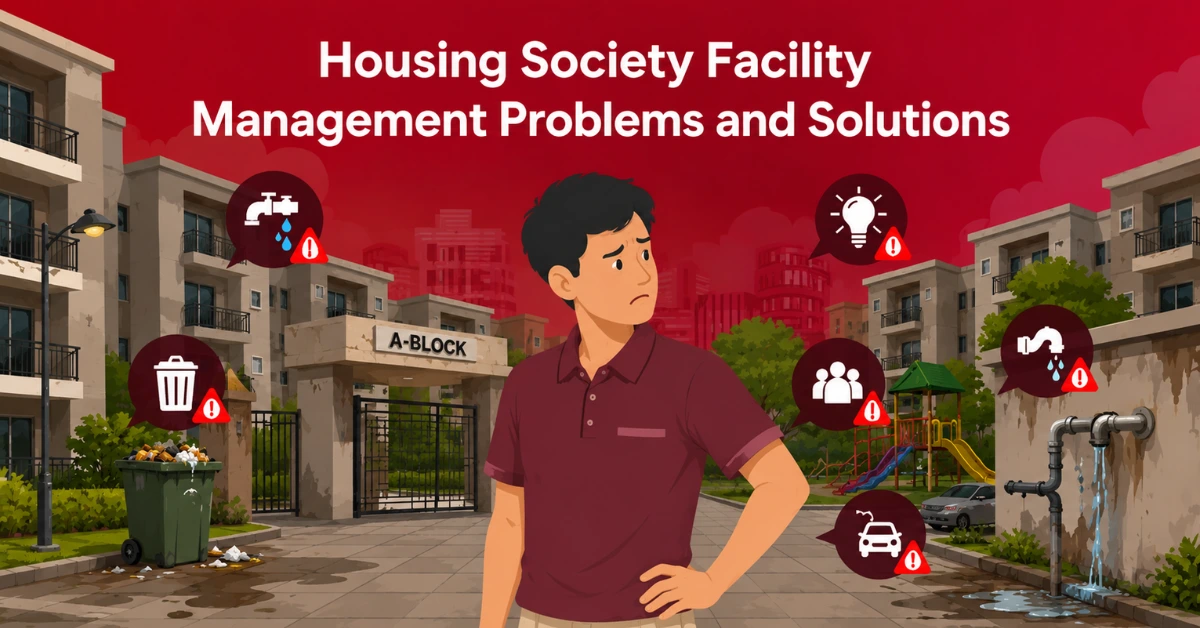


Most residents only notice facility management when something stops working. A lift breaks down, the water supply is disrupted, security is compromised, or a maintenance request remains unresolved. These everyday issues quickly affect comfort and safety.

Today, the challenges in facility management are growing as residential communities become larger and more complex. Modern societies now include clubhouses, gyms, parking systems, swimming pools, gardens, and advanced security systems. Managing all of this requires continuous coordination. Facility management is no longer limited to repairs and maintenance. It now includes security management, vendor supervision, infrastructure planning, budget control, compliance, and resident communication.
What Is Facility Management in a Housing Society?
Facility management refers to the planning, maintenance, and operation of all shared services and infrastructure inside a residential community. Its purpose is to ensure that common assets function smoothly and that residents experience safe, comfortable living.
The challenges in facility management often arise when societies fail to manage these operations efficiently.
The Scope of Facility Management in Housing Societies
Facility management covers multiple areas within a housing society. These include infrastructure maintenance, housekeeping, security operations, waste management, utility services, vendor coordination, and resident support.
It also involves maintaining lifts, pumps, electrical systems, plumbing lines, fire safety equipment, parking areas, and common recreational spaces.
Importance of Facility Management
Good facility management directly affects resident satisfaction. Clean surroundings, functioning amenities, and quick issue resolution improve everyday living.
It also improves operational efficiency by reducing emergency repairs and unnecessary costs. Well-maintained societies often retain higher property values and achieve stronger long-term sustainability.
Read also: Facility Management Services in Societies
Facility Management Responsibilities in Housing Society
The people who take care of facility management in a housing society do a lot of work to keep the community safe and nice to live in. They have to do things like maintenance and administration tasks. Here is what they do:
1. Maintenance & Upkeep
- They take care of the building by doing repairs, painting and making sure the plumbing and electrical systems are working.
- They also keep the areas like lobbies and staircases clean.
- The facility management team takes care of the gardens and lawns. Make sure they are nice and green.
- They service the elevators regularly to ensure they are safe to use.
- They manage the water supply by taking care of the bore wells and water tanks.
- They also do pest control to keep the society free of pests.
2. Security & Safety
- The facility management team is responsible for the security guards and the CCTV cameras.
- They manage who comes into the society and keep track of visitors and vendors.
- They make sure the fire safety systems are working and do checks.
- They also have emergency plans in place. Do evacuation drills.
3. Utilities & Infrastructure
- The facility management team takes care of the power backup systems like generators.
- They manage the distribution and metering.
- They take care of the waste management and make sure the waste is segregated.
- They also manage the parking and allocate spaces to residents.
4. Financial Management
- The facility management team collects the maintenance charges from residents.
- They make a budget for the maintenance and sinking funds.
- They pay the vendors. Manage the contracts.
- They also do reporting and audits.
- They take care of the insurance policies for the housing society.
5. Vendor & Contract Management
- The facility management team. Negotiates with service providers like housekeeping and security.
- They make sure the service providers are doing their job as agreed.
- They review the performance of the vendors regularly.
6. Amenities Management
- The facility management team takes care of the clubhouse gym and swimming pool.
- They manage the booking systems for the amenities.
- They make sure the amenities are safe to use.
7. Regulatory & Legal Compliance
- The facility management team follows the local municipal bylaws and society registration acts.
- They get the certifications, like fire NOC and lift licenses.
- They pay the property tax and utility bills on time.
8. Resident Communication & Grievance Handling
- The facility management team listens to the complaints and service requests from residents.
- They send out circulars and notices to the residents.
- They hold Annual General Meetings. Manage the resolutions.
9. Technology & Digital Management
- The facility management team uses software and apps to manage the billing and complaints.
- They use notice boards to communicate with the residents.
- The facility management team uses technology to make their job easier and more efficient.
Why Facility Management Is Becoming More Challenging?
Residential communities today are far more complex than they were a decade ago. Large gated societies may have hundreds of residents, multiple towers, and many shared amenities.
As communities grow, the challenges in facility management increase.
Growing Resident Expectations
Residents today expect fast responses and transparent service. They want complaints resolved quickly and expect facilities to remain functional at all times.
Delayed service often leads to dissatisfaction and complaints against management committees.
Increasing Operational Complexity
Managing a large society requires coordination between staff, vendors, gated community security teams, residents, and committee members. Even a small communication gap can create operational problems.
The more moving parts a society has, the harder coordination becomes.
Major Challenges of Facilities Management
Most societies face similar recurring operational issues. These challenges in facility management affect communities regardless of size.
Rising Maintenance Costs
Maintenance expenses continue to increase due to inflation, rising labour costs, utility bills, and repair charges. Societies often struggle to balance quality services with affordable society maintenance charges for residents.
Ageing Infrastructure and Equipment
Infrastructure naturally deteriorates with time. Lifts, pumps, pipelines, electrical wiring, and water systems need regular servicing. Delayed repairs usually turn small issues into expensive failures. Ageing equipment also increases resident complaints.
Vendor and Contractor Management
Housing societies often depend on outsourced service providers for cleaning, security, repairs, and maintenance. Monitoring service quality and maintaining accountability across multiple vendors is difficult without clear processes.
Security and Access Management
Managing visitors, delivery staff, domestic workers, and contractors has become more difficult in modern societies. Manual entry systems create security risks and increase workload for guards.
Resident Complaint Resolution
Complaint handling is one of the biggest operational challenges. Delayed responses frustrate residents and reduce trust in management. Poor communication often makes the problem worse.
Facility Management Problems and Solutions
While these issues are common, most facility management problems and solutions revolve around better planning, structured processes, and technology adoption.
Common Problems and Their Practical Solutions
| Facility Management Problem | Recommended Solution |
| Delayed maintenance | Preventive maintenance schedules |
| Complaint backlogs | Digital helpdesk systems |
| Vendor performance issues | Vendor monitoring and audits |
| Security gaps | Smart visitor management |
| High repair costs | Asset lifecycle planning |
| Poor communication | Resident communication platforms |
Proactive management reduces costs and prevents operational disruptions. Societies that fix issues early usually spend less than societies that wait for emergencies.
Read Also: Vendor Management Best Practices
The Role of New Technology in Facility Management
New technology in facility management is changing how societies operate. Technology helps shift facility management from reactive problem-solving to predictive, data-driven operations.
Smart Visitor and Security Management
Digital visitor management improves security by replacing manual entry registers. Visitors can be verified through apps, QR codes, OTP-based approvals, and access control systems. This reduces unauthorised access and improves tracking.
Digital Complaint and Helpdesk Systems
Digital complaint systems allow residents to raise issues instantly. Management teams can assign tasks, monitor progress, and close complaints with proper tracking. This improves accountability and communication.
Asset and Maintenance Management Software
Maintenance software stores service records, maintenance schedules, warranty details, and repair history. This helps societies avoid missed servicing and unexpected breakdowns.
IoT and Smart Monitoring Systems
IoT devices can monitor water usage, energy consumption, pump performance, and utility systems in real time. These systems help identify problems before major failures occur.
How Facility Management Challenges Affect Residents?
Poor facility management impacts more than operations. The effects are felt directly by residents.
Impact on Resident Satisfaction
Frequent breakdowns, delayed repairs, and poor communication reduce trust and satisfaction.
Impact on Property Value
Poorly maintained societies often struggle to attract buyers and tenants. Property value can decline when facilities deteriorate.
Impact on Community Reputation
Societies known for operational problems may develop a poor reputation in the market.
Impact on Operational Costs
Reactive repairs usually cost more than planned maintenance. Poor management increases long-term expenses.
Best Practices for Improving Facility Management
Improving facility management requires consistent effort and practical systems.
Adopt Preventive Rather Than Reactive Maintenance
Regular inspections and scheduled servicing reduce breakdowns and repair costs. Preventive maintenance helps detect issues early.
Improve Vendor Accountability
Societies should define service standards, track performance, and conduct regular audits. Clear accountability improves service quality.
Create Transparent Communication Channels
Residents should receive timely updates about maintenance schedules, outages, and repairs. Transparent communication reduces frustration.
Use Data and Technology for Decision-Making
Digital records help committees identify patterns such as recurring repairs, rising utility costs, or poor vendor performance. Better data leads to better decisions.
Conduct Regular Facility Audits
Periodic audits help identify hidden maintenance risks and compliance gaps before they become serious problems.
Future Trends in Residential Facility Management
The future of new technology in facility management is centred around automation and smarter operations.
Smart Communities and Automation
Smart communities will increasingly automate visitor entry, utility management, and amenity bookings.
Predictive Maintenance Systems
Predictive maintenance uses sensors and historical data to detect early signs of equipment failure.
Data-Driven Facility Management
Real-time analytics will help management committees optimise costs and improve planning.
Resident-Centric Service Models
Future facility management will focus heavily on convenience, faster service, and better resident experience.
Read Also: Housing Society Problems and Solutions
How NoBrokerHood Helps Societies Overcome Facility Management Challenges?
Many facility management issues happen because societies rely on manual processes, disconnected records, and fragmented communication. NoBrokerHood is a society management app that helps Management Committees centralise operations on a single platform.
Centralised Complaint Management
Residents can raise complaints digitally, while committees track resolution progress in real time. This improves accountability and faster resolution.
Smart Visitor and Security Management
Digital visitor approvals, staff tracking, and security monitoring improve gate security while reducing manual workload.
Facility and Amenity Management
Societies can manage clubhouse bookings, parking, and shared amenities through a structured system.
Vendor and Maintenance Tracking
Vendor schedules, service logs, and maintenance records can be monitored from one dashboard.
Society Accounting and Financial Transparency
Committees can track expenses, maintenance collections, and budgets with better visibility.
Resident Communication and Notices
Announcements, notices, and emergency alerts can be shared instantly, improving transparency and trust.
With the right processes and technology, societies can overcome major facility management challenges and create safer, more efficient communities.
All Solutions by NoBrokerHood:
Case Study
Facility management in housing societies
Facility management in housing societies involves maintaining shared infrastructure, utilities, security, and resident services. Common challenges in facility management include rising maintenance costs, security concerns, delayed repairs, and complaint handling. These issues can be solved through better planning, preventive maintenance, and new technologies in facility management, such as digital help desks, IoT monitoring, and automated visitor management.
