






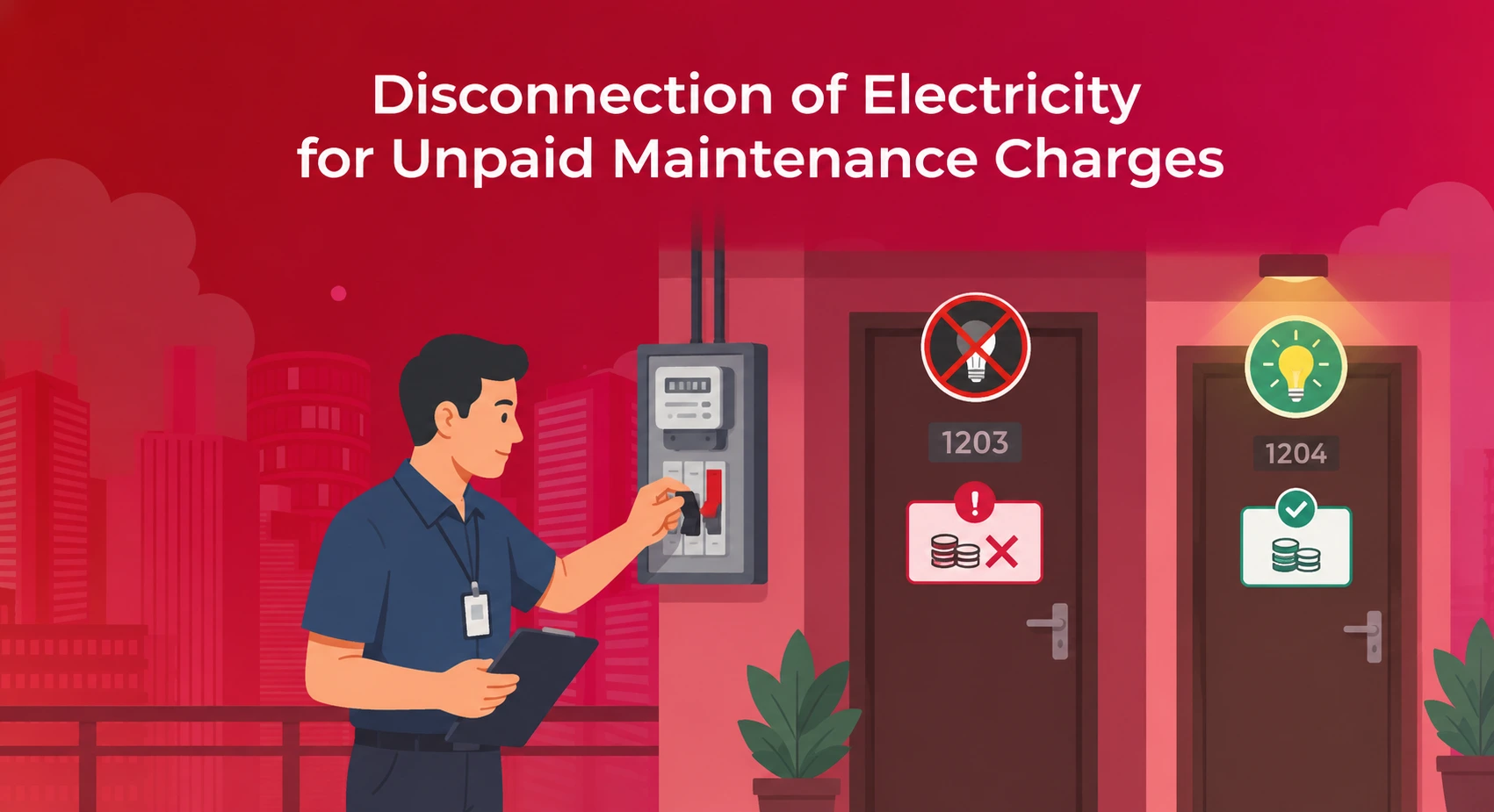


Disconnection of electricity supply for non payment of maintenance charges is a concern for many housing society residents. While RWAs need to recover pending dues to manage common expenses, they cannot disconnect essential services on their own authority. This guide explains the legal position, relevant court rulings, consequences for societies, lawful recovery methods, steps residents can take and ways to prevent maintenance payment defaults.

Why Societies Threaten to Cut Power Over Pending Dues?
Anyone who has lived in an apartment complex has probably seen a notice on the lift board about pending maintenance. When a few residents keep delaying payment for months, the society's common fund starts to feel the pinch. Diesel bills, security salaries, lift maintenance and housekeeping all depend on this collection.
So it is not surprising that some managing committees consider disconnection of electricity supply for non payment of maintenance charges as a quick fix. It feels like an easy way to get an immediate response from a defaulting resident. The problem is that this shortcut is rarely legal, and it often creates a much bigger mess for the society than the unpaid amount itself.
Read also: Non Payment of Society Maintenance Charges
Can a Society Legally Disconnect Electricity for Non Payment of Maintenance Charges?
This is a common question among housing society residents. The answer is no, not on their own authority. Electricity is treated as an essential service under Indian law, much like water. Indian courts have repeatedly held that disconnection of electricity supply for non payment of maintenance charges by a society amounts to unlawful pressure, since basic utilities cannot be used as a bargaining tool. Only the licensed electricity distribution company under the Electricity Act, 2003, or a similar statutory body can disconnect an actual power connection and that too after following due billing and notice procedures.
An RWA is a self-governing body of residents, not a utility provider. Collecting maintenance charges does not give it the authority to disconnect a resident's electricity, even through a shared sub-meter or common line.
What Courts and Consumer Forums Have Said?
Consumer forums and several High Court rulings have taken a fairly consistent view on this over the years:
- Essential services such as electricity and water cannot be withheld as a recovery tool for unpaid dues.
- Disconnection carried out by a society without statutory backing can be challenged as illegal interference.
- Office bearers responsible for such action may face civil or even criminal complaints in serious cases.
- Disputes over maintenance charges are treated as a financial matter to be settled through legal recovery, not through the meter box.
Read also: Bombay High Court: Housing Society Maintenance Dues Are Continuing Liability
Are There Any Exceptions?
There is some nuance here, and it is worth knowing about:
- A few state specific apartment acts and cooperative society rules, including certain provisions applied in Telangana, have in narrow cases allowed disconnection of a separately billed, non essential supply, such as water bought from a private tanker.
- This exception applies only when it is backed by clear statutory bylaws and proper process, not as a general rule for maintenance charges.
- The core electricity connection billed by the state discom rarely falls under this exception.
Read also: Can Society Cut Water Supply of a Member for Not Paying the Maintenance
What Happens If an RWA Disconnects Power Illegally?
Cutting the power supply without legal backing puts the association itself at risk. Affected residents can approach a consumer forum, file a civil complaint or write to the Registrar of Cooperative Societies. Courts have, in multiple cases, directed societies to restore supply immediately and in some instances awarded compensation for harassment. Beyond the legal cost, this kind of action damages trust within the community and often turns a simple payment delay into a long running dispute between neighbours.
Lawful Ways RWAs Can Recover Maintenance Dues Instead of Cutting Power
Associations have several legitimate ways to recover unpaid dues without resorting to disconnection of electricity supply for non payment of maintenance charges.
1. Send a formal payment notice
The notice should clearly mention:
- Outstanding amount
- Billing period
- Applicable interest or penalty
- Due date
- Payment method
- Time allowed to raise a dispute
- Consequences permitted under the bylaws
A clear statement of dues can prevent many disputes that arise from incorrect balances or missed payments.
2. Charge interest or late-payment penalties
If permitted by the applicable law and registered bylaws, the society can levy interest or a late-payment charge. The calculation should follow the approved rule and should be visible in the resident's account.
3. Restrict non-essential amenities where legally permitted
Depending on the applicable rules, the association may consider restrictions on facilities such as a clubhouse, gym, swimming pool or other recreational amenities. Such action should be based on the registered bylaws and applied consistently. It should not affect essential living requirements.
4. Pass a properly documented resolution
For long-standing defaults or substantial dues, the society can seek general body approval where required under its bylaws. The managing committee should record the recovery decision, supporting documents and applicable rules in its minutes.
5. Start formal recovery proceedings
If informal recovery efforts fail, the society can approach the appropriate civil court or cooperative court to recover outstanding dues and applicable interest, subject to the governing law.
6. Approach the Registrar of Cooperative Societies
Registered cooperative housing societies can approach the Registrar or use the recovery mechanism available under the applicable cooperative societies law. The procedure and eligibility depend on the state law and the nature of the claim.
A recent 2026 Bengaluru District Court matter illustrates why documentation matters. The association had pursued recovery suits for maintenance dues, while the court separately examined whether there was any authority to disconnect electricity and water.
What Residents Should Do If Threatened With Disconnection?
If a housing society threatens residents with disconnection of electricity supply for non payment of maintenance charges, residents should address the issue in writing and keep a record of all communication. The following steps can help:
- Ask for an explanation: Request written reasons for the proposed or actual disconnection and keep a copy of the response.
- Check the society bylaws: Ask for a copy of the registered bylaws and check whether they contain any provision allowing disconnection.
- Keep payment records: Preserve maintenance bills, electricity bills, receipts, notices and messages related to the dispute.
- Discuss repayment: If you cannot pay the outstanding dues in full, write to the managing committee and propose a payment plan.
- Raise a complaint: If the society continues to threaten disconnection or has already cut the supply, approach the Registrar of Cooperative Societies or the appropriate consumer forum, depending on the applicable law.
Do not ignore maintenance notices, as the society may still pursue legal recovery of unpaid dues. If the disconnection has already taken place, contact the electricity supplier to check the connection status and seek legal advice on the remedies available under your state's laws.
How Can Societies Prevent Maintenance Payment Defaults?
The best time to deal with maintenance defaults is before they become a dispute. A society can create a predictable collection process:
Step 1: Generate bills on a fixed date
Residents should know when monthly maintenance bills are issued.
Step 2: Show a clear bill breakdown
Separate maintenance, utility charges, parking, interest and other approved charges.
Step 3: Send reminders before the due date
A reminder a few days before the deadline can reduce accidental delays.
Step 4: Follow up consistently
Use the same process for all defaulters rather than relying on personal calls or informal WhatsApp messages.
Step 5: Maintain a proper defaulter record
The committee should be able to see the outstanding amount, ageing and payment history.
Step 6: Escalate gradually
Move from reminders to formal notices and lawful recovery proceedings when necessary.
This approach also helps protect the society's cash flow. Maintenance collections pay for everyday expenses such as security, housekeeping, repairs and common utilities, so delayed collections can eventually affect residents who pay on time.
Read also: Housing Society Maintenance Due Notice Format
Manage Maintenance Collections with NoBrokerHood Society Accounting Software
Maintenance disputes often start when residents miss payment deadlines, question outstanding amounts or have difficulty checking their payment records. Committees also need a reliable way to track collections and follow up on overdue payments without relying on manual records or repeated individual reminders.
NoBrokerHood helps committees organise maintenance billing and collections through its accounting system. Residents can pay dues online, while committees can track payments, calculate applicable late charges and maintain financial records in one place.
Key features include:
- Online Payments: Residents can pay maintenance charges through UPI, NEFT or cards, making it easier to clear pending dues without visiting the society office.
- Late-Payment Interest or Penalty Configuration: Committees can configure interest or penalties according to the society's approved rules to calculate overdue charges consistently.
- Digital Payment Records and Receipts: Maintain payment histories and digital receipts so residents can verify payments and committees can keep collection records organised.
- Flexible Maintenance Billing: Generate maintenance bills based on flat, square footage, BHK or a hybrid calculation, depending on the society's approved billing method.
- Payment Tracking and Bank Reconciliation: Maintain payment records and match bank transactions with accounting entries to keep collection records updated.
- Defaulter and Outstanding Dues Reports: Review pending amounts and payment history to identify overdue accounts and plan follow-ups.
- Automated Payment Reminders: Send maintenance reminders through WhatsApp, SMS and email to help residents keep track of due dates and pending payments.
With these features, NoBrokerHood helps committees maintain organised maintenance accounts and follow up on pending dues systematically. This supports timely collections and clearer communication while allowing societies to use the recovery procedures permitted under applicable laws and bylaws.
