





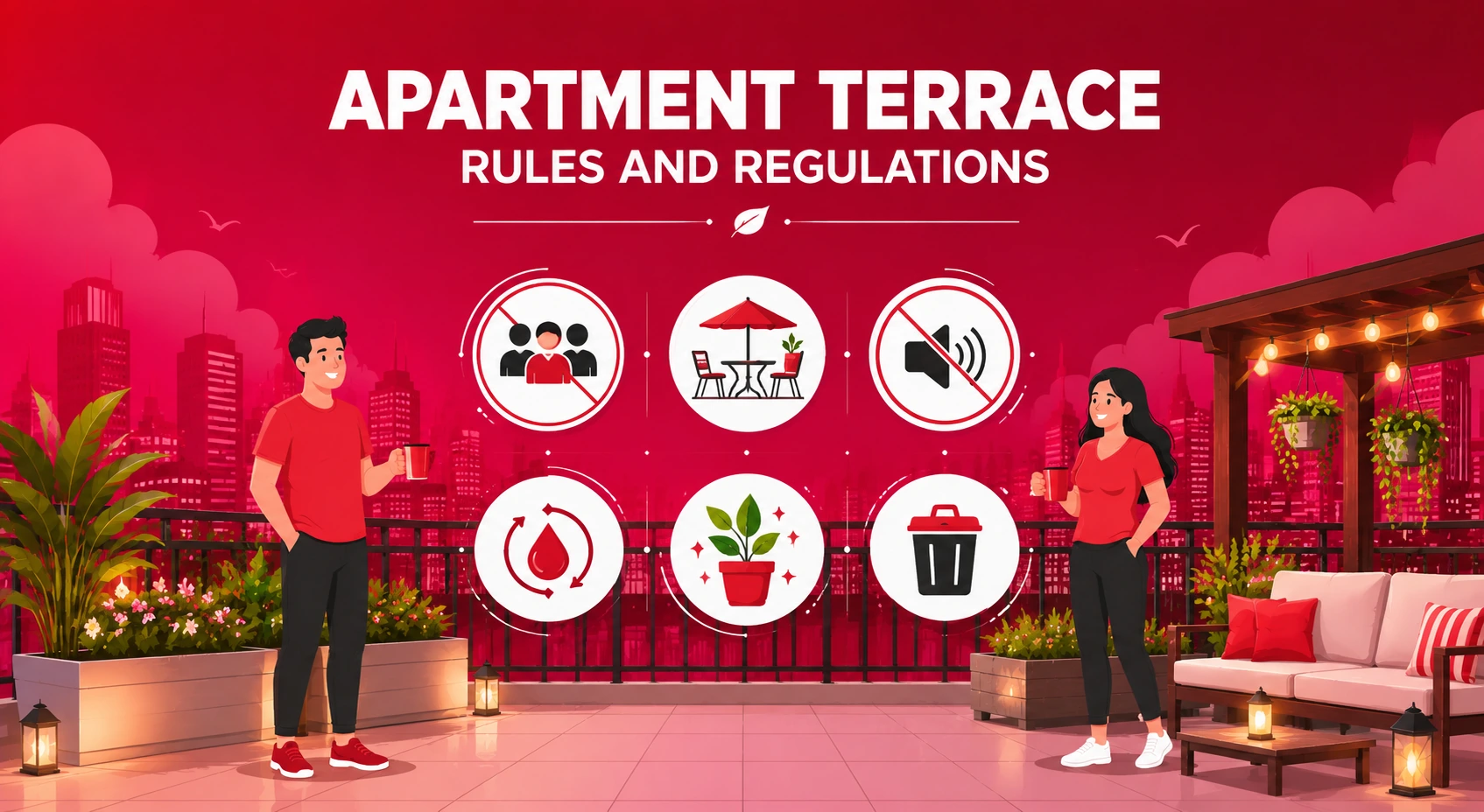


Many people misunderstand apartment terrace rules and regulations. A worrying trend has emerged where developers sell exclusive terrace rights to individual owners illegally. State laws like the Maharashtra Ownership of Flats Act and UP Apartment Act 2010 clearly state that developers cannot sell or lease terrace spaces to specific residents.

The law classifies your apartment terrace as a common area. This means all residents have equal rights to access and enjoy these spaces. A set of specific guidelines ensures everyone’s safety and comfort. This piece explains your terrace rights as a flat owner, the regulations for terrace usage, and ways to stay compliant while enjoying your building’s communal spaces. Make your apartment living peaceful with NoBrokerHood Apartment Management Software.
What Are Apartment Terrace Rules and Regulations?
Under Indian law, apartment terraces are classified as shared property, giving every resident an equal stake in these spaces. Housing laws place terraces in the same category as corridors and staircases - common facilities that no single owner can claim exclusively. Courts have repeatedly held that developers cannot sell or grant exclusive terrace rights to individual owners, as it directly violates basic property laws.
Apartment terrace rules and regulations go beyond just controlling access. They prevent any single person or group from taking over shared spaces for private or commercial use. The Supreme Court has ruled against builders monetising terrace areas - such as installing cell phone towers - without obtaining approval from all residents, reinforcing that terraces belong to the entire community.
These regulations serve multiple purposes:
- Protecting equal access rights for all residents
- Preventing unauthorized commercial exploitation
- Maintaining safety standards and structural integrity
- Ensuring proper maintenance responsibilities
Any changes or commercial use of terrace spaces need approval from the resident welfare association. The law clearly states that developers’ attempts to sell exclusive terrace rights will be void. This protection will give all residents access to terraces and keep them as shared community spaces.
Supreme Court Judgments on Terrace Rights in Apartments
The Supreme Court of India has consistently upheld that apartment terraces are common areas and cannot be privately owned or commercially exploited. In a landmark ruling, the court held that builders cannot install cell phone towers or lease terrace space for commercial purposes without the consent of all residents. Courts have also ruled that any sale deed or agreement that grants exclusive terrace rights to an individual flat owner is legally void and unenforceable. These judgments reinforce that terrace rights in apartments belong equally to all residents, and no developer or owner can override this through private agreements.
Read More on: Supreme Court Judgement on Terrace Rights
Private Terrace Rights of Flat Owners
While rooftop spaces are considered common property by default, private terrace rights can exist in very specific, tightly regulated scenarios. However, claiming exclusive use of a terrace requires an airtight paper trail, vague assumptions or casual habits won't cut it in a legal dispute.
Here is what it actually takes to establish and maintain private terrace rights:
The Legal Paper Trail Comes First
Exclusive rights are entirely dependent on formal documentation. You only have a legitimate claim if the right was explicitly transferred to you through a registered sale deed or a formal builder’s agreement. Marketing brochures, colorful floor plans, and verbal promises made during the sales pitch carry zero legal weight. Furthermore, this right must be carried forward into the final conveyance deed executed with the society. If that final document remains silent on the matter, the terrace automatically reverts to common ownership.
Premium Sales and Limited Scope
- Bought and Paid For: Builders often charge a premium for top-floor apartments by bundling them with attached terrace rights. This extra cost must be spelled out clearly in the contract; you cannot assume ownership just because the flat is located directly underneath the roof.
- Boundaries Matter: Even when valid, private rights are strictly localized. They generally apply only to the specific section of the terrace directly above that particular flat, not the entire rooftop layout. Furthermore, if there are shared utilities located in that private zone, you must still grant the society reasonable access for maintenance.
Enforcement and Limitations
Living on the top floor for a decade doesn't change the legal status of the space. Courts are incredibly strict about this: the burden of proof rests entirely on the flat owner. Long-term usage, or the mere fact that your apartment doors open directly onto the roof, is not considered proof of ownership.
The Compliance Catch: Having a private terrace doesn't mean you have a free pass to build whatever you want. Even if you legally own the space, any actual construction like putting up a room or a permanent awning still requires formal approval from both the local municipal authorities and the society's Management Committee.
Difference Between Roof Rights and Terrace Rights
| Aspect | Roof Rights | Terrace Rights |
| What it refers to | The topmost structural covering of the building | An accessible, usable open space (often top floor or setback level) |
| Typical use | Houses water tanks, lift machinery, solar panels, telecom equipment | Used by residents for walking, sitting, drying clothes, small gatherings |
| Default ownership | Common property under MOFA/state apartment acts | Common property under MOFA/state apartment acts |
| Access | Usually restricted to maintenance staff/authorized personnel | Generally open to residents for everyday use |
| Common dispute type | Commercial use (e.g., leasing for telecom towers) requiring society consent | Exclusive-use claims by top-floor owners |
| Legal nuance | "Roof rights" rarely means usage rights for residents | Sale deeds may separate "terrace access" (utilities) from "terrace ownership/usage" |
| Buyer takeaway | Confirm if roof access is limited to utility maintenance only | Confirm whether deed grants access, usage, or ownership each is legally different |
Common Rules and Regulations for Apartment Terraces
A peaceful life in apartment complexes depends on everyone understanding the terrace usage guidelines. These rules help to keep residents safe, protect their privacy, and look after everyone’s interests in shared spaces.
1. Usage of Terrace Space
Terraces are designed as shared spaces for all residents to enjoy recreational activities. The homeowners association sets specific schedules for terrace access, and residents need written permission to organize events. The society management can also create rules about terrace usage for individual blocks, but this needs every member to agree.
2. Modifications and Decorations
Both the resident welfare association and local authorities must approve any changes or decorative additions to terrace spaces. On top of that, it’s strictly forbidden to cover terraces with temporary structures or make permanent changes that affect the building’s outer appearance.
3. Noise and Privacy Considerations
Peace and quiet matter a lot in residential complexes. Standard rules say residents should keep noise down between 8:00 PM and 7:00 AM. Cricket games or loud gatherings on terraces aren’t allowed because they disrupt the community’s peaceful environment.
Also Read: Noise Pollution Rules in Residential Areas
4. Fire Safety and Emergency Regulations
Terraces must follow the National Building Code 2016’s fire safety rules. Key requirements include:
- Clear paths to emergency exits and firefighting equipment
- Fire doors stay closed unless they close automatically
- Regular fire drills and programs to keep residents informed
The terrace needs anti-skid flooring to prevent accidents, especially when you have wet conditions. Locked doors should control terrace access, with specific times set for resident use.
Also Read: Essential Fire Safety Measures Every Housing Society Should Implement
Use of Terrace in Housing Society
Roof terraces in residential buildings are a frequent source of friction among neighbors. The core thing to remember is simple: the terrace is a collective asset. Because it belongs to the entire community, how it gets used depends entirely on housing society bylaws, not personal preferences.
If you are trying to figure out what is and isn't allowed, here is a breakdown of how shared terraces typically operate.
1. The Right of Equal Access
First things first: the roof does not belong to the person living directly beneath it. Every single resident has an equal right to use the space. No individual owner can arbitrarily padlock the terrace doors or restrict entry without official authorization from the management team.
2. Daily Errands vs. Big Gatherings
For regular, low-impact activities, you don't need to ask for permission. Doing a morning workout, drying a load of laundry, or catching a breeze in the evening are totally fine, provided you aren't disturbing anyone. However, if you want to host a birthday party, pitch a tent, or set up event catering, the rules change. You will need to secure written clearance from the Management Committee or rely on a standing General Body resolution.
3. Alterations and Commercial Deals
- Zero Permanent Structures: You cannot simply erect a personal tool shed, a gazebo, or a brick-and-mortar room on the roof. Unapproved construction is a major liability and is almost always ordered to be torn down at the owner's expense.
- Commercial Monetization: Leasing out rooftop space for cell towers, solar grids, or massive advertising billboards isn't a decision the committee can make behind closed doors. Because it affects the whole property, it requires a full vote and approval from the General Body.
4. Peace, Quiet, and Upkeep
Living directly under a busy terrace can be loud. To protect residents on the top floor, most communities enforce strict curfews and noise limits—often restricting casual use between 8 PM and 7 AM. That said, these time limits cannot block essential maintenance; if a resident needs to fix their satellite dish or check their water tank, they must be allowed reasonable access.
Finally, because the roof is shared property, individuals aren't responsible for fixing it. Major expenses like waterproofing, repairing parapet walls, or clearing out blocked drains are paid for entirely out of the society's collective maintenance fund.
How to Stay Compliant with Apartment Terrace Regulations
Apartment terrace regulations require you to understand your legal obligations and communicate well with building management. A good relationship with your community starts when you follow the rules that protect your rights as a resident.
1. Understanding Your Lease or Agreement
Your lease agreement outlines what you can and cannot do with your terrace. Residents must follow the rules stated in their agreement. Take time to read your community’s constitutive title. This helps you know if your terrace is meant for everyone or just for you. Most lease agreements need you to ask your landlord before changing anything, even small decorative updates.
2. Seeking Approval for Modifications
You need to complete several steps to get approval for changes. Start by sending your managing committee a detailed request with your plans and documents. You must get approval from:
- The homeowners association
- Local authorities (when needed)
- Building management committee
The approval process needs certified plans from registered architects and structural engineers. You’ll also need to pay fees that your housing society requires. Any structural changes need supervision certificates and indemnity bonds to ensure safety. Common areas, including terraces, cannot be changed for private use by any resident or group.
Consequences of Not Following Terrace Regulations
Breaking apartment terrace rules and regulations goes far beyond just paying fines. Unauthorised shade structures block sunlight and airflow, creating conditions for disease-carrying pests and health risks. Insurance companies may raise premiums or deny coverage for terrace-related incidents, and property values drop when buyers discover rule violations in a building.
The legal consequences are equally serious. Courts consistently rule against unauthorised terrace modifications and order owners to bear removal and restoration costs - including lawsuits covering medical expenses and damages. A damaged reputation also makes it harder to get future building permits, as authorities scrutinise properties with a history of non-compliance.
Also Read: Housing Society Rules and Regulations for Tenants
Simplify Apartment Terrace Rules and Regulations with NoBrokerHood
Enforcing terrace rules manually tracking who booked the space, chasing noise complaints, or getting written approvals for events often turns into a headache for MC members, while residents are left unsure of what's actually allowed. NoBrokerHood's Apartment Management Software takes this off both sides' plates by digitizing terrace access, approvals, and compliance tracking in one place.
- Amenity Booking: Residents can book terrace slots for events directly through the app, so usage stays fair and organized instead of first-come-first-served chaos.
- Complaint Management: Report unauthorized terrace use, noise violations, or safety concerns and track resolution status in real time no more chasing the MC over WhatsApp.
- Digital Notice Board: MC members can instantly share approved timings, event schedules, or terrace closures with all residents, cutting down on miscommunication.
- Document Storage: Keep terrace usage policies, RWA approvals, and modification agreements stored digitally, so there's no scrambling for paperwork during a dispute.
- Society Noticeboard & Forums: Residents and MC members can discuss terrace-related rule changes openly, resolving disagreements before they escalate into formal complaints.
- Visitor Management: Control and monitor who accesses the terrace during events or after restricted hours, adding an extra layer of safety and accountability.
All Solutions by NoBrokerHood:
