Occupancy Certificate Vs Completion Certificate
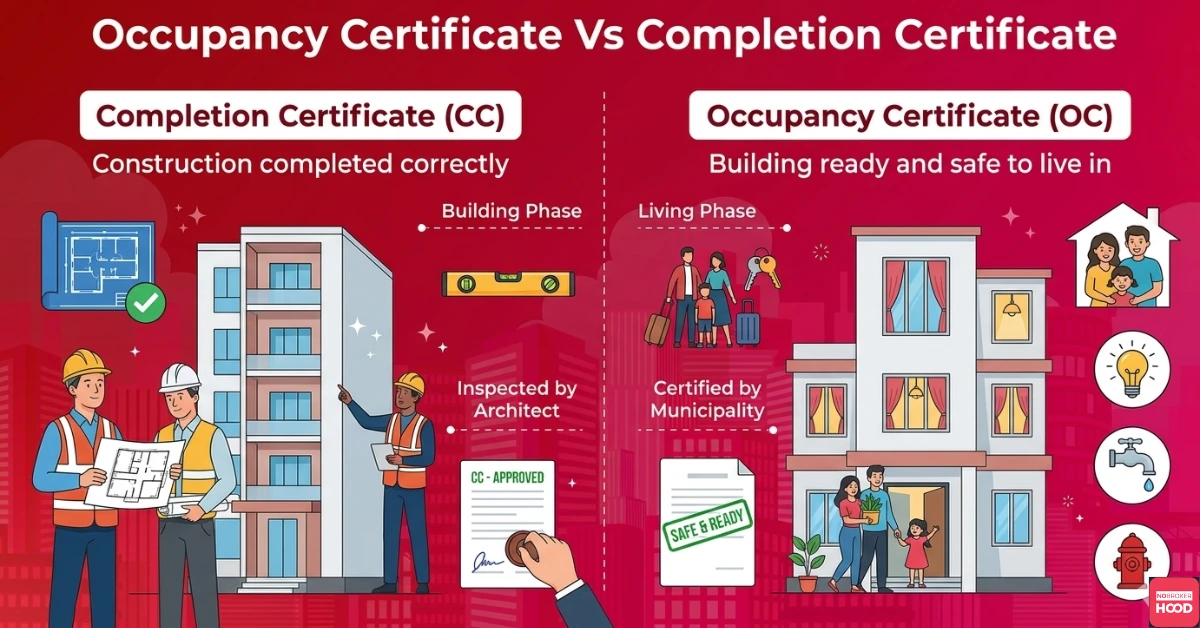
The difference between OC and CC is simple. A Completion Certificate (CC) confirms that a building is constructed according to the approved plan. An Occupancy Certificate (OC) confirms that the building is safe and legally ready for people to live in. Both documents are issued by local authorities and are essential for legal property ownership in India.
What Is a Completion Certificate (CC)?
To understand the difference between OC and CC, it helps to first know what each document means. The local municipal authority issues a Completion Certificate (CC) after a building project is finished. It confirms that the construction has followed the approved building plan and local regulations. This certificate checks whether the builder followed the original plan approved by the government.
Key points about a Completion Certificate:
- Confirms construction is completed as per the approved plan
- Issued by local municipal authorities
- Verifies structural rules like building height, layout, and setbacks
- Required before applying for an Occupancy Certificate
- Acts as proof that the building is legally constructed
Without a CC, the building may be considered unauthorised construction, which can create legal problems for buyers and residents later. So when discussing the difference between OC and CC, remember that the CC focuses mainly on construction compliance.
What Is an Occupancy Certificate (OC)?
An Occupancy Certificate (OC) is issued after a building passes safety inspections and is declared fit for people to live in. This document confirms that the building has proper infrastructure, such as water supply, electricity, drainage, sanitation, and fire safety systems.
Key points about an Occupancy Certificate:
- Certifies the building is safe for human habitation
- Confirms compliance with safety and sanitation standards
- Required for the legal occupation of the property
- Needed to obtain permanent water and electricity connections
- Important for resale and property registration
The difference between OC and CC becomes clear here. While the CC confirms the building is built correctly, the OC confirms the building is safe to live in. In most cases, a builder must first obtain a Completion Certificate before applying for an Occupancy Certificate.
Read also: What Is Occupancy Certificate?
Difference Between OC and CC
Many homeowners confuse these two documents. Understanding the difference between OC and CC helps avoid legal or financial problems in the future.
Key Differences
| Factor | Completion Certificate (CC) | Occupancy Certificate (OC) |
| Meaning | Confirms construction is completed according to approved plans | Confirms building is safe and ready for habitation |
| Focus | Structural completion and legal compliance | Safety, sanitation, and livability |
| Issued When | After construction is completed | After inspections and safety approvals |
| Purpose | Proof that construction followed the sanctioned plan | Legal permission for residents to occupy the building |
| Sequence | Issued first | Issued after CC |
In simple terms:
- CC = Construction completed correctly
- OC = Building ready and safe to live in
This explains the core difference between OC and CC for homebuyers and housing societies.
Why OC and CC Are Important for Homebuyers?
Many people move into flats without verifying these documents. However, the difference between OC and CC becomes important when legal issues arise. These certificates protect buyers in several ways,
1. Legal protection
A building without a CC may be considered illegal construction. Authorities may impose penalties or refuse approvals.
2. Utility connections
Permanent electricity, water, and sewage connections are usually granted only after the building receives an Occupancy Certificate.
3. Property resale
Properties with valid OC and CC have higher resale value and attract more buyers.
4. Home loan approvals
Banks and financial institutions often require these certificates before approving home loans.
5. Safety assurance
An OC ensures the building meets safety rules related to fire protection, drainage systems, and structural stability.
These factors explain why understanding the difference between OC and CC is important before purchasing property.
Is OC and CC Mandatory in India?
A common question buyers ask is: “Is OC and CC mandatory?” In most residential and commercial projects in India, both certificates are required.
Legal expectations
- Builders must obtain a Completion Certificate after construction.
- They must then apply for an Occupancy Certificate before residents move in.
- Living in a building without an OC can be considered illegal in many cities.
This is why buyers often ask is OC and CC mandatory before taking possession of their property.
Possible exceptions
Some states may relax OC requirements for small residential buildings under certain conditions. For example, certain small plots in Karnataka may receive exemptions if deviations are within limits.
However, such cases are exceptions. In most urban housing projects, the answer to is OC and CC mandatory is still a yes.
Read also: Apartment Handover Checklist
How Developers Obtain CC and OC?
Understanding the process also clarifies the difference between OC and CC.
Step 1: Construction completion
The builder finishes the project according to the approved building plan.
Step 2: Apply for Completion Certificate
The developer submits documents such as:
- Approved building plan
- Structural safety reports
- Compliance certificates
The municipal authority inspects the property before issuing the CC.
Step 3: Apply for Occupancy Certificate
After receiving the CC, the builder applies for the OC.
Authorities inspect:
- Fire safety systems
- Water supply and drainage
- Electricity infrastructure
- Lift and sanitation facilities
If everything meets the rules, the Occupancy Certificate is issued.
Read also: Society Handover Process
Risks of Buying a Property Without OC or CC
Understanding the difference between OC and CC also helps buyers avoid risky property purchases.
Common problems residents may face
- Legal penalties: Authorities may impose fines or take legal action if residents occupy a building without an OC.
- Utility connection problems: Permanent water and electricity connections may not be provided.
- Loan difficulties: Banks may refuse to approve loans or refinancing.
- Lower resale value: Buyers often avoid properties that lack proper approvals.
- Possibility of demolition: If major deviations exist in construction, authorities may order corrective action or demolition.
This is why many experts advise buyers to confirm is OC and CC mandatory for the project before moving in.
How NoBrokerHood Helps Societies Manage Property Documents
For housing societies and apartment communities, managing property documents such as the Completion Certificate (CC) and Occupancy Certificate (OC) is important for legal compliance and record keeping. NoBrokerHood provides a society management system that helps societies organise these documents and keep residents informed about essential property approvals.
| NoBrokerHood Feature | How It Supports Document Management |
| Digital Document Storage | Societies can securely store important documents such as OC, CC, building approvals, and society bylaws in one place. |
| Resident Communication Tools | Committees can share updates, notices, and announcements related to property documentation with residents instantly. |
| Member & Property Records | Maintain updated records of flat ownership, resident details, and occupancy information within the platform. |
| Maintenance Billing & Payments | Once the building receives the OC and residents move in, societies can manage maintenance billing and online payments digitally. |
| Secure Access for Residents | Residents can view society documents and important records through the mobile app or the resident portal. |
By organising records and communication digitally, NoBrokerHood helps housing societies maintain transparency and manage essential property documentation efficiently.
All Solutions by NoBrokerHood:
FAQs
The difference between OC and CC is that the Completion Certificate confirms construction is completed as per approved plans, while the Occupancy Certificate confirms the building is safe and ready for residents to live in.
Yes. In most cases, OC and CC are mandatory for residential projects in India. Without an Occupancy Certificate, living in the building may be considered illegal, and utility connections may not be approved.
Some builders may offer possession before the OC is issued. However, it is risky because the building may not yet be legally approved for occupation.
Selling a property without an OC is difficult. Many buyers and banks require proof that the building is legally approved for habitation.
Both certificates are issued by local municipal authorities, such as city corporations or development authorities, after inspecting the building.