








Quick Answer
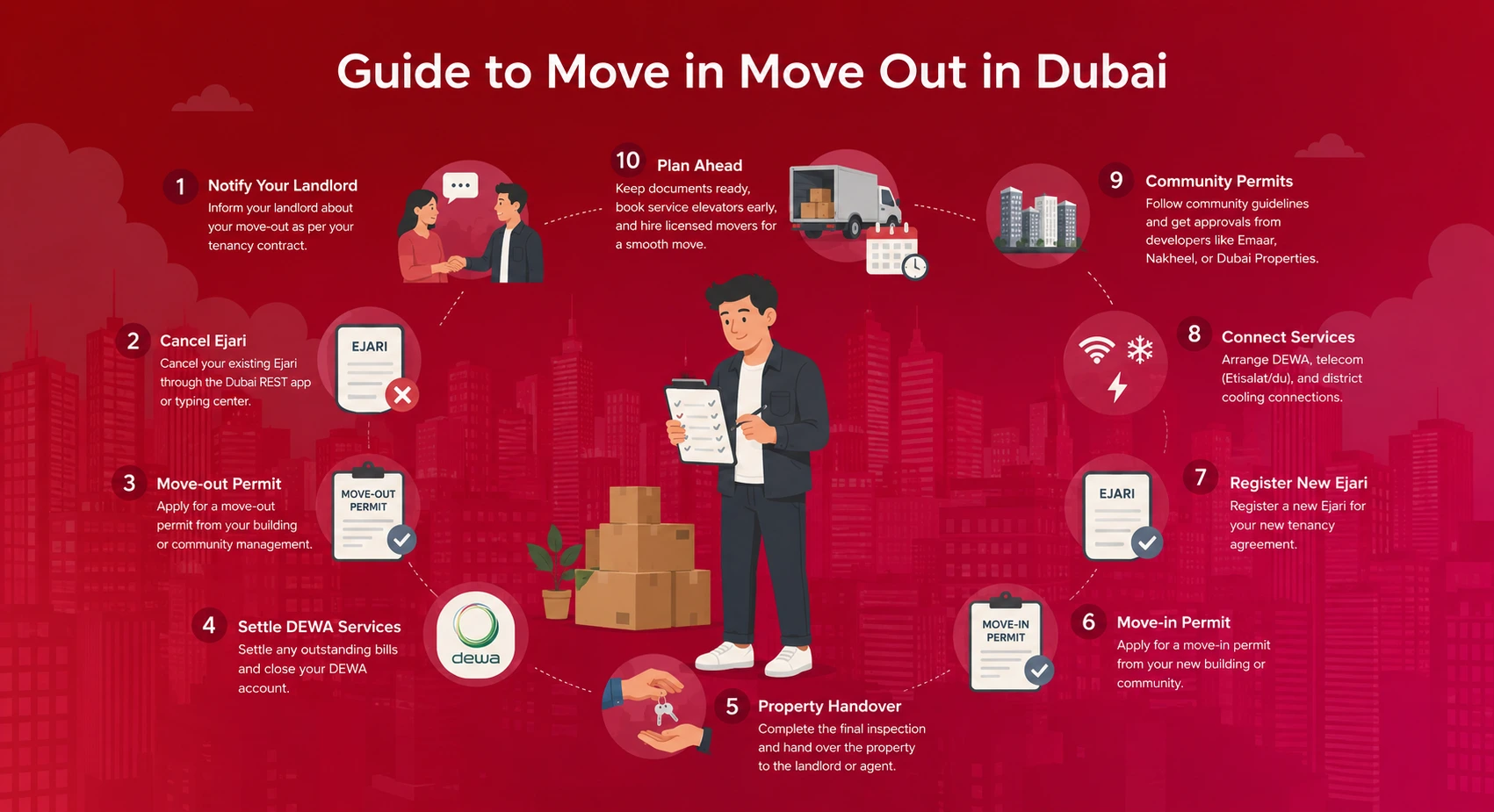
This guide to move in move out in Dubai walks you through the full process, from giving notice and cancelling your Ejari to securing the right permits and reconnecting your DEWA account. Each step protects your security deposit and keeps your move legal under Dubai's tenancy rules. Skipping even one step can delay your refund or stop your movers at the building gate.

Why Moving In and Out of a Dubai Property Involves So Much Paperwork?
Dubai's rental market runs on a few systems that all need to talk to each other. Ejari registers your tenancy with the Dubai Land Department, DEWA manages your power and water, and your community developer controls who can bring a truck full of furniture into the building.
This is why a simple house move in Dubai often feels closer to a small project. Emaar introduced its move permit rule back in 2013 to keep track of who was entering its communities, and Nakheel and Dubai Properties later adopted similar systems of their own.
Once you understand the logic behind this process of move in move out in Dubai, both phases start to feel a lot more manageable. None of the paperwork exists to slow you down on purpose. It exists to keep your deposit, your new tenancy, and your move properly recorded, which protects you as much as it protects the landlord or developer.
This applies whether you are a tenant renewing somewhere new, a tenant leaving for good, or a homeowner shifting between two villas in the same community. Homeowners usually swap the tenancy contract for a title deed in the paperwork, but the permit and Ejari logic stay largely the same.
Read also: DLD Service Charges
Phase 1: How to Move Out of a Dubai Property the Right Way
Moving out in Dubai follows a fairly fixed order. Missing a step, like skipping your Ejari cancellation, tends to hold up everything that comes after it.
Step 1: Give Your Landlord Official Notice
Check your tenancy contract for the exact notice period first. Many standard contracts ask for 60 to 90 days before the contract ends, though the number can differ depending on whether you are the one giving notice or receiving it.
Put your notice in writing rather than relying on a phone call or message. A written record matters later if there is ever a dispute about deposit deductions or extra rent.
Step 2: Cancel Your Ejari Registration
Once your landlord acknowledges your notice, you can cancel your Ejari registration. This can be done through the Dubai REST app, on the Dubai Land Department website, or in person at an authorised typing centre.
Keep the cancellation receipt somewhere safe. You will need it again for the move-out permit and your final DEWA disconnection.
Step 3: Apply for a Move-Out Permit
Most master communities, including those run by Emaar, Nakheel, and Dubai Properties, require a move-out permit before moving trucks can use the building or service elevators. You usually apply through your community's management portal, such as Dubai REST or the developer's own app.
You will generally need your Ejari cancellation receipt and Emirates ID on hand. Without this permit, security staff at the gate may simply turn your movers away.
Read also: How to Get an Emirates ID in the UAE?
Step 4: Settle Your DEWA Account and Claim Your Deposit
Submit a final disconnection request through the DEWA website and pay any outstanding bill. Your security deposit, typically around 5% of annual rent for an unfurnished home or 10% for a furnished one, should then be refunded to your bank account, though some landlords still process it through services like Western Union.
Normal wear and tear, such as faded paint or light carpet wear, should not be deducted from your deposit. Genuine damage, unpaid rent, or outstanding utility bills are the usual reasons a refund gets delayed.
Step 5: Complete the Property Handover
Repair any obvious damage and repaint if your contract requires it. Under general RERA guidance, repainting between tenancies is usually the landlord's responsibility unless the contract states otherwise, so it is worth checking before paying for it yourself.
Walk through the property with your landlord, sign a joint inspection report, and hand over all keys and access cards. Ask for a signed handover form as proof that the process is complete.
Phase 2: How to Move Into Your New Dubai Home
Moving in follows a similar pattern to moving out, just in reverse order. The same names come up again: Ejari, DEWA, and your new community's permit system.
Step 1: Apply for a Move-In Permit
Once your lease is signed, apply for a move-in permit from your new community's developer using your signed tenancy contract, new Ejari, and Emirates ID. This permit is what allows your movers to access the building or community.
Processing usually takes one to two working days once your documents are complete and any service fees are settled.
Step 2: Register Your New Ejari
Register your new tenancy contract through the Dubai REST app or an authorised typing centre. This step legally confirms your residency at the new address and is needed before most other registrations, including DEWA, can go through.
Step 3: Connect Your DEWA Account
Activate your power and water using the DEWA Move-In service through their website or app. You will need the premises number for your new villa or apartment, usually printed on your lease or available from building security.
Step 4: Set Up Telecom and Cooling Services
Register your internet connection with a provider such as Etisalat or du using your Ejari and Emirates ID. If your building uses district cooling from a provider like Emicool or Empower, set up that account separately, since it is usually billed apart from DEWA.
Simple Tips to Make Moving Day Easier
A few small habits make the actual moving day go more smoothly once the move in move out in Dubai paperwork is sorted.
Book your service elevator as soon as your permit is approved, and agree on a specific time slot with building security so other residents are not left waiting. Choose a moving company that is legally registered in Dubai, since most reputable movers handle the building paperwork themselves and know how to avoid damaging shared corridors and lifts.
Smoother Move In Move Out in Dubai with NoBrokerHood
Managing move-in and move-out requests across a residential community can quickly become complicated, especially when permits, security approvals, service elevators, and contractor access all need to be coordinated. NoBrokerHood UAE helps communities streamline the entire process through a centralised resident and security management platform.
Key NoBrokerHood Features for Move-In and Move-Out Management:
- Digital move-in and move-out requests are submitted directly through the resident app.
- Automated approval workflows for management committees and facility teams.
- Visitor and vendor management for movers, contractors, cleaning teams, and installation personnel.
- Security gate pass generation for approved moving staff and vehicles.
- Real-time entry and exit tracking of movers and service providers.
- Resident communication tools for sharing move schedules, guidelines, and community policies.
- Digital record-keeping of approvals, permissions, and resident requests.
- Complaint and service request management for reporting issues during the moving process.
- Security guard app that helps gate staff verify approvals and manage access efficiently.
- Community-wide notifications to inform residents about scheduled move activities and elevator bookings.
By digitising approvals, visitor access, and security verification, NoBrokerHood reduces administrative workload while creating a smoother moving experience for residents. Property managers gain better visibility into every move request, security teams can verify permissions instantly, and residents can complete the move-in or move-out process with fewer delays and less paperwork.
